Kurt Gödel
1906–1978 · Austrian-American logician whose incompleteness theorems showed the limits of formal mathematical systems.
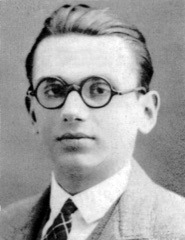
Kurt Gödel was born in 1906 in Brünn, Austria-Hungary, now Brno in the Czech Republic, into a German-speaking family. As a child he was so curious that his family called him 'Mr. Why'. He studied at the University of Vienna, first physics and then mathematics and philosophy, and attended meetings of the philosophers known as the Vienna Circle. In 1931 he published the paper On Formally Undecidable Propositions of Principia Mathematica and Related Systems, which contains his incompleteness theorems. They show that any consistent formal system rich enough to describe basic arithmetic contains true statements that cannot be proved within the system, and that such a system cannot prove its own consistency. The result changed mathematical logic and the philosophy of mathematics. In 1940, after the annexation of Austria by Nazi Germany, he and his wife Adele emigrated to the United States, where he joined the Institute for Advanced Study in Princeton and became a close friend of Albert Einstein. He also did important work in set theory and on Einstein's equations. He died in Princeton in 1978.
Kurt Gödel is also an author in the library: author page and works.
Faith: Baptized Lutheran; he called his belief theistic but did not belong to any religious congregation. Source: Wikipedia
Key dates
- 1906 Born in Brünn
- 1931 Publishes the incompleteness theorems
- 1938 Marries Adele Nimbursky
- 1940 Emigrates to the United States
- 1978 Dies in Princeton
Fun facts
- As a boy he was so curious that his family nicknamed him 'Herr Warum', or 'Mr. Why'. (Source: Kurt Gödel (Wikipedia))
Watch


Videos load from YouTube in privacy-enhanced mode only when you press play.
Read about them
Grades 9–12
- On Formally Undecidable Propositions · In the library
More lives
Hannah Arendt · Henri Bergson · Niels Bohr · Vannevar Bush · George Washington Carver · Marie Curie