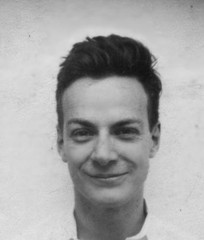
Richard Feynman
1918–1988 · Physicist awarded the Nobel Prize for quantum electrodynamics, later a member of the commission that investigated the Challenger disaster.
Richard Phillips Feynman was born on 11 May 1918 in Far Rockaway, Queens. He studied at MIT and took his doctorate at Princeton, then joined the Manhattan Project at Los Alamos, where he worked on the theory and calculation of the bomb. After the war he taught at Cornell and at Caltech. In 1965 he shared the Nobel Prize in Physics for work on quantum electrodynamics; the diagrams named after him gave physicists a clearer way to calculate how light and matter interact. He was a teacher who insisted on saying only what he could show and on not fooling himself. After the space shuttle Challenger broke apart in 1986, he served on the presidential commission and, with a glass of ice water, showed in public that a rubber seal could fail in the cold. He died in Los Angeles on 15 February 1988. His first wife, Arline, died of tuberculosis in 1945 while he was at Los Alamos; a later marriage ended in divorce, and in 1960 he married Gweneth Howarth.
Faith: He was not a religious believer and did not belong to a church. He spoke as a scientist who would not claim to know what he did not know. Source: Wikipedia
See also: J. Robert Oppenheimer · Albert Einstein · Isaac Newton

Key dates
- 1918 Born in Far Rockaway, Queens, on 11 May
- 1942 Completes his Princeton doctorate; marries Arline Greenbaum
- 1943 Joins the Manhattan Project at Los Alamos
- 1945 Arline dies of tuberculosis on 16 June
- 1965 Shares the Nobel Prize in Physics for quantum electrodynamics
- 1986 Serves on the presidential commission after the Challenger disaster
- 1988 Dies in Los Angeles on 15 February
Fun facts
- At Los Alamos he opened locked filing cabinets to show that secret papers were not being kept as safely as people assumed. (Source: Richard Feynman (Wikipedia))
- On the Challenger commission he dipped a piece of the rubber seal in ice water during a public hearing, to show that it stiffened in the cold. (Source: Rogers Commission Report (Wikipedia))
Record-breaker
Firsts and records, worded as the sources give them ("first known", "at the time").
- He shared the 1965 Nobel Prize in Physics with Julian Schwinger and Shin’ichirō Tomonaga. (Source: The Nobel Prize in Physics 1965)
Read about them
As an Amazon Associate I earn from qualifying purchases. As a Bookshop.org affiliate I earn from qualifying purchases, which also support independent bookstores.
Grades 9–12
- Genius by James Gleick (Vintage, 1993; ISBN 9780679747048)
Bookshop.org · Amazon
More lives
Niels Bohr · Vannevar Bush · George Washington Carver · Marie Curie · Arthur Eddington · Albert Einstein