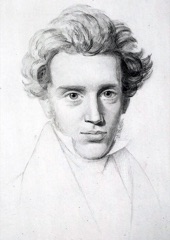
Søren Kierkegaard
1813–1855 · Danish Christian philosopher who wrote on faith, choice and the individual.
Søren Kierkegaard was born in Copenhagen, the youngest of seven children of a wealthy, deeply religious and melancholy wool merchant. He studied theology at the University of Copenhagen. In 1840 he became engaged to Regine Olsen but broke off the engagement a year later, an event he wrote about for the rest of his life. Living on his inheritance, he wrote a remarkable stream of books in a few years, many under invented pen names, so that readers would have to think for themselves rather than simply follow an author. In Either/Or, Fear and Trembling, The Sickness unto Death and other works he described the stages of life, the anxiety of choice, and faith as a passionate personal commitment, illustrated by Abraham's willingness to sacrifice Isaac. He stressed that truth must be lived by the individual before God, not merely understood. He was mocked by a satirical newspaper, The Corsair. In his last years he sharply attacked the Danish state church for making Christianity comfortable and conventional. He collapsed in the street and died in 1855, at forty-two.
Søren Kierkegaard is also an author in the library: author page and works.
Faith: Danish Christian philosopher in the Lutheran tradition. Source: Stanford Encyclopedia of Philosophy
Further reading
- Kierkegaard: A Very Short Introduction by Patrick Gardiner (Oxford University Press, 2002), ISBN 9780192802569
Key dates
- 1813 Born in Copenhagen
- 1841 Breaks his engagement to Regine Olsen
- 1843 Either/Or and Fear and Trembling
- 1849 The Sickness unto Death
- 1855 Dies in Copenhagen
Fun facts
- He loved walking the crooked streets of Copenhagen, where carriages rarely went. (Source: Søren Kierkegaard (Wikipedia))
- The philosopher William James's favourite line from him was 'We live forwards but we understand backwards.' (Source: Søren Kierkegaard (Wikipedia))
Watch


Videos load from YouTube in privacy-enhanced mode only when you press play.
Read about them
Grades 9–12
- Fear and Trembling · In the library
- The Sickness Unto Death · In the library
- Either/Or · In the library
More lives
Frédéric Bastiat · Eugen von Böhm-Bawerk · Thomas Carlyle · Carl von Clausewitz · Samuel Taylor Coleridge · John Dewey