Wonders & Monuments · Great monuments
The Colosseum
Rome’s great amphitheatre, built under the Flavians, ruined but still immense.
In ruins. The outer wall and much of the seating survive as a ruin. The wooden floor of the arena is gone, so the underground passages are open to the sky. Medieval and later stone-robbing took large parts of the façade.
What it is
The Colosseum, more formally the Flavian Amphitheatre, was built in Rome under the emperors Vespasian and Titus and was dedicated in AD 80. It held tens of thousands of spectators for games, including gladiatorial combats and hunts, in an oval arena surrounded by tiered seats. The outer façade was of travertine, in stacked storeys of arches; the interior used concrete and stone. It is the largest amphitheatre the Romans left, and it still dominates the valley between the Palatine and the Esquiline.
It is a ruin. The arena floor is gone, exposing the hypogeum — the passages and rooms under the sand. Much of the outer south wall was taken for later buildings. What remains is still of enormous scale: arches on arches, as Byron wrote when he stood in it. In the edition of Childe Harold’s Pilgrimage in this library he calls the building the Coliseum, the older English spelling.
“Arches on arches! as it were that Rome, Collecting the chief trophies of her line, Would build up all her triumphs in one dome, Her Coliseum stands;”
Why it matters
The skill is real, and so is the purpose. This was a palace of public spectacle, paid for by an imperial dynasty, in which men and animals were killed for a crowd. To look with integrity is to see both the beauty of the arches and the cost of what was done inside them. The ruin does not erase that history; it makes the seating and the underground passages easier to read.
Look closely
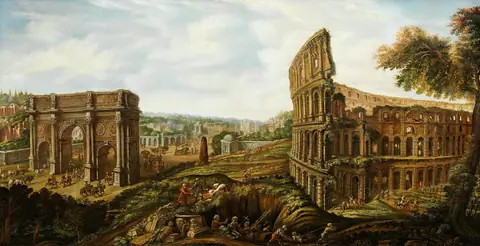
Image: Wikimedia Commons · Public domain The Colosseum in the nineteenth century
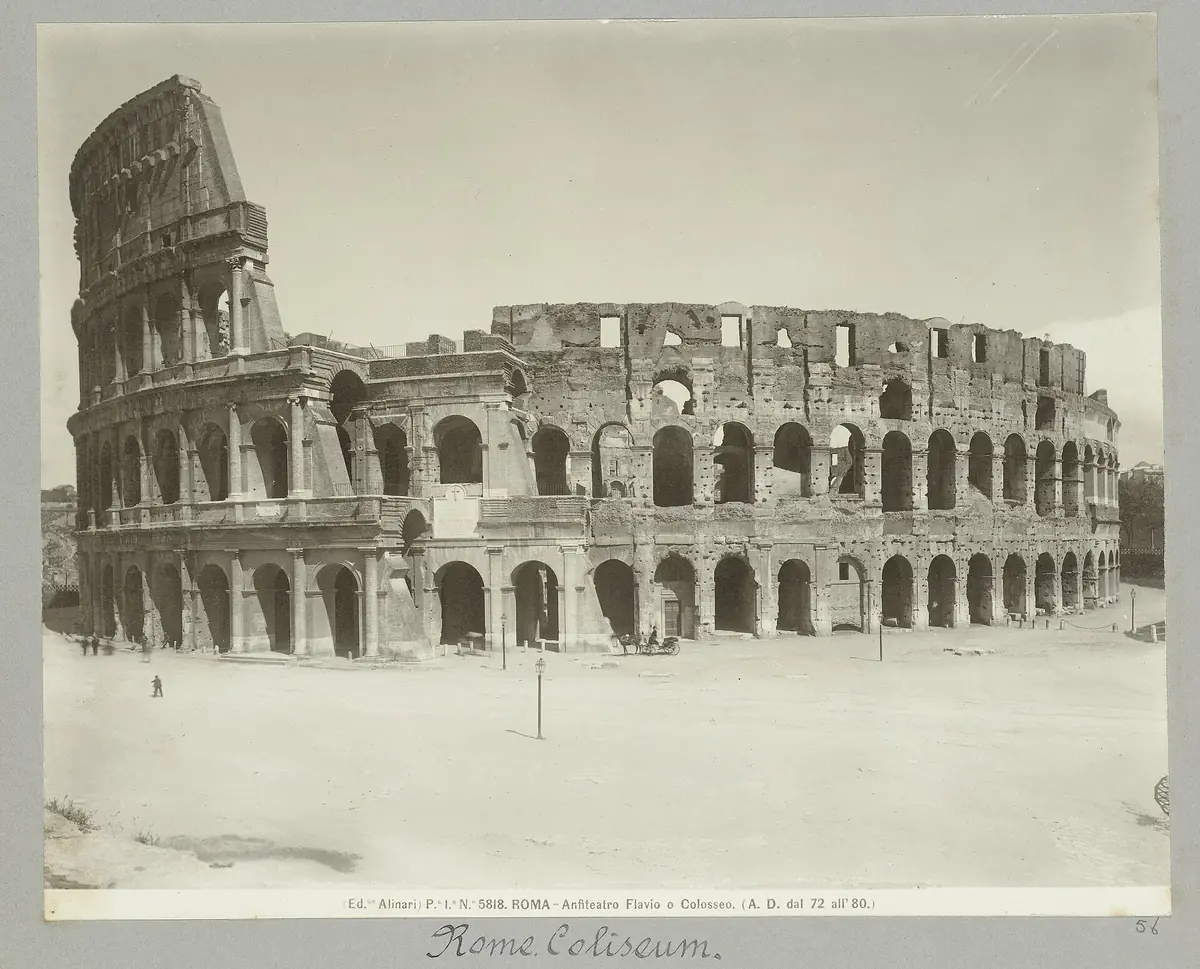
Look closely. An early photograph of the ruined amphitheatre from the outside, with the broken outer wall and the remaining arcades in open ground. The scale of the surviving façade is clear, and so is the damage: whole bays of the exterior are gone. This is the building as a ruin in the city, not a reconstruction.
In the library: Byron, Childe Harold’s Pilgrimage
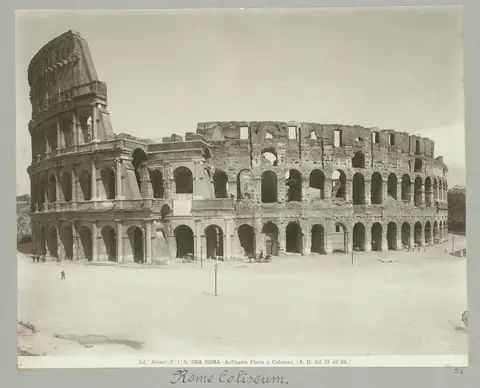
Image: Wikimedia Commons · CC0 (public domain) The Flavian amphitheatre from the outside
Look closely. A later nineteenth-century photograph, in the tradition of the Alinari views of Rome, showing the outer arches and the mass of the ruin. Compare the complete and broken stretches of the façade, and notice how the stacked storeys of openings still read as one design.
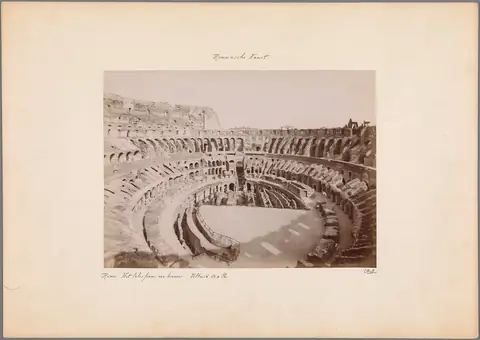
Image: Wikimedia Commons · CC0 (public domain) Inside the Colosseum
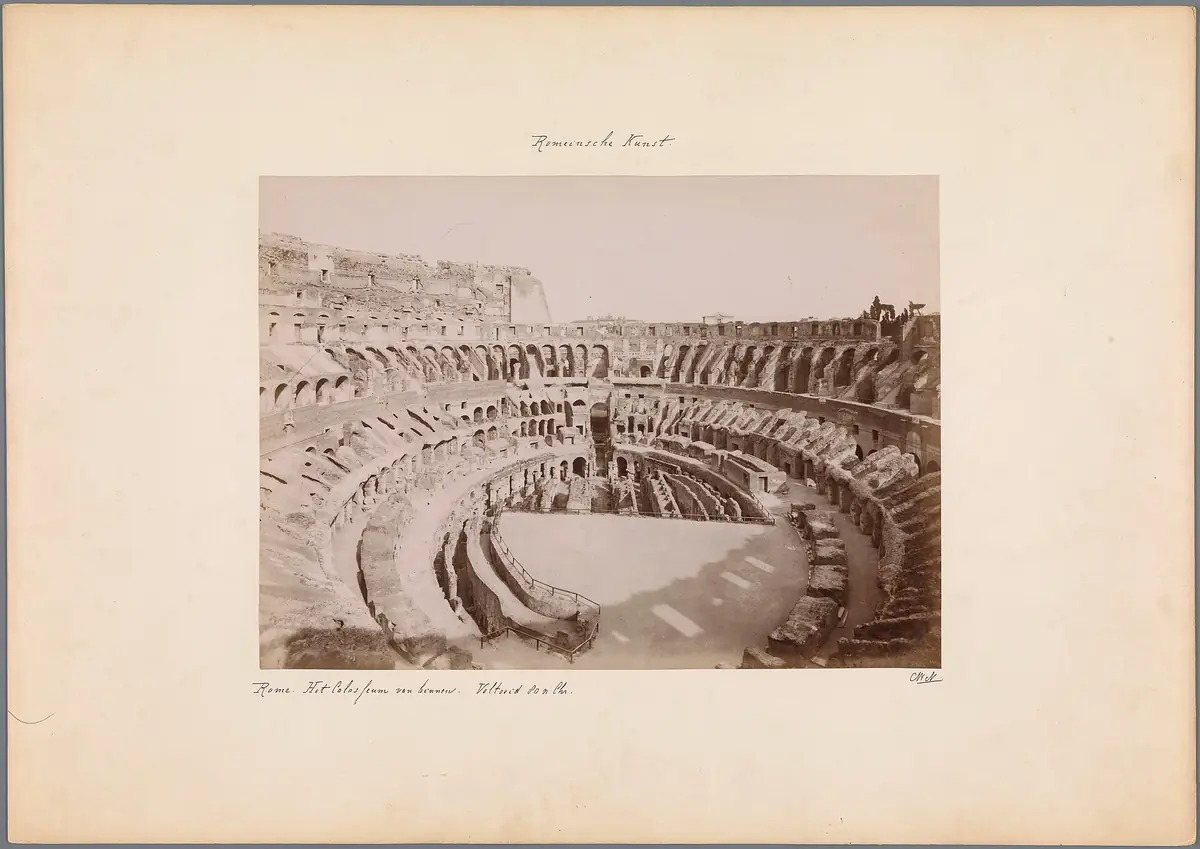
Look closely. The interior, photographed when the arena floor was already gone. You look across the concentric walls of the hypogeum and up to the broken seating. Byron’s arches on arches are easier to feel from here than from a plan. This is not a picture of a game in progress; it is a picture of what time and stone-robbing left.
In the library: Byron, Childe Harold’s Pilgrimage


What to watch for
Look slowly- Outer wall and missing bays. Part of the façade is gone. The remaining arches show the original storeys.
- The arena floor is missing. Interior views look down into the hypogeum, which would once have been hidden under boards and sand.
- Oval, not a circle. The plan is an ellipse. Notice how the seating curves around the long axis.
- Stone-robbing. Holes and ragged edges often mark where clamps and facing were taken for later use.
- Byron’s name for it. In the hosted poem the building is the Coliseum. That is the same amphitheatre.
Sources
Dates follow standard historical references and, where we quote a book, the wording of the edition hosted in this library. Photographs are used only when the photograph itself is Public domain, CC0, or CC BY with a named credit. Lost wonders are shown in later engravings and reconstructions, which are imaginings, not photographs of the original work. Each picture links to its source page with full licence details.