Wonders & Monuments · Great monuments
The Parthenon
The great temple of Athena on the Acropolis, ruined but still the measure of Greek sacred building.
In ruins. The temple still crowns the Acropolis, but it is a ruin. The roof is gone, many sculptures were removed, and a 1687 explosion wrecked the interior when the building was being used as a powder magazine.
Phidias, in Great Art · The Statue of Zeus at Olympia, also associated with Phidias
What it is
The Parthenon was built on the Acropolis of Athens in the fifth century BC, in the time of Pericles, as the great temple of Athena Parthenos. The architects were Ictinus and Callicrates; the sculptural programme was under the direction of Phidias, whose gold-and-ivory statue of the goddess once stood inside. The plan is a Doric temple of pentelic marble, with subtle curves in the steps and columns that keep the long lines from looking sagged or stiff.
It has not come down to us as a complete temple. It later served as a church and then as a mosque. In 1687, during a siege, a Venetian shell struck the powder stored inside and blew out the heart of the building. Many of the surviving sculptures were later removed. What stands now is a magnificent ruin: columns, a broken cella, and the platform on the sacred rock. The statue itself is lost; this library’s page on Phidias discusses that work.
Why it matters
This is costly marble, offered to a city’s goddess, and shaped with a care that still teaches anyone who looks at a column or a step. Ruin has made the construction visible: you can see how the drums of the columns were stacked, and how much has been taken away. Integrity here means not pretending the temple is complete, and still honouring the skill that remains.
Look closely
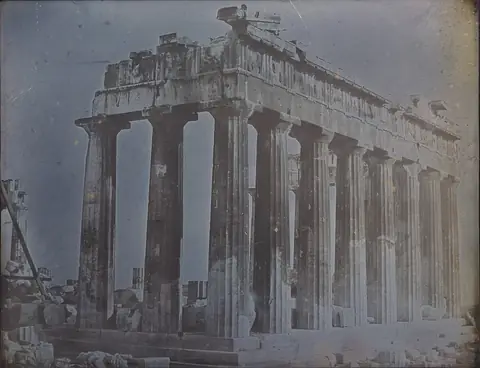
Image: Wikimedia Commons · Public domain Façade and north colonnade
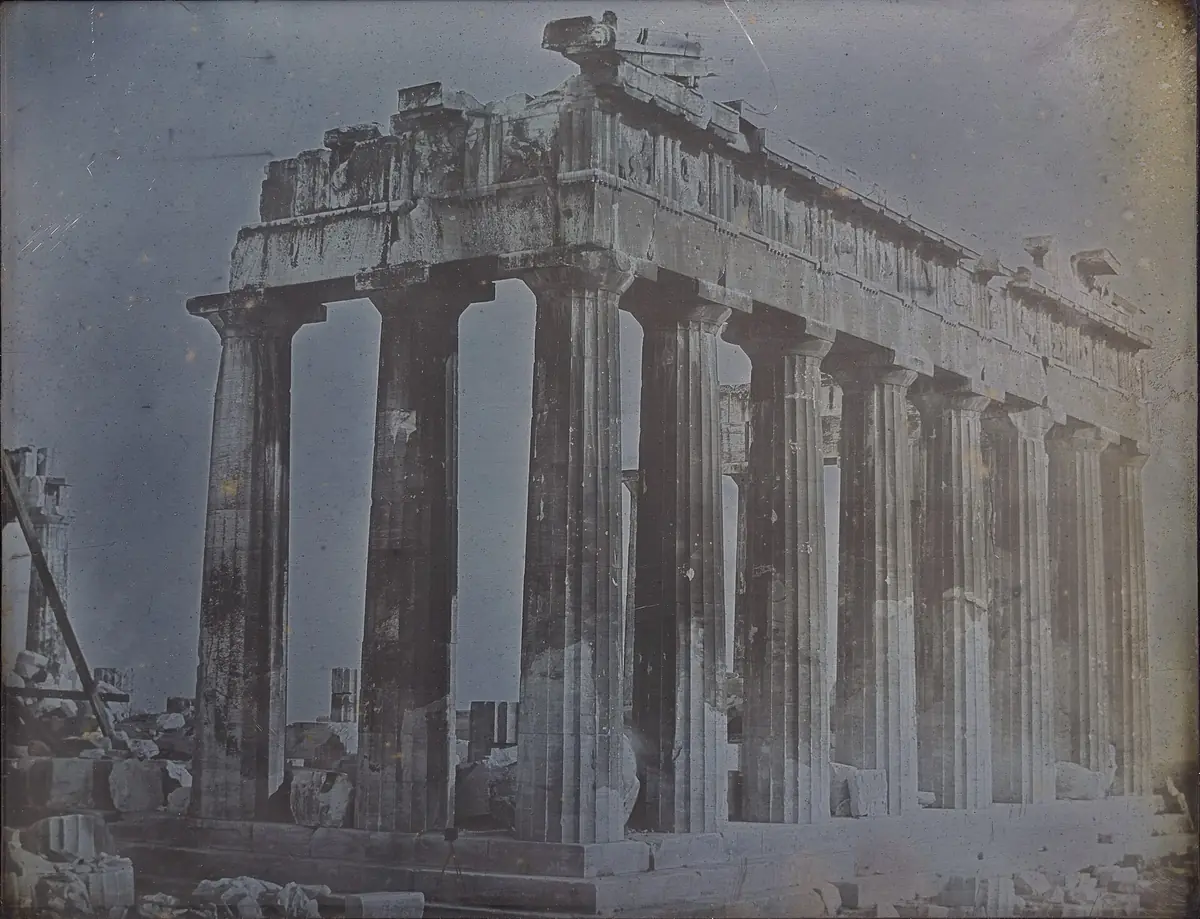
Look closely. One of the earliest surviving photographs of the Parthenon, taken by Girault de Prangey in 1842. The west or principal front and the long north colonnade are seen before later anastylosis filled some of the gaps. The stone is bare, the roof long gone, and the mountain light falls on the flutes of the columns.
In the library: Phidias, in Great Art
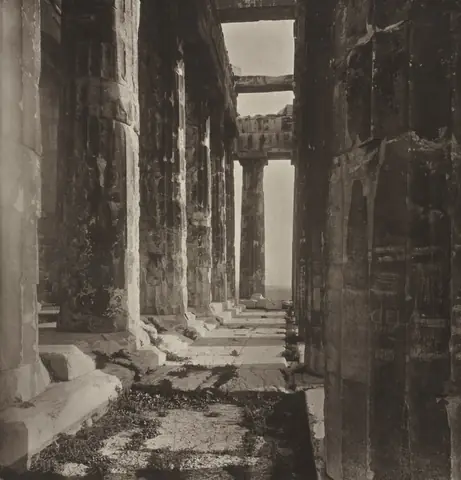
Image: Wikimedia Commons · CC0 (public domain) The western portico from within
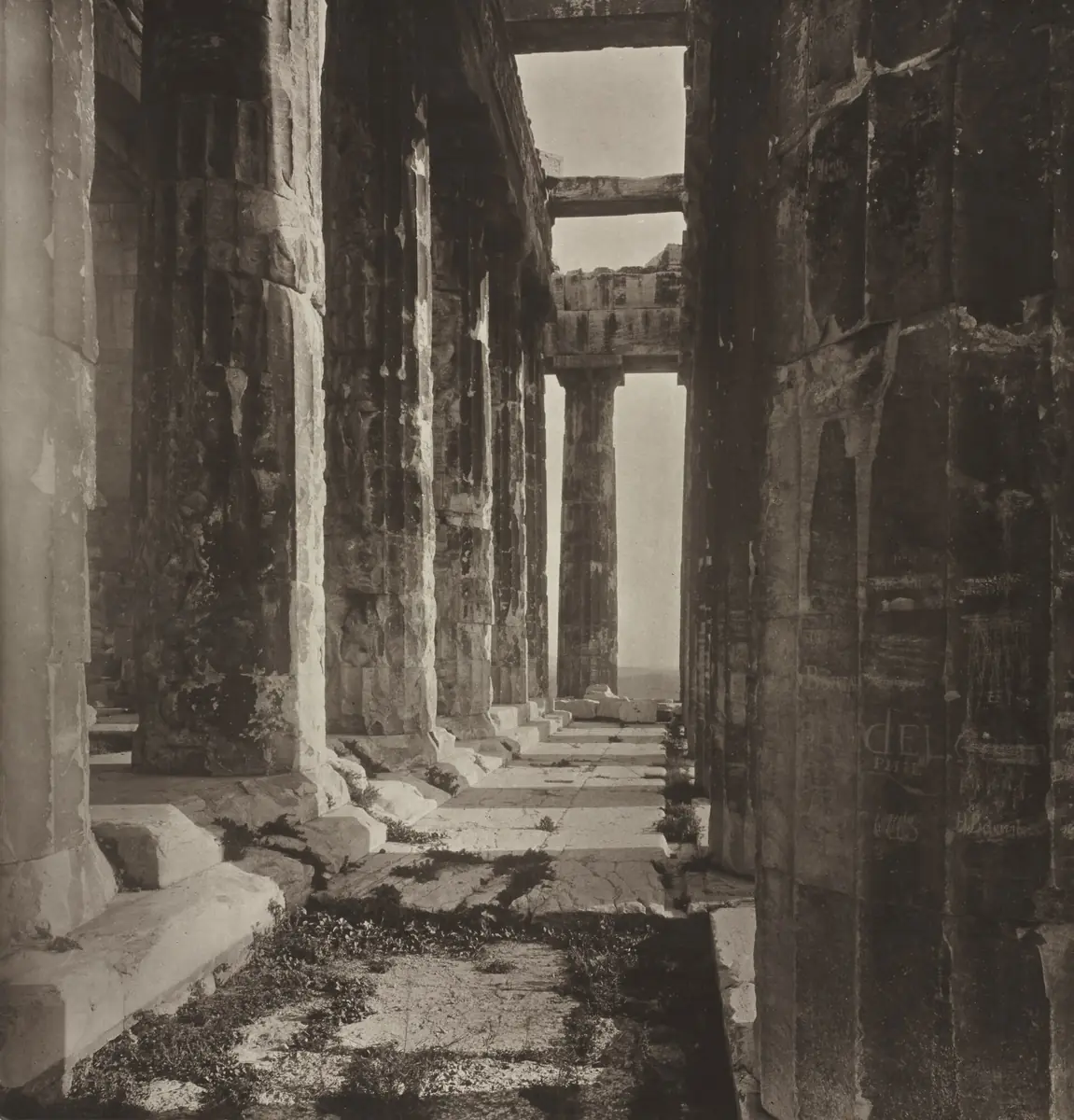
Look closely. Stillman photographed the western portico from inside the ruin, so that you look out through the columns. The view makes the thickness of the marble and the spacing of the colonnade easy to judge. This is a record of the temple as a ruined room of stone, not as a distant silhouette.
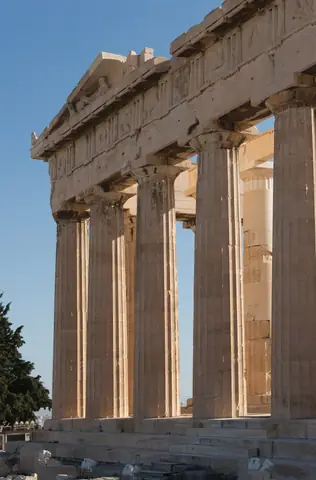
Image: Wikimedia Commons · CC0 (public domain) The east front, a closer view
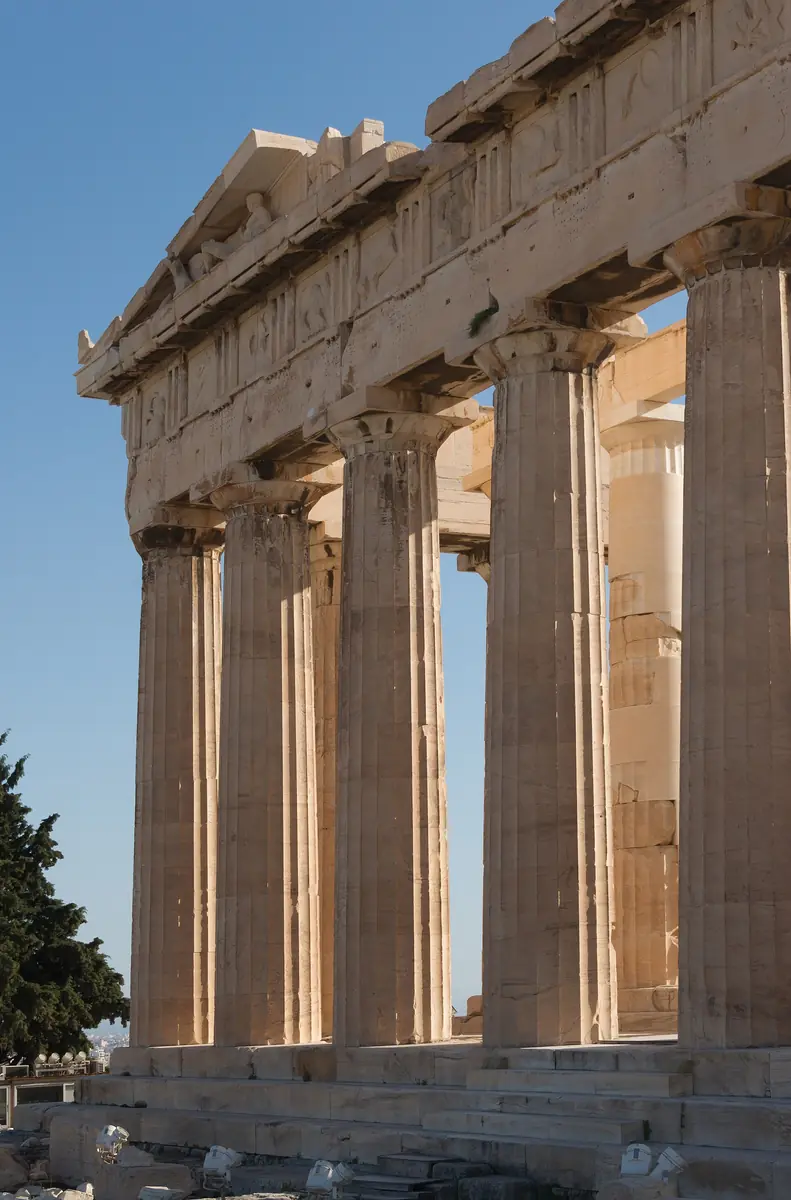
Look closely. A modern photograph of the eastern façade, closer to the columns. You can see the drums, the weathering, and the empty spaces where sculpture once sat. Compare it with Prangey’s daguerreotype and ask what later repair has changed, and what the stones themselves still show.
In the library: Phidias, in Great Art


What to watch for
Look slowly- A ruin, not a whole temple. There is no roof. Look for the broken cella and the missing sculpture.
- Doric order. Notice the fluted columns, the capitals, and the remaining bits of the entablature.
- The platform. The temple stands on a stepped base on the Acropolis rock, not on level ground.
- East and west fronts. The photographs show different faces. Compare the colonnade from the side with a view into the ruin.
- Later damage. The 1687 explosion is why the centre is so open. That is history, not the original design.
- Phidias’s statue is gone. The temple was built to house it. For that work, see the Great Art page on Phidias.
Sources
Dates follow standard historical references and, where we quote a book, the wording of the edition hosted in this library. Photographs are used only when the photograph itself is Public domain, CC0, or CC BY with a named credit. Lost wonders are shown in later engravings and reconstructions, which are imaginings, not photographs of the original work. Each picture links to its source page with full licence details.