Wonders & Monuments · Seven Wonders
The Colossus of Rhodes
The bronze Helios of Rhodes, a short-lived wonder whose harbour-striding pose is a later myth.
Lost. The statue stood for only about fifty-six years before an earthquake threw it down. Ancient reports say the remains lay on the ground for centuries and were later broken up and sold. It did not straddle the harbour mouth; that pose is a later legend, repeated in many pictures.
What it is
After Rhodes survived a long siege by Demetrius I in 305–304 BC, the city used the abandoned siege equipment to help pay for a great bronze statue of the sun-god Helios, patron of the island. The sculptor was Chares of Lindos, a pupil of Lysippus. The work was finished around 280 BC and stood near the harbour. It was among the tallest statues of the ancient world. About fifty-six years later, around 226 BC, an earthquake brought it down. The Rhodians, we are told, were advised not to raise it again.
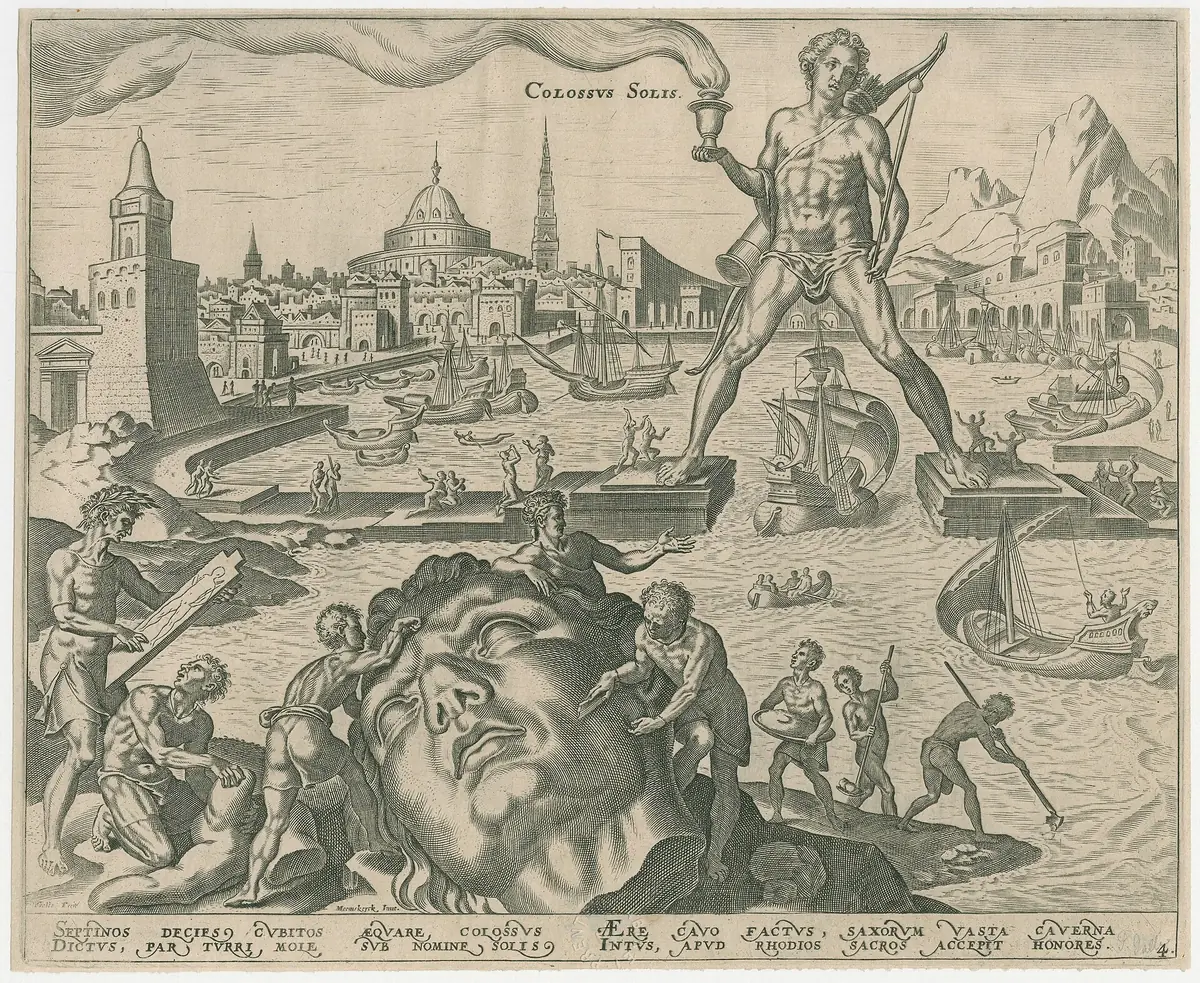
The famous image of the Colossus standing astride the harbour mouth, with ships passing between its legs, is a later invention. Ancient accounts place a standing figure beside the harbour, not across it, and after the fall the broken statue lay on land. In the fifteenth and sixteenth centuries, however, that straddling pose became the usual picture of the wonder, and Heemskerck’s engraving follows the legend. The plates on this page are all imaginings. None of them is a portrait of the lost bronze, and the most familiar pose is almost certainly wrong.
Why it matters
The Colossus was a city’s thank-offering after deliverance, and a work of extraordinary bronze-casting. Its short life is part of the story: even a wonder can stand for less than a long human lifetime, and still be remembered for ages. Looking well here means resisting a false picture. It takes a kind of integrity to set aside the dramatic harbour stride, however often it has been printed, and to keep to what the older reports actually allow us to say.
Look closely
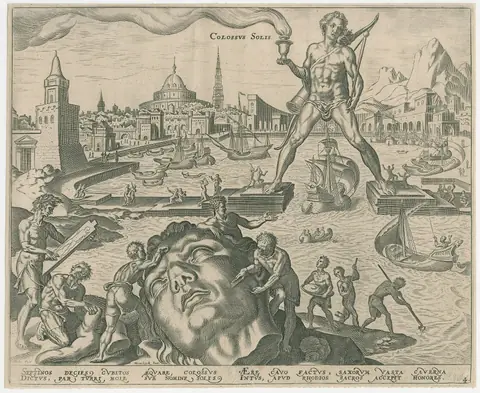
Image: Wikimedia Commons · Public domain (PD-Art) The Colossus of Rhodes, 16th-century engraving
Look closely. This is the legendary pose: a huge Helios standing astride the harbour, with ships passing under him and people worshipping at his feet. It is the picture many later students still carry in their heads. It is almost certainly not how the statue stood. Look at the plate as a Renaissance wonder-picture, then hold on to the harder fact: the bronze stood beside the harbour and fell in an earthquake after a few decades.
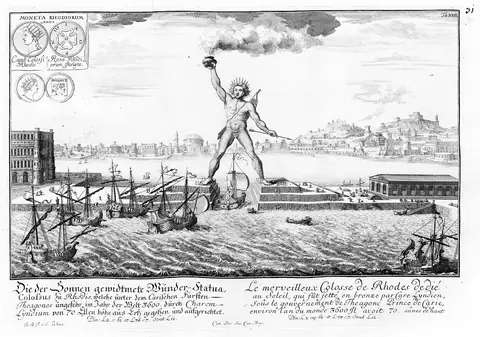
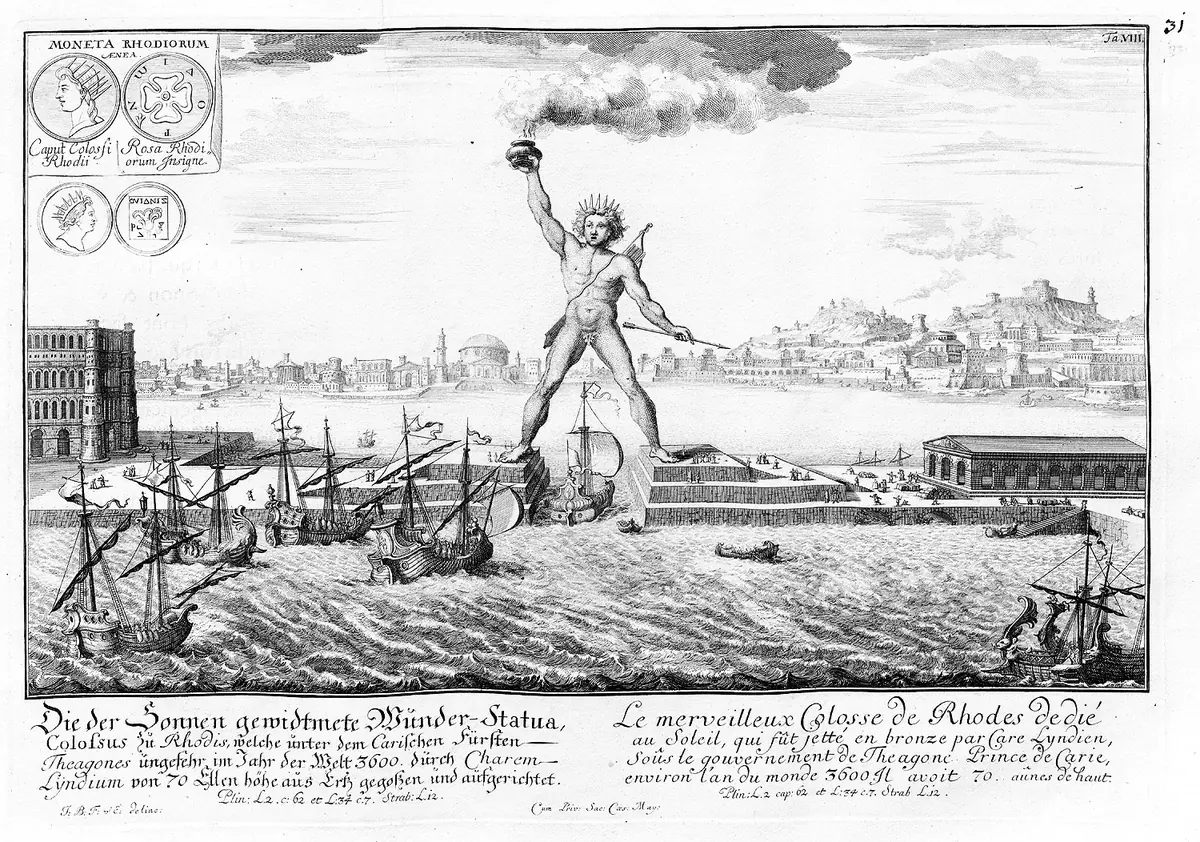
Image: Wikimedia Commons · Public domain (PD-Art) The Colossus in Fischer von Erlach’s historical architecture
Look closely. Johann Bernhard Fischer von Erlach, an architect, redrew the wonders for a book of historical reconstructions. His Colossus is still an invention, but the setting is treated as a problem in scale and architecture rather than as a simple marvel-print. Compare the pose and the harbour with Heemskerck’s plate, and you will see how one legend was restaged a century and a half later.
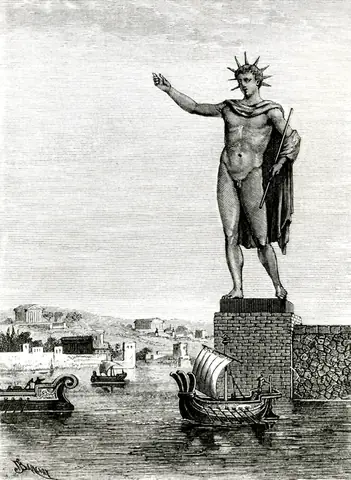
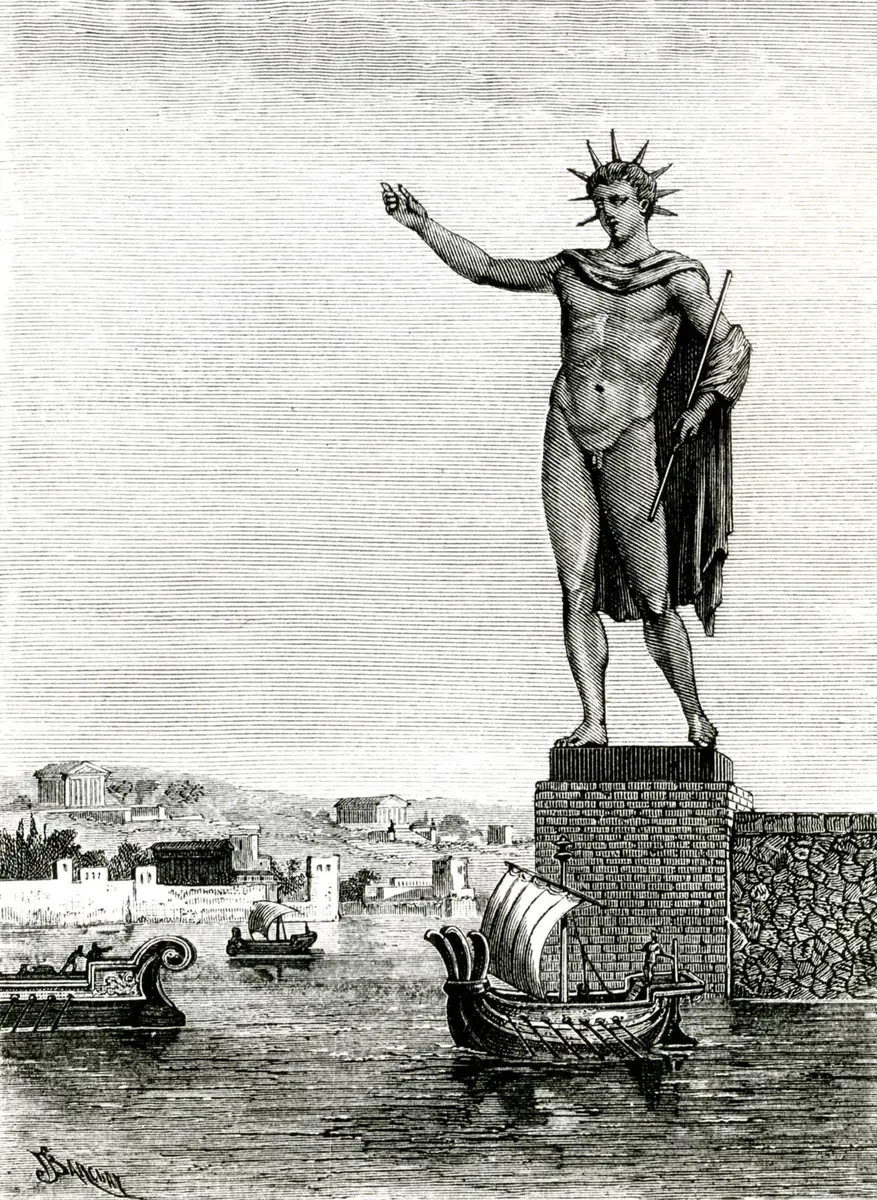
Image: Wikimedia Commons · Public domain (PD-Art) A nineteenth-century wood engraving of the Colossus
Look closely. A later popular engraving again shows a towering sun-god, this time in a style closer to a history-book illustration. It is useful as evidence of how long the imagined Colossus kept circulating, not as evidence of the bronze itself. By the time this plate was cut, the statue had been gone for many centuries, and the harbour-stride story was still doing most of the work.


What to watch for
Look slowly- The harbour-stride is a legend. If the statue stands astride a channel with ships beneath, you are looking at a later invention, not at ancient evidence.
- A standing Helios. The older reports point to a tall standing figure near the harbour, not a gateway over it.
- A short life. About fifty-six years up, then centuries as a fallen ruin: fame and duration are not the same.
- Three ages of imagining. Heemskerck, Fischer von Erlach and the Barclay engraving show how the story kept being redrawn.
- No photograph is possible. The bronze was gone long before the camera. Every picture is a reconstruction or an allegory.
- Thanksgiving in metal. The statue was raised after a siege failed. That origin is more certain than any later pose.
Sources
Dates follow standard historical references and, where we quote a book, the wording of the edition hosted in this library. Photographs are used only when the photograph itself is Public domain, CC0, or CC BY with a named credit. Lost wonders are shown in later engravings and reconstructions, which are imaginings, not photographs of the original work. Each picture links to its source page with full licence details.