Wonders & Monuments · Seven Wonders
The Mausoleum at Halicarnassus
The tomb of Mausolus, so famous that it gave later languages the word mausoleum.
In ruins. Earthquakes brought the building down. In the fifteenth century the Knights of St John used many of its stones to build Bodrum Castle. The site is an excavation hollow with scattered blocks. Important sculptures from the tomb are now in the British Museum.
What it is
Mausolus was satrap of Caria, a powerful local ruler under the Persian kings, and he made Halicarnassus his capital. After he died, about 353 BC, his sister and wife Artemisia II finished the great tomb that already seems to have been under way. Vitruvius, in this library, places the building halfway up the curved slope of the city, on a broad street, and says it was classed among the Seven Wonders. He names Satyrus and Pytheos as the architects, and Leochares, Bryaxis, Scopas and Praxiteles as the sculptors who, in rivalry, decorated the façades.
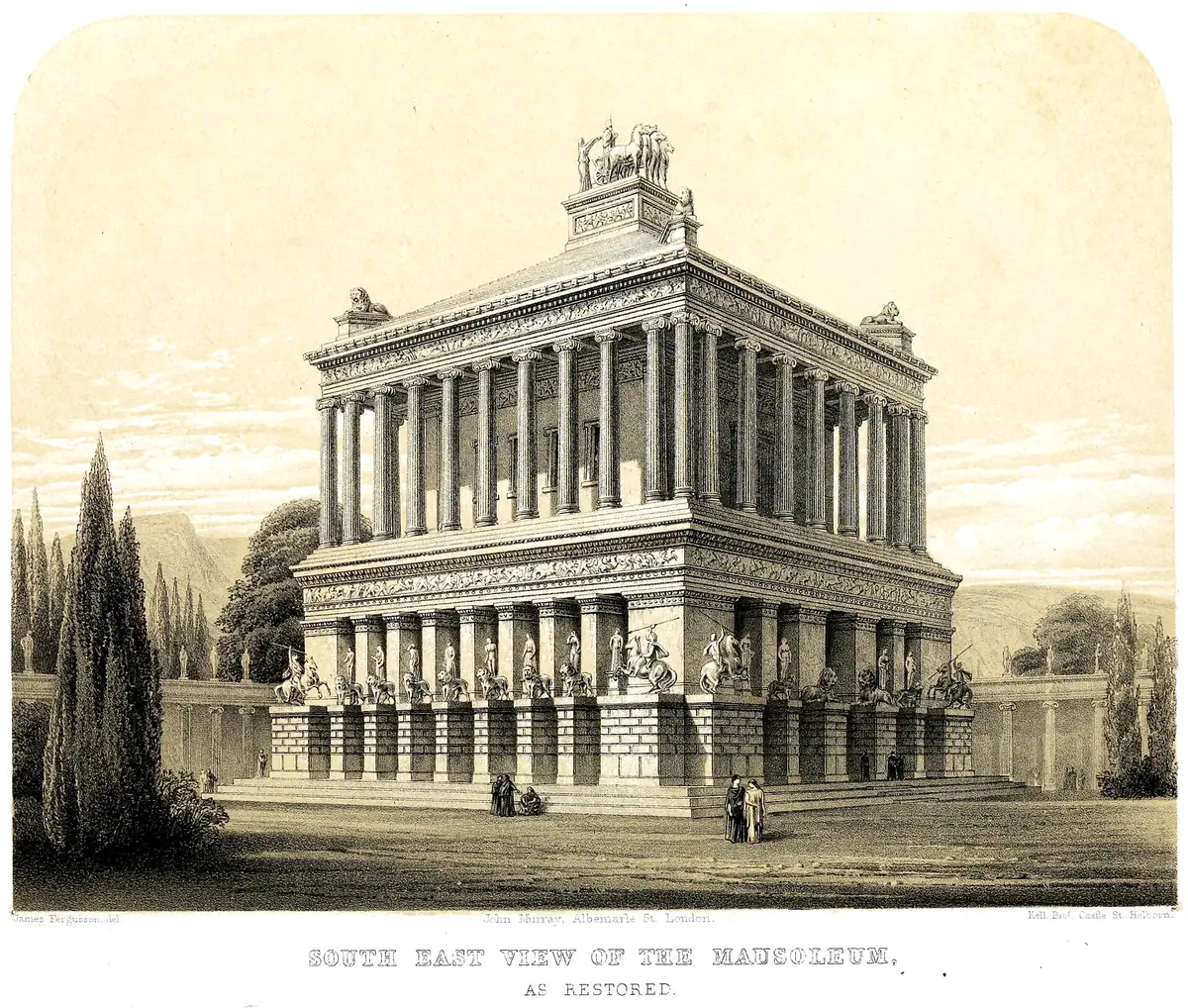
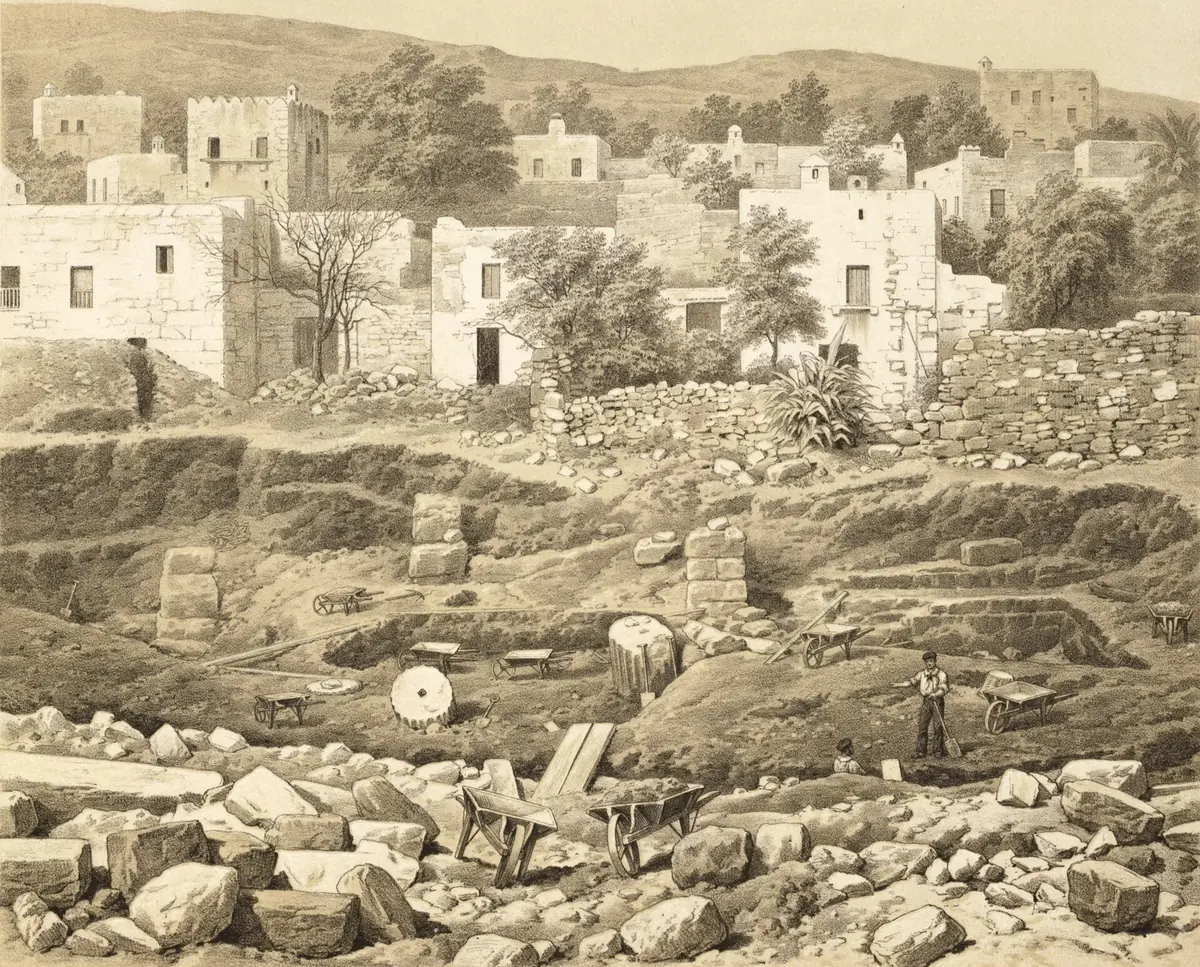
The tomb was a tall, stepped structure with a sculptured podium, a colonnade, and a pyramidal roof that carried a chariot group at the top. Earthquakes ruined it in the Middle Ages. The Knights Hospitaller took much of the remaining stone for the castle that still stands in Bodrum. In the 1850s and 1860s Charles Newton excavated the site; sculptures from the Amazonomachy frieze and other figures were taken to London. What you can see at Bodrum today is the open pit of that excavation, not a standing wonder.
“The decoration and perfection of the different façades were undertaken by different artists in emulation with each other: Leochares, Bryaxis, Scopas, Praxiteles, and, as some think, Timotheus; and the distinguished excellence of their art made that building famous among the seven wonders of the world.”
Why it matters
The mausoleum is a work of memory and of costly honour paid to the dead. Artemisia’s persistence in finishing the tomb, and the sculptors’ rivalry in adorning it, are forms of loyalty and excellence that Vitruvius himself thought worth recording. The word we still use for a great tomb is a quiet witness to that fame. The broken site, and the sculptures far from home, also ask for an honest look at how wonders are scattered when power, time and later builders have had their way.
Look closely
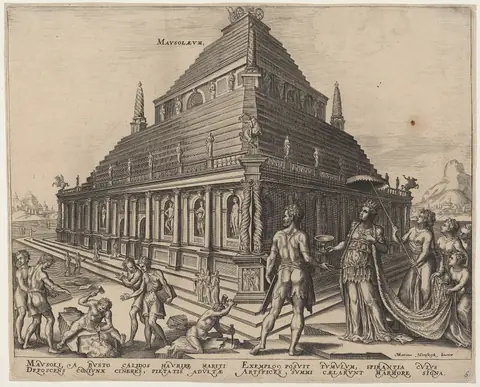
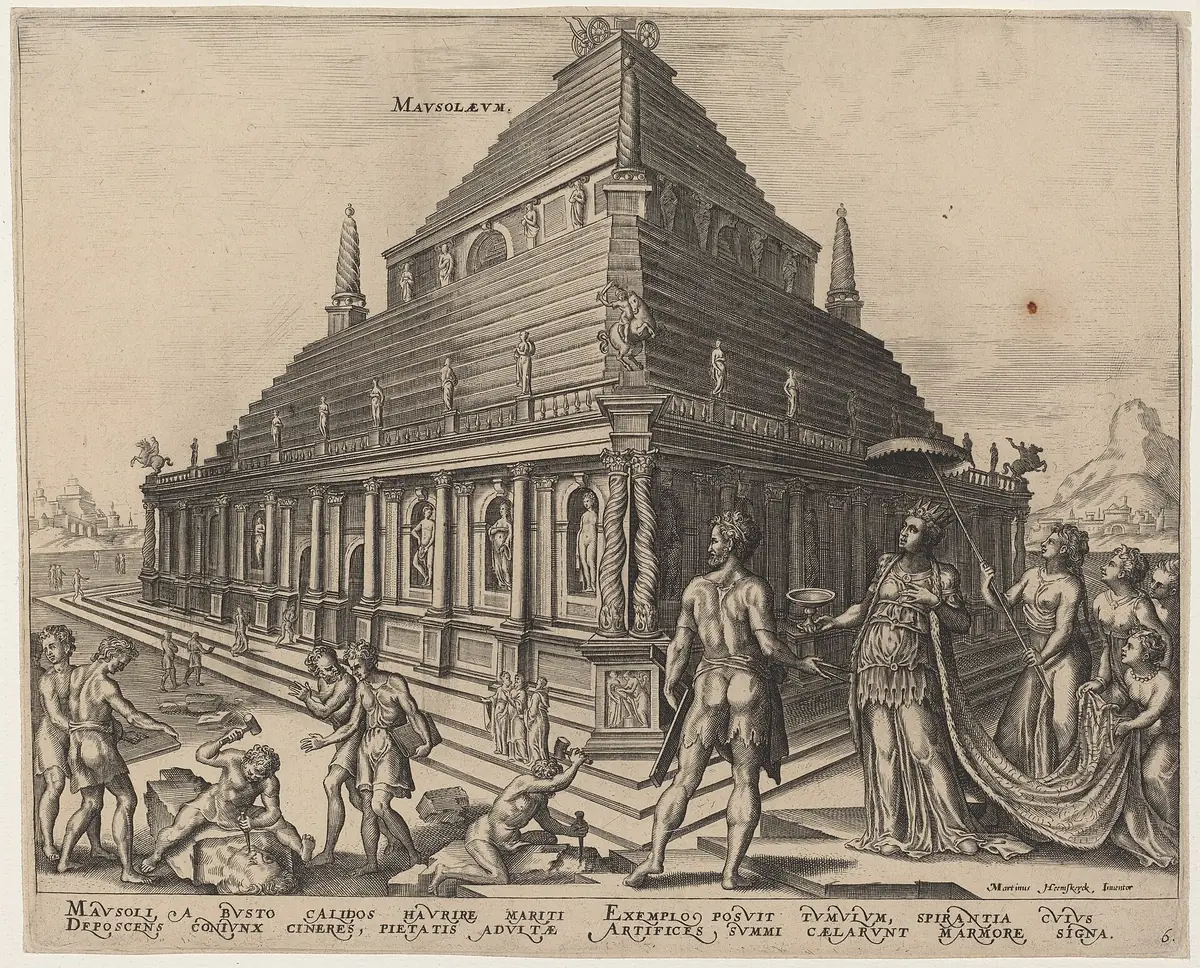
Image: Wikimedia Commons · CC0 (public domain) The Tomb of Mausolus at Halicarnassus, 1572
Look closely. Heemskerck’s design, engraved by Galle, piles a crowded sculptural monument into a steep, almost theatrical city. It catches the fame of the tomb and the idea of a building covered with figures, but the details are invented. Read it beside Vitruvius, who had at least a builder’s interest in the place, and beside the nineteenth-century excavation views, which show how little was left in the ground.
In the library: Vitruvius, The Ten Books on Architecture
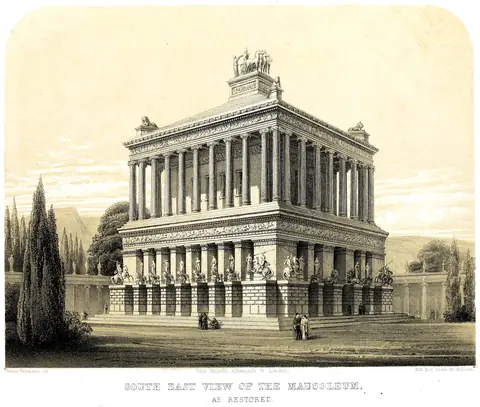
Image: Wikimedia Commons · Public domain (PD-Art) The mausoleum restored by James Fergusson
Look closely. Fergusson drew this south-east view after Newton’s discoveries, trying to fit a colonnade, a sculptured podium and a pyramidal roof into one reasoned reconstruction. It is a careful argument in picture form, not a witness of the standing building. Notice the chariot group at the summit, the stepped pyramid, and the way the sculpture is imagined as a band around the tomb.
In the library: Vitruvius, The Ten Books on Architecture
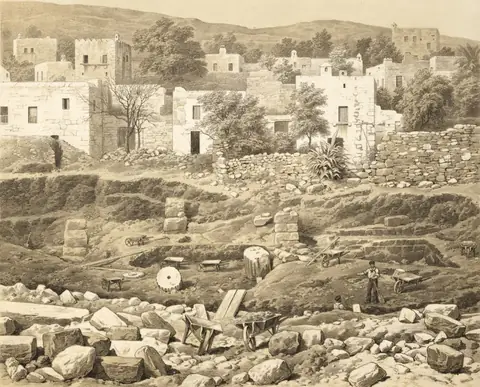
Image: Wikimedia Commons · Public domain (PD-Art) The excavation of the site, 1862
Look closely. This is the mausoleum as an archaeological site, not as a wonder in its prime. Houses stand on the slope above; below, men work among foundation stones, a fallen column drum and scattered blocks. The picture is one of the most honest views we have: it shows what remained once the castle-builders and the earthquakes had done their work, and what patience it took to recover the plan.


What to watch for
Look slowly- A tomb that named a type. Later ages called great tombs mausoleums after Mausolus of Caria.
- Vitruvius on the site. He sets the building on a broad street halfway up a city shaped like a theatre.
- Rival sculptors. The famous names were not a committee at rest; Vitruvius says they worked in emulation on different faces.
- Reconstruction is an argument. Fergusson’s 1862 view is a scholarly guess drawn after new finds, not a photograph of a standing tomb.
- The excavation pit. Picken’s lithograph shows the site as it was being uncovered: houses above, worked stones below.
- Where the sculpture went. Major reliefs and figures from the tomb are in the British Museum, not on the site.
Sources
Dates follow standard historical references and, where we quote a book, the wording of the edition hosted in this library. Photographs are used only when the photograph itself is Public domain, CC0, or CC BY with a named credit. Lost wonders are shown in later engravings and reconstructions, which are imaginings, not photographs of the original work. Each picture links to its source page with full licence details.