Wonders & Monuments · Seven Wonders
The Pharos of Alexandria
The great lighthouse of Alexandria, which gave later languages a word for a pharos, and which now lives only in pictures and in the fort on its site.
Lost. Earthquakes badly damaged the lighthouse in the Middle Ages, especially in the early fourteenth century. Its stones were later used in the Citadel of Qaitbay, built in 1477 on the same point at the mouth of the eastern harbour. The citadel still stands; the Pharos does not.
Ptolemy I Soter, in Great Lives · Ptolemy II Philadelphus, in Great Lives
What it is
The lighthouse was built on the island of Pharos, at the entrance to the harbour of Alexandria, the city founded by Alexander and ruled in this age by the Ptolemaic kings. Work is usually said to have been begun under Ptolemy I Soter and finished under Ptolemy II Philadelphus, in the first half of the third century BC. Ancient writers name Sostratus of Cnidus as the architect. The tower rose in tiers, with a fire and a mirror at the top, and was one of the tallest buildings of the ancient world. Estimates of its height vary; many modern accounts place it at well over 300 feet.
It served a practical purpose that the other wonders did not: it guided ships into a busy harbour and advertised the wealth of the city at the same time. Earthquakes weakened and finally ruined it. After the great shocks of the early fourteenth century little remained to rebuild. In 1477 Sultan Qaitbay built a fortress on the same point, using stone from the site. That citadel is the landmark at the harbour mouth today. The plates below are later imaginings of the lost tower, not views of a standing lighthouse.
Why it matters
The Pharos joins beauty to a public good. It was a work of perseverance in cut stone, raised to keep sailors from wreck and to honour a new capital. There is a kind of charity in a light kept for strangers at sea, and a kind of civic courage in spending a fortune on a tower that could not be hidden. The later fort on the same rock is not the wonder, but it does mark the place, and it reminds a student that later ages still saw the point as worth defending.
Look closely
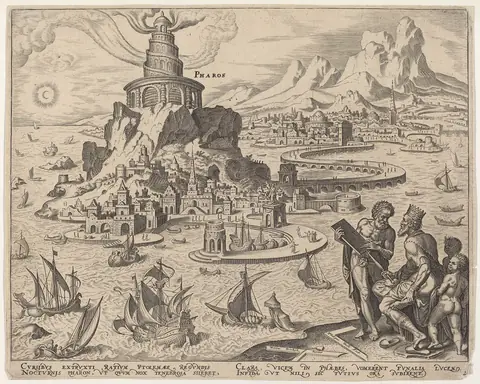
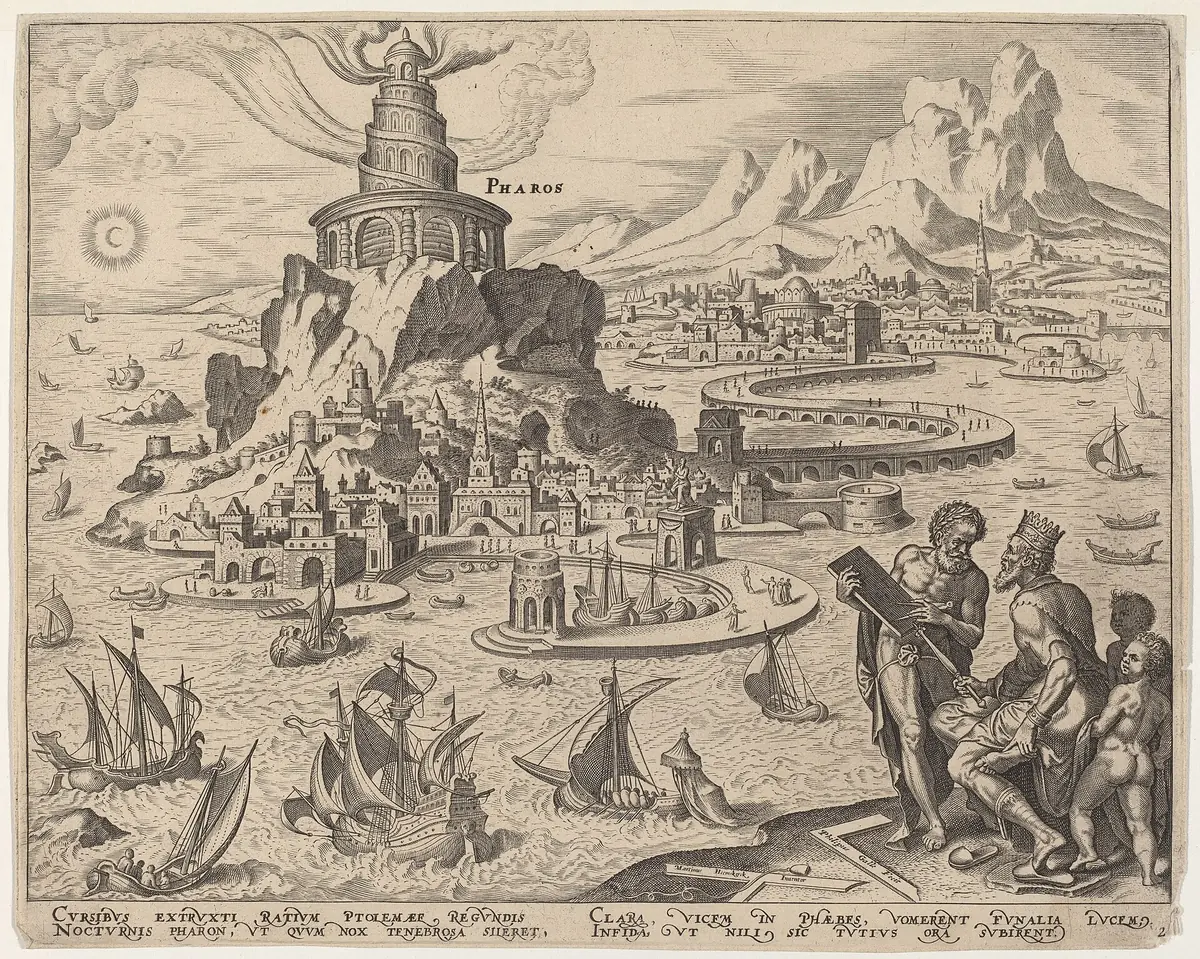
Image: Wikimedia Commons · CC0 (public domain) The Lighthouse at Alexandria, 1572
Look closely. Galle after Heemskerck shows a crowded harbour and a fantastic, many-windowed tower, already an invention of the sixteenth century rather than a working drawing of the Ptolemaic lighthouse. Use it to see how early modern Europe pictured the wonder, then compare the later coloured plate and the Latin-titled engraving, which invent the tower all over again.
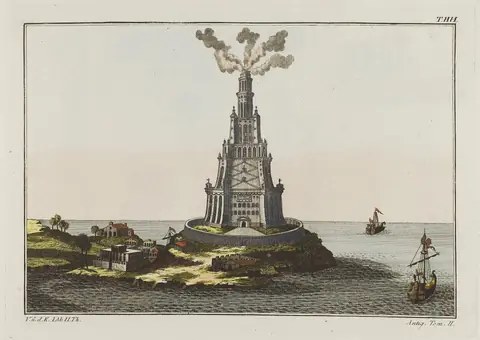
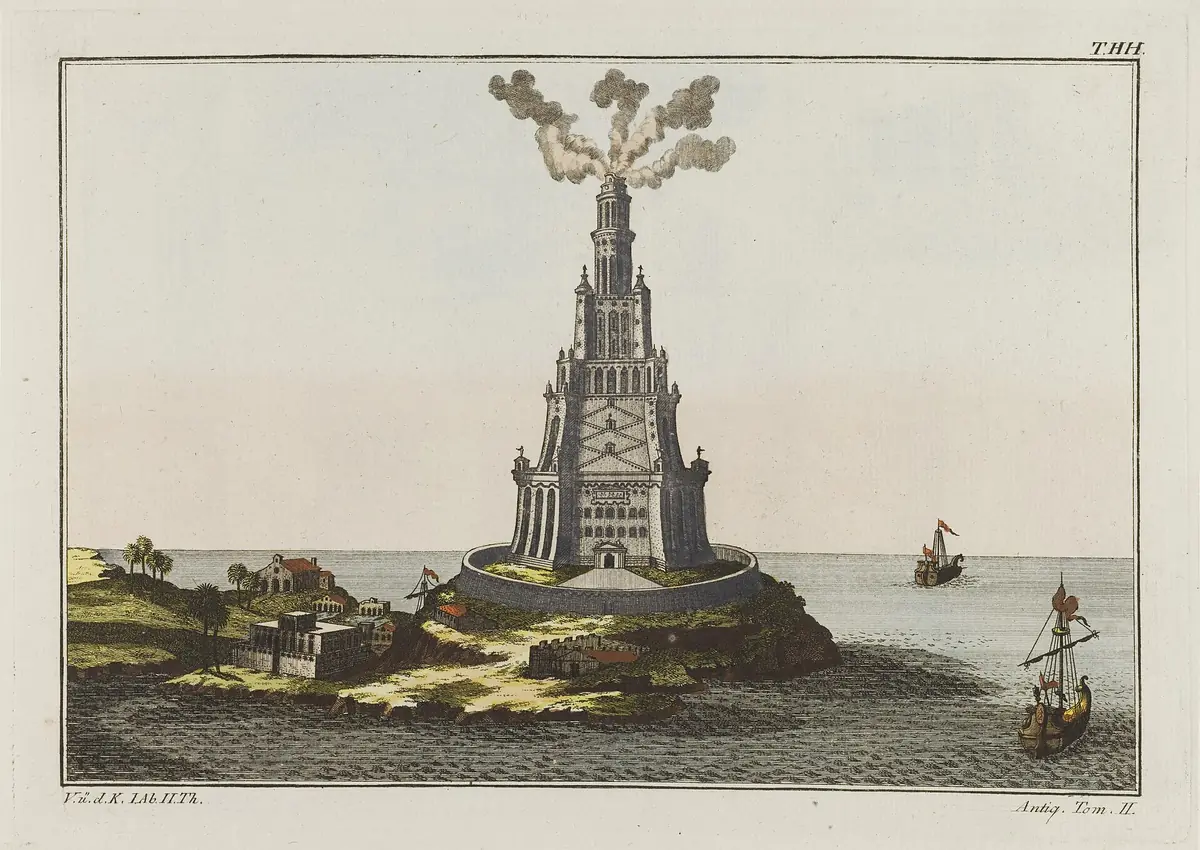
Image: Wellcome Collection · CC BY 4.0 · Photo: Wellcome Collection The Pharos, a coloured engraving, c. 1804–1811
Look closely. This later coloured plate gives the lighthouse a clearer three-tier shape and a dramatic seaways setting. It is still a reconstruction. Look at how the artist tries to make the tower both a building and a beacon, and how the ships are used to suggest its height. No one who drew this had seen the ancient Pharos standing.
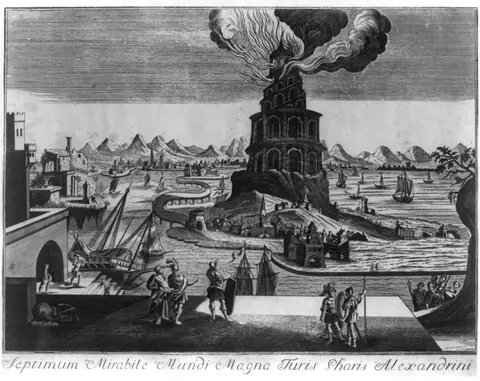
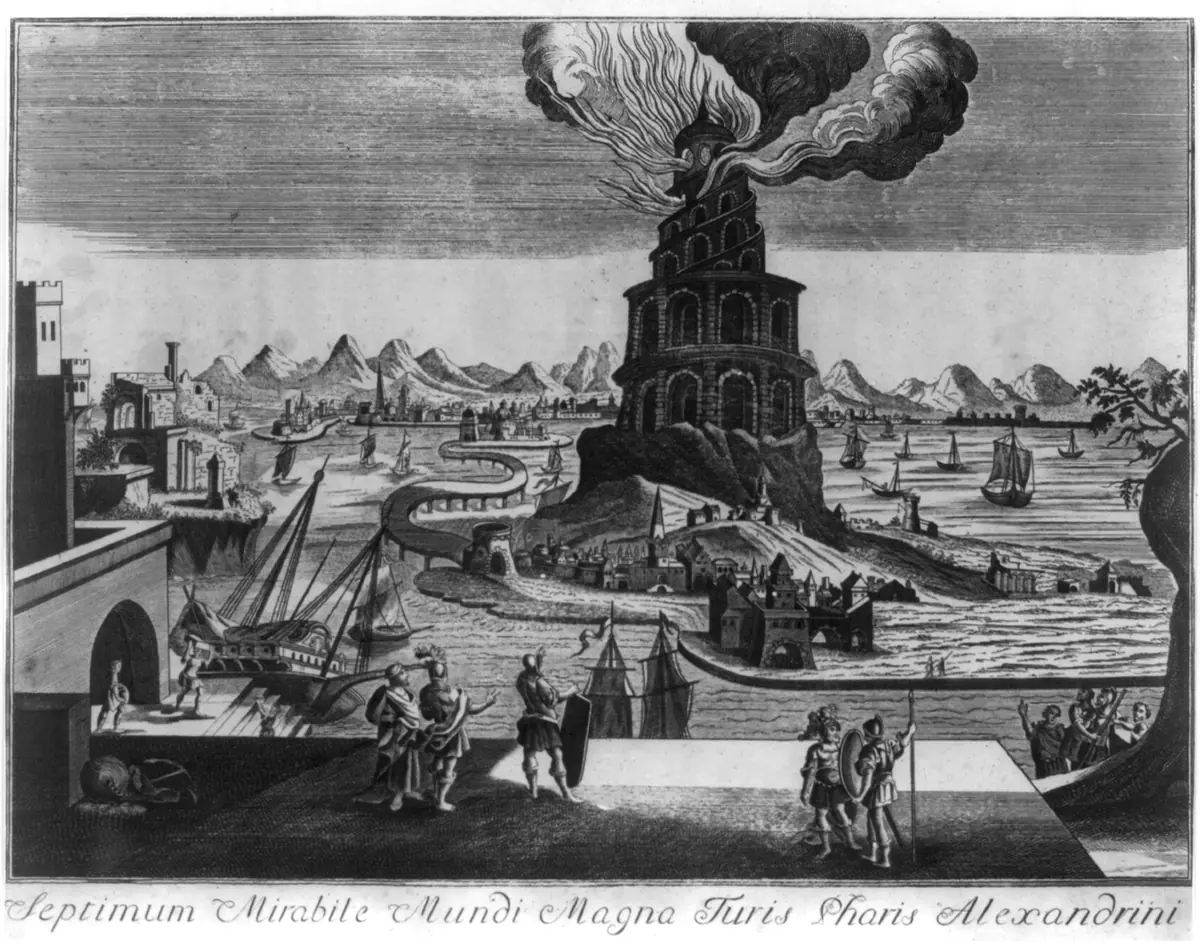
Image: Wikimedia Commons · Public domain (PD-Art) Septimum mirabile mundi: the Pharos of Alexandria
Look closely. The Latin title names the lighthouse as the seventh wonder of the world. Smoke pours from a round, many-storeyed tower on a rocky island, with a harbour full of ships and a staged group in the foreground. The print is a piece of wonder-literature in pictures. It should not be mistaken for a view from the shore of ancient Alexandria.


What to watch for
Look slowly- A working tower. Unlike a tomb or a cult statue, the Pharos was built to be used every night.
- Tiers, not a simple shaft. Later pictures usually show a stepped tower: a broad base, a narrower middle, and a lantern at the top.
- Imagined views only. No photograph of the lighthouse exists. Compare several engravings and you will see how freely the details change.
- The same point of land. The Citadel of Qaitbay stands where the Pharos stood, at the mouth of Alexandria’s eastern harbour.
- Name and word. Pharos was first the island, then the tower, and then, in some languages, a general word for a lighthouse.
- Earthquake, then reuse. The wonder was not pulled down in a day. It failed by shocks, and its stones went into a later fort.
Sources
Dates follow standard historical references and, where we quote a book, the wording of the edition hosted in this library. Photographs are used only when the photograph itself is Public domain, CC0, or CC BY with a named credit. Lost wonders are shown in later engravings and reconstructions, which are imaginings, not photographs of the original work. Each picture links to its source page with full licence details.