Wonders & Monuments · Great monuments
Petra
The Nabataean city cut into the red cliffs of southern Jordan, famous for its tomb façades.
In ruins. The rock-cut façades still stand in the cliffs, but the city as a living capital is gone. Earthquakes, lost trade routes and time emptied it. What you see are tombs, a monastery-like monument, streets and the remains of a city in a gorge.
What it is
Petra was the capital of the Nabataeans, a people who grew rich on the caravan trade through the deserts of what is now southern Jordan. In the Hellenistic and Roman centuries they cut great tomb façades into the sandstone cliffs — most famously the Treasury (Al-Khazneh) and the Monastery (El-Deir) — and built a city in the gorge, reached by the narrow Siq. The architecture mixes local rock-cutting with classical columns, pediments and ornaments.
The city declined when trade routes changed and after later earthquakes. It was never a secret to the region’s people, but it became widely famous in Europe after the early nineteenth century, when travellers such as David Roberts drew it. The pictures on this page are later views and lithographs, not Nabataean drawings. They are still among the best public-domain records of the façades.
Why it matters
This is costly work offered to the dead and to a city’s standing, cut into living rock with great patience. The virtue to notice is perseverance, and the beauty of a classical front that is also a cliff. Ruin here means an emptied city, not the loss of the façades themselves.
Look closely
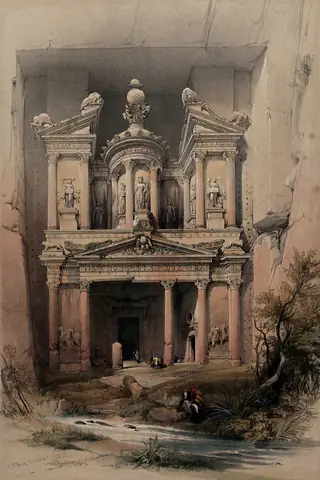
Image: Wellcome Collection · CC BY 4.0 · Photo: Louis Haghe after David Roberts; Wellcome Collection El Khasne, the Treasury
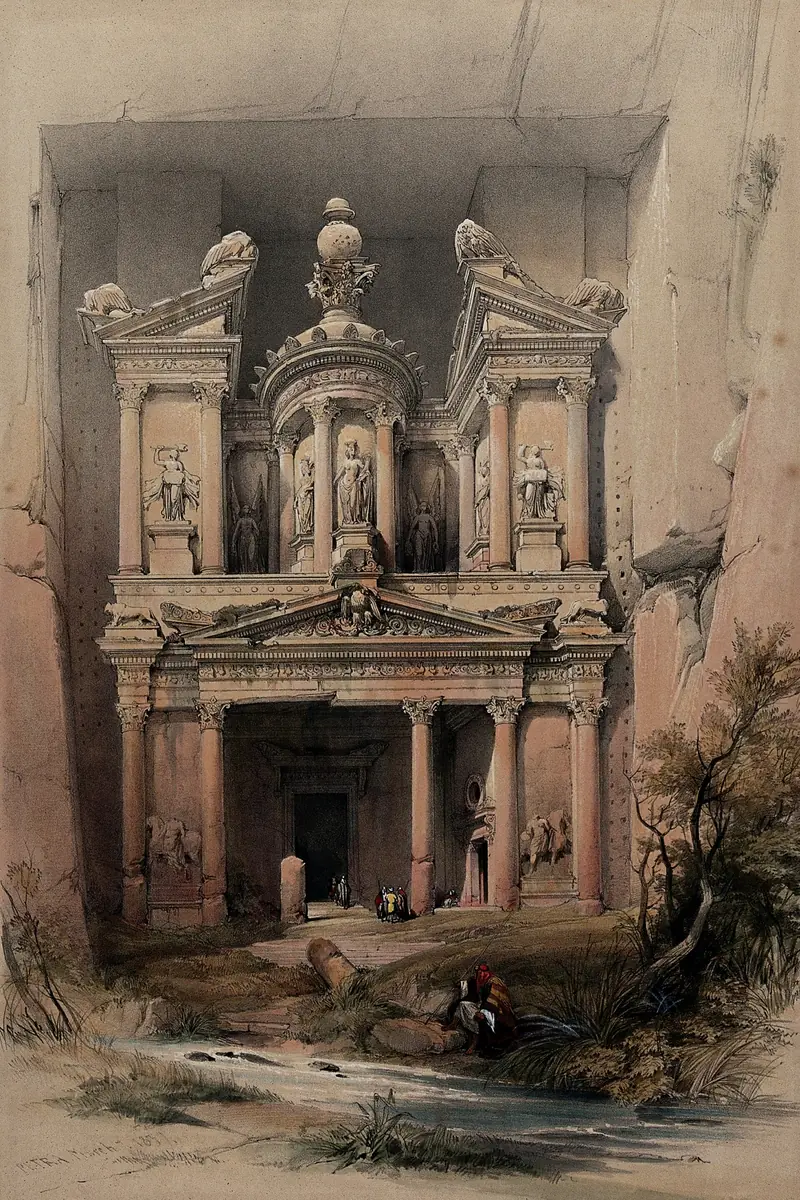
Look closely. Haghe’s coloured lithograph, after Roberts’s 1839 drawing, shows the famous Treasury façade at the end of its narrow approach, with figures in the foreground for scale. This is a traveller’s view, not a photograph, but it records the rock-cut columns, the broken upper urn, and the way the monument is framed by the gorge.
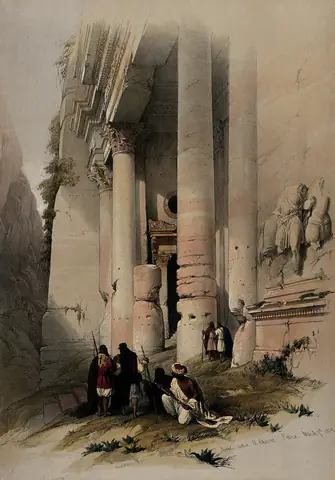
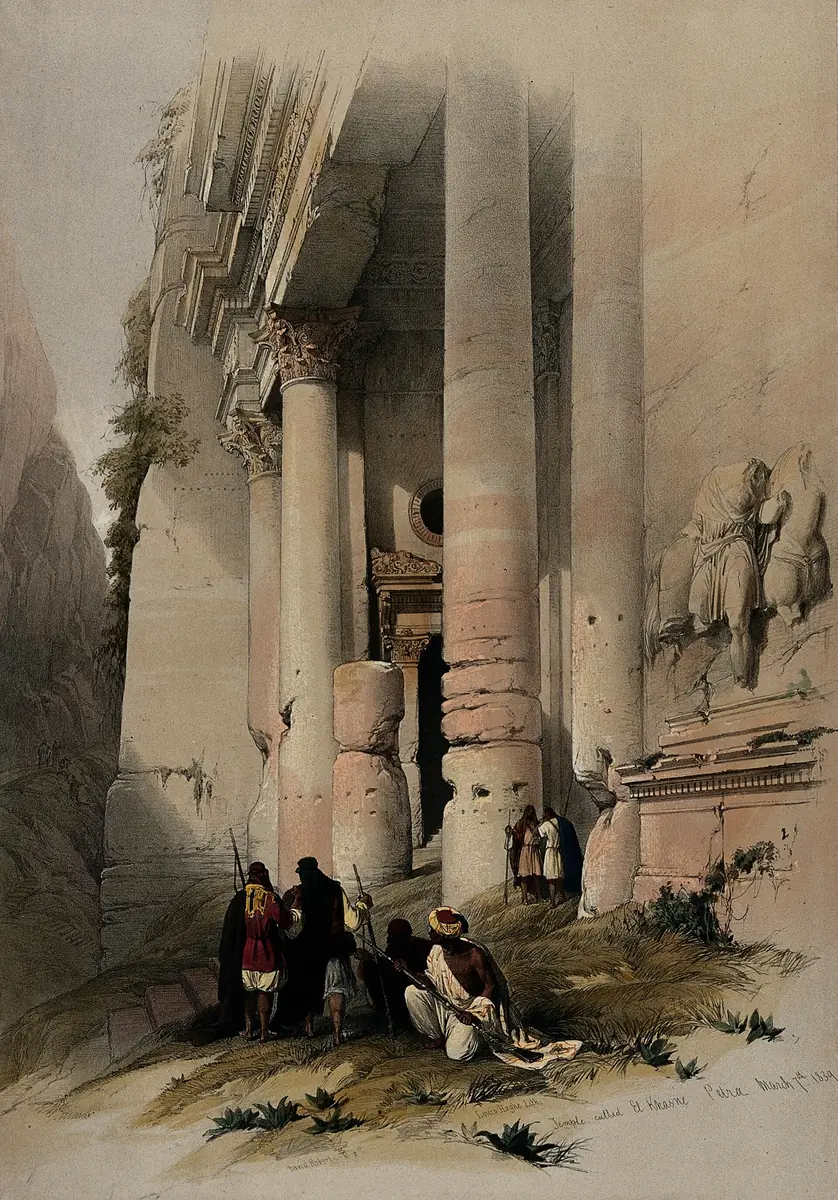
Image: Wellcome Collection · CC BY 4.0 · Photo: Louis Haghe after David Roberts; Wellcome Collection The Treasury, a closer side view
Look closely. A closer view of the lower order of the Treasury, with the columns and the doorway and a group in the foreground. Use it to read the capitals and the depth of the porch, and to remember that the upper storey is cut in the same cliff above.
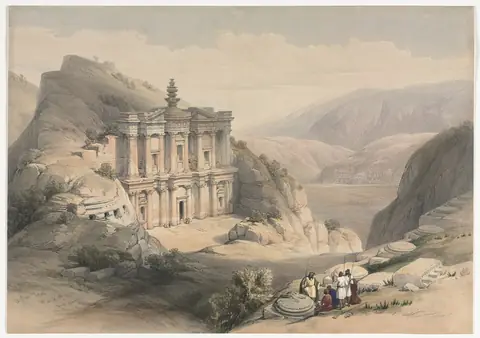
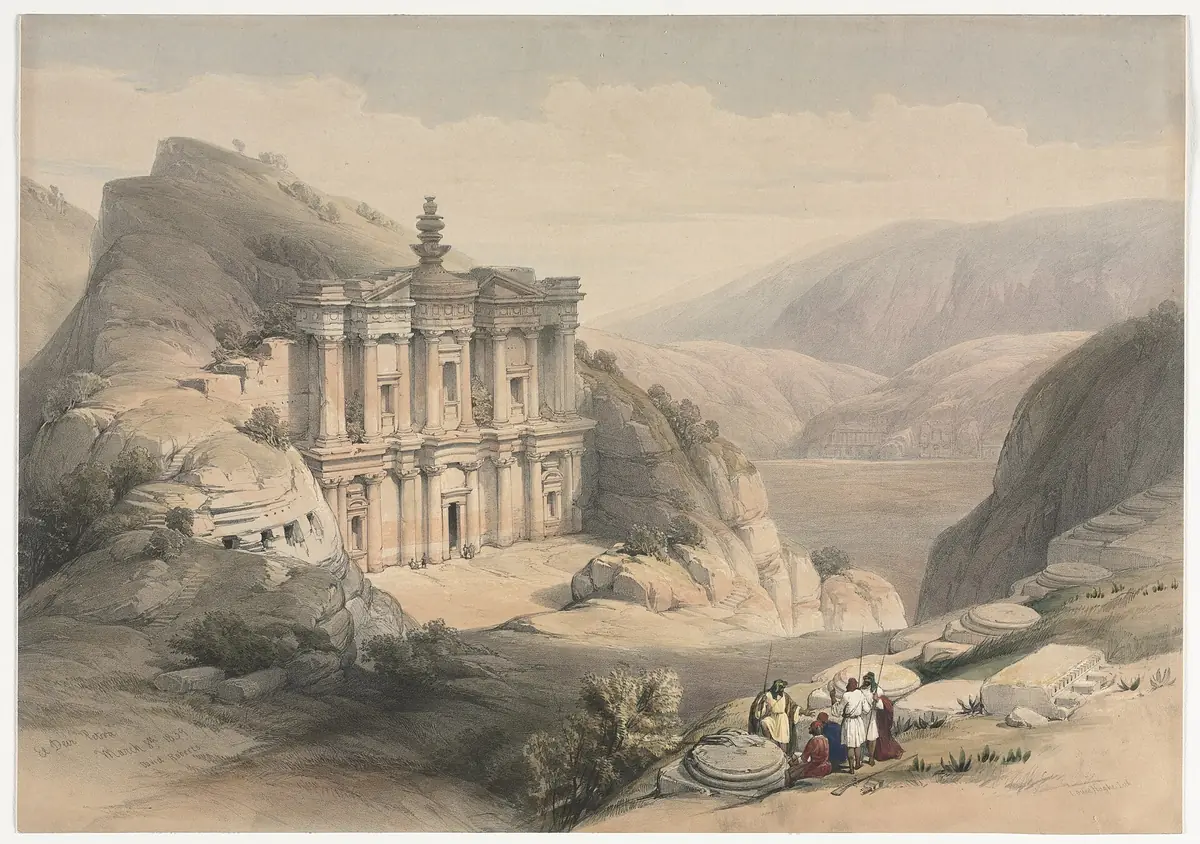
Image: Wikimedia Commons · CC0 (public domain) El Deir, the Monastery
Look closely. Roberts’s view of El-Deir, the great monastery-like façade high in the cliffs west of the city centre. The monument is broader and more austere than the Treasury. Notice how the rock face continues around the carved front, and how small the figures are on the approach.


What to watch for
Look slowly- Rock-cut, not built up. The famous fronts are carved back into the cliff. Look for the living rock around the columns.
- Treasury and Monastery. Al-Khazneh and El-Deir are different monuments. Do not treat every great façade as the same building.
- Later pictures. Roberts and Haghe were nineteenth-century visitors. Their lithographs are careful, and they are still imaginings of colour and staffage.
- A city, not only two tombs. Streets, a theatre and many lesser tombs also remain. The gorge is part of the work.
- Colour of the stone. The sandstone is not a single red. Notice bands and weathering in the drawings and in the rock.
Sources
Dates follow standard historical references and, where we quote a book, the wording of the edition hosted in this library. Photographs are used only when the photograph itself is Public domain, CC0, or CC BY with a named credit. Lost wonders are shown in later engravings and reconstructions, which are imaginings, not photographs of the original work. Each picture links to its source page with full licence details.