Work record
The Mayflower Compact
1620 · Renaissance Early Modern · Political Theory · English
Abstract
Background. Separatists from Leiden and other English emigrants, financed by London merchants, crossed the Atlantic in 1620 holding a Virginia Company patent for land near the Hudson. Contrary winds and shoals left them at Cape Cod instead, beyond any legal grant, and some passengers spoke of answering to no one once ashore.
Content. Before landing, the men pledge allegiance to James I, name their aims as God's glory, the spread of the faith and England's honour, and bind themselves into one political society. That society may frame equitable statutes and appoint officers as the colony's welfare requires, and each signer pledges to obey them.
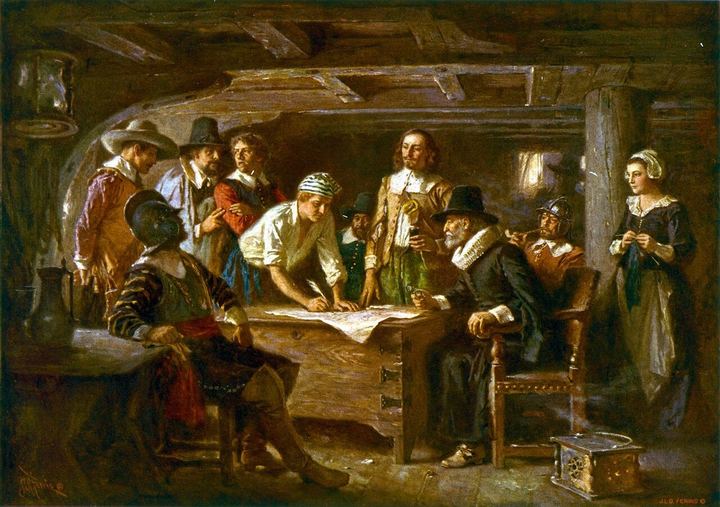
Signers. Forty-one men subscribed, led by Carver, Bradford, Winslow and Brewster. Their names are known from Morton's 1669 Memorial, because the original sheet is lost.
Significance. The agreement served as Plymouth's working constitution until 1691. Nineteenth-century Americans prized it as a precedent for rule by consent and for the movement of Puritan church covenants into civil life, while historians note its loyal, practical purpose.
Text. No manuscript in the signers' hands survives. The wording reached print through the 1622 London pamphlet and through Bradford's history, whose manuscript returned to Boston from England in 1897; the library uses the Avalon Project version taken from Thorpe's 1909 government collection of American charters, constitutions and organic laws.
Key figures
- John Carver: Heads the signers' list; elected the first governor
- William Bradford: Signer and later governor whose history keeps the text
- William Brewster: Elder of the Leiden Separatist church
- Myles Standish: Military captain of the expedition
- King James I: Monarch to whom the signers profess allegiance

Summary
The Mayflower Compact is a single paragraph of about two hundred words, signed on 11 November 1620 (Old Style; 21 November by the modern calendar) aboard the ship Mayflower as it lay at anchor in the hook of Cape Cod, in what is now Provincetown Harbor. The ship had left Plymouth, England, in September with about a hundred passengers. Some were members of an English Separatist congregation that had lived in exile at Leiden in Holland; others had been recruited in England by the London merchants who financed the voyage. Their patent from the Virginia Company allowed them to settle in the northern part of the Virginia territory, near the Hudson River, but storms and the shoals off Cape Cod brought them to land well to the north, outside that grant. William Bradford later wrote that some of the passengers began to say that once ashore no one would have power to command them. The compact was the leaders' answer. The text opens with the words In the Name of God, Amen, and the signers describe themselves as loyal subjects of King James. They say they have undertaken the voyage for the glory of God, the advancement of the Christian faith, and the honour of their king and country, to plant a settlement in the northern parts of Virginia. They then covenant and combine themselves together into a civil body politic, for their better ordering and preservation, and agree that by virtue of this agreement they will enact and frame just and equal laws, ordinances, acts, constitutions and offices, as shall be thought most meet for the general good. They promise all due submission and obedience to those laws, and they sign at Cape Cod on the eleventh of November, in the eighteenth year of King James's reign in England. Forty-one men signed. The library text lists them beginning with John Carver, William Bradford, Edward Winslow and William Brewster, and including Myles Standish, the company's military captain, John Alden, Samuel Fuller, Stephen Hopkins and John Howland. Carver was chosen governor; after his death in the spring of 1621 Bradford succeeded him and served for most of the next thirty-five years. The signers' list comes from Nathaniel Morton's New England's Memorial (1669), since the signed original is lost. The compact was first printed in Mourt's Relation (London, 1622) and copied into Bradford's manuscript history Of Plymouth Plantation. It governed Plymouth until the colony gained further patents and remained a separate jurisdiction until it was joined to Massachusetts in 1691. Later Americans, especially in the early nineteenth century, honoured it as an early written example of self-government by consent and of covenant ideas carried from church life into civil life, and it is regularly read beside the Declaration of Independence and the Constitution. The library text follows the Avalon Project transcription from Bradford.
Virtues in this work
- Prudence: Facing a landing outside their patent and talk of disorder, the leaders secure a lawful government before anyone goes ashore.
- Justice: The signers promise to frame just and equal laws for the general good and to obey them.
- Piety: The agreement opens in the name of God and is made in the presence of God for his glory and the advancement of the Christian faith.
Plot or Argument
- Invocation and allegiance
The signers begin In the Name of God, Amen, and identify themselves as loyal subjects of King James of Great Britain, France and Ireland, Defender of the Faith.
- Purpose of the voyage
They state that the voyage was undertaken for the glory of God, the advancement of the Christian faith and the honour of king and country, to plant a settlement in the northern parts of Virginia.
- The covenant
Solemnly and mutually, in the presence of God and one another, they combine into a civil body politic for their ordering and preservation.
- Power to make laws and promise of obedience
By virtue of the agreement they will frame just and equal laws and offices for the general good, and they promise due submission and obedience to them.
- Date and signatures
The witness clause dates the document at Cape Cod on 11 November 1620, in King James's eighteenth year in England and fifty-fourth in Scotland, followed by forty-one names.
Characters
- John Carver, first signer and governor
First name on the list; chosen governor of the company and died in 1621.
- William Bradford, signer and historian
Second governor of Plymouth, whose history Of Plymouth Plantation preserves the compact and its occasion.
- William Brewster, signer and elder
Ruling elder of the Leiden congregation and spiritual leader of the settlement.
- Edward Winslow, signer
Leading settler, usually credited as a contributor to Mourt's Relation, where the compact was first printed.
- Myles Standish, signer and captain
Professional soldier hired to lead the settlement's defence.
- King James, sovereign
James I of England and VI of Scotland, to whom the signers declare their loyalty.
Lessons
A covenant before God and one another
The signers bind themselves solemnly and mutually in the presence of God and one another. The language echoes the church covenants of English Separatist congregations, carried here from church order into civil order.
- Who are the two witnesses to the promise the signers make?
- How is a covenant different from a simple list of rules?
- Why might a congregation used to making church covenants turn naturally to this form?
Law made for the general good
The compact promises just and equal laws suited to the general good, and asks every signer to submit to them. It joins a duty of the lawmakers to a duty of the governed in a single sentence.
- What does the compact promise the laws will be like?
- What do the signers promise in return?
- Why might the phrase general good matter to a small company facing a winter in an unknown land?
Order in a crisis
Bradford records that some passengers questioned anyone's authority once they landed outside their patent. The compact gave the company a lawful basis for government before they went ashore.
- Why did landing at Cape Cod rather than near the Hudson create a problem of authority?
- How does the compact solve that problem while still declaring loyalty to King James?
Context
English Separatists, who believed the Church of England could not be reformed from within, had left England for the Netherlands in 1607-1608 and settled at Leiden in 1609. Seeking a place where they could keep their English identity and worship freely, some of them joined with other emigrants and with London investors to sail for America in 1620. The Mayflower crossed the Atlantic between September and November, reaching Cape Cod rather than the region near the Hudson named in their patent.
Composition
The agreement was written and signed aboard ship on 11 November 1620, before the company landed; its drafter is not recorded. It was first printed in Mourt's Relation (1622), an account of the first months at Plymouth, and was copied into William Bradford's manuscript Of Plymouth Plantation, which was not published in full until 1856. The list of forty-one signers first appears in Nathaniel Morton's New England's Memorial (1669). The library text is the Avalon Project transcription, from Thorpe's Federal and State Constitutions (1909).
Reception
The compact served Plymouth as its founding frame of government until later patents and the colony's absorption into Massachusetts in 1691. From the late eighteenth century onward American orators and historians celebrated it as an early instance of government founded on the consent of the governed, and it became a fixture of American civic education. Historians also stress that it declared loyalty to the Crown and was meant as a practical agreement rather than a theory of independence.
Comparisons
- a-model-of-christian-charity
Winthrop's 1630 sermon to the Massachusetts Bay settlers also frames a new community as a covenant with God, ten years after the Plymouth compact.
- second-treatise-of-government
Locke's 1689 account of men uniting by consent into one body politic reads almost as a theory of what the Mayflower passengers did in practice in 1620.
- the-founding-documents
The compact's civil body politic and just and equal laws anticipate the Declaration's consent of the governed and the Constitution's We the People, though the compact professes loyalty to a king.
- articles-of-confederation
Both are written agreements by which separate parties bind themselves into a common government; the Articles join thirteen states, the compact forty-one men.
- the-pilgrims-progress
Bunyan's allegory of the Christian pilgrim comes from the same English Puritan and Nonconformist world that gave the Plymouth settlers the name Pilgrims.
Quotes
Frequently cited
“solemnly and mutually, in the Presence of God and one another, covenant and combine ourselves together into a civil Body Politick, for our better Ordering and Preservation”
“IN THE NAME OF GOD, AMEN.”
“Having undertaken for the Glory of God, and Advancement of the Christian Faith, and the Honour of our King and Country, a Voyage to plant the first Colony in the northern Parts of Virginia”
“such just and equal Laws, Ordinances, Acts, Constitutions, and Officers, from time to time, as shall be thought most meet and convenient for the general Good of the Colony; unto which we promise all due Submission and Obedience.”
For Students
A reading companion for classical Christian high school students. See the student guide.
Reading Guide
Watch for
- The opening invocation and the long royal title of King James, Defender of the Faith.
- The three purposes of the voyage: the glory of God, the advancement of the Christian faith and the honour of king and country.
- The verbs covenant and combine, and the phrase civil body politic.
- The promise of just and equal laws for the general good, answered by a promise of submission and obedience.
- The date at Cape Cod and the list of forty-one signers headed by John Carver and William Bradford.
Key terms and names
- Covenant
- A solemn binding agreement made before God; the signers covenant with one another to form a government.
- Civil body politic
- A political community able to make and enforce laws, which the passengers create by their agreement.
- Separatists
- English Christians who left the Church of England to form independent congregations; many Mayflower leaders came from the Leiden congregation.
- Patent
- The grant from the Virginia Company that allowed the company to settle near the Hudson, which they could not use once they reached Cape Cod.
- Cape Cod
- The hooked peninsula where the Mayflower anchored and where the compact was signed on 11 November 1620.
- Old Style
- The Julian calendar then used in England, ten days behind the modern calendar in 1620.
Seminar Questions
- Comprehension What three purposes for the voyage do the signers name?
- Comprehension What do the signers promise to do, and what do they promise to obey?
- Comprehension Why were the passengers outside the land granted in their patent when they signed?
- Interpretation Why do the signers say they covenant in the presence of God and one another, rather than only with one another?
- Interpretation The compact declares loyalty to King James and also creates a new government. How do the signers hold these two together?
- Interpretation What might just and equal laws have meant to a company that included both church members and hired craftsmen?
- Big Question Does a government gain its authority from the agreement of the governed, from God, from the king, or from some combination of these?
Faith Connections
- Joshua 24:24-25 (Scripture)
Joshua makes a covenant with the people at Shechem and sets them a statute and an ordinance; the Plymouth signers likewise join a covenant to the making of laws.
- Romans 13:1-7 (Scripture)
Paul's teaching on submission to governing authorities stands behind the compact's promise of all due submission and obedience to lawful rule.
- William Bradford, Of Plymouth Plantation, Book I (Great Conversation)
Bradford's account of the Leiden years and the farewell sermon of pastor John Robinson shows the congregational covenant life from which the compact grew.
Logic and Rhetoric
Central argument: Since the company has undertaken the voyage for God, faith, king and country, and since it needs order and preservation in a place without settled government, its members should bind themselves by mutual covenant into a civil body politic that makes just and equal laws for the general good, which all promise to obey.
Rhetorical device: doublets and lists. Pairs such as solemnly and mutually, covenant and combine, and Submission and Obedience, and the list of Laws, Ordinances, Acts, Constitutions, and Officers (quotes 2 and 3), give the short text the weight of a legal deed.
Debate: Resolved: that the Mayflower Compact is better understood as a church covenant applied to civil life than as an early constitution.
Memory Work
solemnly and mutually, in the Presence of God and one another, covenant and combine ourselves together into a civil Body Politick, for our better Ordering and Preservation
such just and equal Laws, Ordinances, Acts, Constitutions, and Officers, from time to time, as shall be thought most meet and convenient for the general Good of the Colony; unto which we promise all due Submission and Obedience.
Writing Prompts
Essay: Explain how the Mayflower Compact combines religious, royal and self-governing ideas in a single sentence, using its opening, its covenant clause and its promise of obedience.
Comparison with A Model of Christian Charity: Compare the covenant language of the Mayflower Compact (1620) with John Winthrop's A Model of Christian Charity (1630): what does each expect of the community it addresses?
Medical Lens
The compact itself contains nothing medical, but it was signed on the eve of the settlement's first winter, when, according to Bradford's history, about half the company died of what he called the general sickness, likely a mix of scurvy, exposure and infectious disease; retrospective diagnosis is uncertain. Several signers, including Governor Carver, died within months. Samuel Fuller, a signer, served as the settlement's physician.
- Signers' list
Samuel Fuller, the company's physician and a deacon of the church, appears among the signers.
Creative Prompts
- Fiction
Write a journal entry by a young passenger in the Mayflower's crowded hold on 11 November 1620, as the men go up to sign.
- Classroom
Draft a class compact in the same shape as the Mayflower Compact: a purpose, a mutual promise, a commitment to fair rules for the general good, and signatures.
- Essay
Explain why the passengers needed an agreement before landing at Cape Cod, using what Bradford reports about the mutinous speeches.
- Dialogue
Stage a debate aboard ship between William Brewster and a passenger who doubts that anyone may command him once ashore.
Further Reading
- Of Plymouth Plantation, William Bradford
Bradford's history, which records the compact and the circumstances of its signing.
- Mourt's Relation, Edward Winslow and William Bradford (attributed)
The 1622 account of the first months at Plymouth where the compact was first printed.
- Mayflower: A Story of Courage, Community, and War, Nathaniel Philbrick
A narrative history of the voyage and the first generations at Plymouth.
Verification notes
All four quotations were found by Grep in content/texts/mayflower-compact.txt (Avalon Project transcription, with its capitalization and spelling). The forty-one signers are named exactly as spelled in that file, which follows the traditional list first printed by Nathaniel Morton in 1669 (checked at https://en.wikipedia.org/wiki/Mayflower_Compact_signatories); Morton probably worked from Bradford rather than the lost original, so the order of names is not certain. The phrase about mutinous speeches is paraphrased from Bradford and is not quoted here.
- Check Bradford's exact wording about the discontented and mutinous speeches in a scholarly edition before quoting it.
- Confirm the approximate passenger count (about 102) and the proportion who died in the first winter against Bradford's own list.