Work record
Order of the Day, 6 June 1944
1944 · Early 20th Century · Oratory · English
Abstract
Background. After months of planning at SHAEF and a twenty-four-hour weather postponement, Overlord was launched against the Normandy coast. The night before, the Supreme Commander's printed message went out to troops boarding ships and aircraft.
Content. The text opens by casting the assault as a crusade watched by the whole world and states its goals in a rising series, from defeating Germany's armed forces to freeing Europe and making the Allied nations safe. A blunt paragraph follows on the quality of the defenders. Eisenhower then reviews what has changed since the German conquests early in the war: battlefield defeats for Germany, bombing that has worn down its strength, and the output of Allied factories and training camps. He ends by trusting the men and calling for prayer.
Form. Short sentences, exclamations, and triplets suit a text meant to be read quickly by men under strain. The salutation joins all three services in a single address.
Themes. Liberation as the war's purpose, candour about danger, confidence in ordinary fighting men, and reliance on God.
Significance. Kept by many veterans as a souvenir and preserved in drafts at Abilene, the message ranks among the defining documents of the Western Allies, and its crusade language later named its author's war memoir.
Key figures
- Dwight D. Eisenhower: Supreme Commander, Allied Expeditionary Force, who signed the order
- Soldiers, sailors, and airmen of the Allied Expeditionary Force: The assault forces to whom the order is addressed
- The Allies on other fronts: Brothers-in-arms fighting Germany elsewhere, named as partners in the effort
- The German army: The trained, battle-hardened enemy holding the French coast

Summary
General Dwight D. Eisenhower's Order of the Day was the message issued by Supreme Headquarters, Allied Expeditionary Force, to the soldiers, sailors, and airmen about to land in Normandy on 6 June 1944. Printed copies were handed to the men of the assault forces on the eve of the invasion, after a day's delay for bad weather, and Eisenhower also recorded it for broadcast. The order is short, about two hundred and thirty words in five paragraphs after its salutation, and moves through a clear sequence. The first paragraph names the mission as the Great Crusade, tells the men that the eyes of the world are on them and that the prayers of liberty-loving people march with them, and sets out three aims: the destruction of the German war machine, the end of Nazi tyranny in occupied Europe, and security in a free world. The second paragraph is frank about the difficulty: the enemy is well trained, well equipped, battle-hardened, and will fight savagely. The third answers it with reasons for confidence: since the German victories of 1940-41 the Allies have won great battles, the air offensive has weakened the enemy, and the home fronts have supplied overwhelming superiority in arms and trained reserves; the tide has turned. The fourth expresses the commander's full confidence in the men's courage, devotion, and skill, and the fifth closes with good luck and a call to beseech the blessing of Almighty God upon the undertaking. The order was read in landing craft and camps across southern England. The same week Eisenhower privately wrote a brief note, to be released if the landings failed, accepting the blame himself. He later titled his war memoir Crusade in Europe (1948), taking the phrase from this order.
Virtues in this work
- Fortitude: The order prepares men for a landing against an enemy it frankly describes as well trained and savage.
- Prudence: Eisenhower grounds confidence in concrete facts, Allied victories, air power, and production, rather than in bravado.
- Piety: The order closes by asking all to beseech the blessing of Almighty God on the undertaking.
- Humility: The commander speaks of himself only to express confidence in his men and commits the outcome to God.
Plot or Argument
- Salutation and the Great Crusade
Eisenhower addresses all three services of the Allied Expeditionary Force, names the invasion as the Great Crusade, and sets out its three aims: destroying the German war machine, ending Nazi rule over the occupied peoples of Europe, and securing a free world.
- The enemy
He tells the men plainly that their task will be hard and that the enemy is trained, equipped, battle-hardened, and will fight savagely.
- Reasons for confidence
He contrasts 1944 with the German triumphs of 1940-41, cites Allied victories, the air offensive, and the production of the home fronts, and declares that the tide has turned.
- Confidence and prayer
He states his full confidence in the men's courage, devotion to duty, and skill, wishes them good luck, and asks that all beseech the blessing of Almighty God on the undertaking.
Key claims
The main steps of the argument, in order, and how they fit together.
- The invasion is a great crusade, watched by the world and supported by the prayers of liberty-loving people everywhere.How it is supported: Appeal to the moral weight of the cause and the hopes of free peoples.
- The aims of the assault are to destroy the German war machine, end Nazi tyranny over Europe, and secure a free world.How it is supported: A rising series of three goals, from military victory to lasting freedom.
- The task will be hard, because the enemy is well trained, well equipped, battle-hardened, and will fight savagely.How it is supported: Frank assessment of the defenders, offered so the men face the danger honestly.
- Since the German victories of 1940 and 1941, the Allies have defeated the Germans in great battles.How it is supported: Contrast between the early years of the war and the present.
- The Allied air offensive has seriously weakened Germany's strength in the air and its ability to wage war on the ground.How it is supported: Appeal to the results of the bombing campaign.
- The home fronts have given the Allies overwhelming superiority in weapons, munitions, and trained fighting men in reserve.How it is supported: Appeal to the output of Allied factories and training camps.
- The tide has turned, and the free men of the world are now marching together toward victory.How it is supported: Conclusion drawn from the battlefield, air, and home-front evidence.
- The commander fully trusts the courage, devotion to duty, and skill of the men who will carry out the assault.How it is supported: Personal statement of confidence from the Supreme Commander.
Argument map
Supported by
- 1The invasion is a great crusade, watched by the world and supported by the prayers of liberty-loving people everywhere.
which rests on
- 2The aims of the assault are to destroy the German war machine, end Nazi tyranny over Europe, and secure a free world.
- 7The tide has turned, and the free men of the world are now marching together toward victory.
which rests on
- 3The task will be hard, because the enemy is well trained, well equipped, battle-hardened, and will fight savagely.
- 4Since the German victories of 1940 and 1941, the Allies have defeated the Germans in great battles.
- 5The Allied air offensive has seriously weakened Germany's strength in the air and its ability to wage war on the ground.
- 6The home fronts have given the Allies overwhelming superiority in weapons, munitions, and trained fighting men in reserve.
- 8The commander fully trusts the courage, devotion to duty, and skill of the men who will carry out the assault.
Therefore
Plain-language summaries of the author's argument, not quotations.
Lessons
Honesty about the danger
Eisenhower does not tell his men the landing will be easy. A full paragraph describes a skilled and savage enemy, and only then does the order give reasons for confidence. The sequence teaches that real encouragement names the difficulty before it answers it.
- Why does Eisenhower describe the enemy's strength before he describes the Allies' advantages?
- What reasons for confidence does he give, and are they facts or feelings?
- When you need to encourage someone facing something hard, how much of the danger should you name?
A commander's confidence in his men
The order says almost nothing about Eisenhower himself; its one first-person sentence expresses full confidence in the men's courage, devotion to duty, and skill. Leadership here consists in placing trust where the work will actually be done, in the landing craft and on the beaches.
- Where does Eisenhower use I, and where we? What is the effect of each?
- Why might a commander who could not land with his troops choose to speak so little of himself?
- What is the difference between giving orders and giving confidence?
The language of crusade and blessing
Eisenhower frames the invasion as a crusade for liberty and closes with a prayer for God's blessing. The order joins military planning to moral purpose and to humility before God, presenting the operation as a just cause whose outcome is not wholly in human hands.
- Why does Eisenhower call the invasion a crusade, and what does the word suggest about its purpose?
- Why might the order end with a prayer rather than a command?
- Can a soldier pray for success in battle, and what should such a prayer ask?
Context
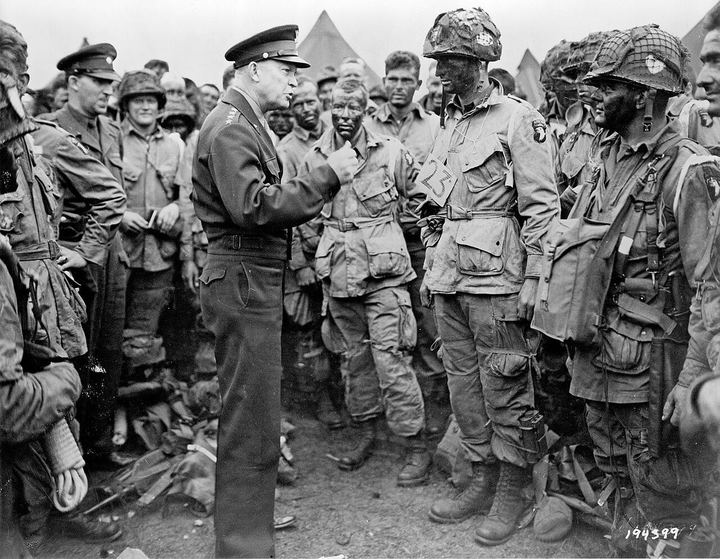
Operation Overlord, the Allied invasion of northwest France, was planned through 1943 and 1944 under Eisenhower's command at Supreme Headquarters, Allied Expeditionary Force (SHAEF). The assault was set for 5 June 1944, postponed a day because of storms, and launched on 6 June after the meteorologist James Stagg forecast a brief break in the weather. Airborne divisions dropped during the night, and American, British, and Canadian forces landed on five beaches in Normandy, supported by a great fleet and air armada. On the evening of 5 June Eisenhower visited men of the 101st Airborne Division at Greenham Common before their departure.
Composition
Eisenhower prepared the order in the months before the invasion and revised it in draft; drafts survive at the Eisenhower Presidential Library. It was printed as a one-page message from Supreme Headquarters with the General's signature and distributed to the assault troops, and he recorded a spoken version for radio. The stored text is the National Archives transcription.
Reception
The order became one of the best-known documents of the Second World War and is displayed and reproduced by the National Archives and the Eisenhower Library. Many veterans kept their printed copies. Its phrase the Great Crusade gave the title to Eisenhower's memoir Crusade in Europe, and the note he had written on 5 June taking responsibility in case of failure, misdated July 5 and preserved by his naval aide Harry Butcher, now held at the Eisenhower Library, has added to its reputation as a model of command.
Comparisons
- st-crispins-day-speech
Shakespeare's Henry and Eisenhower both speak to men about to fight against heavy odds on the coast of France and close by committing the outcome to God.
- elizabeth-speech-at-tilbury
Elizabeth in 1588 and Eisenhower in 1944 address armies facing a cross-Channel threat, one awaiting invasion and the other launching one, and both put their trust in the troops and in God.
- we-shall-fight-on-the-beaches
Churchill's 1940 speech vowed resistance on the beaches after Dunkirk; Eisenhower's order four years later sends Allied armies back across those waters and recalls the Nazi triumphs of 1940-41 to show how far the tide has turned.
- pearl-harbor-address
Roosevelt's 1941 address took the United States into the war with a promise of absolute victory; Eisenhower's order announces the campaign that would carry that promise into western Europe.
Quotes
Frequently cited
“You are about to embark upon the Great Crusade, toward which we have striven these many months.”
Frequently cited
“The eyes of the world are upon you. The hope and prayers of liberty-loving people everywhere march with you.”
Frequently cited
“And let us beseech the blessing of Almighty God upon this great and noble undertaking.”
“Your task will not be an easy one. Your enemy is well trained, well equipped and battle-hardened. He will fight savagely.”
“The tide has turned! The free men of the world are marching together to Victory!”
“I have full confidence in your courage, devotion to duty and skill in battle.”
For Students
A reading companion for classical Christian high school students. See the student guide.
Reading Guide
Watch for
- The salutation to soldiers, sailors, and airmen together, which makes the invasion one effort of all services and all Allied nations.
- The three aims in the first paragraph, moving from destroying an army to freeing peoples to securing a free world.
- The blunt second paragraph about the enemy, set between the high language of the first and the confident third.
- The contrast in the third paragraph between the Nazi triumphs of 1940-41 and the year 1944.
- The single first-person sentence of confidence and the closing turn from good luck to prayer.
Key terms and names
- Allied Expeditionary Force
- The combined American, British, Canadian, and other Allied land, sea, and air forces under Eisenhower's command for the invasion of northwest Europe.
- SHAEF
- Supreme Headquarters, Allied Expeditionary Force, whose name heads the printed order.
- Great Crusade
- Eisenhower's name for the invasion, presenting it as a war for the liberation of Europe rather than merely a military operation.
- United Nations
- In 1944 the name for the wartime alliance formed by the Declaration by United Nations of January 1942, before the postwar organization of the same name.
- Home Fronts
- The civilian populations and industries of the Allied nations, whose production Eisenhower credits with giving the armies their superiority in weapons.
- Nazi triumphs of 1940-41
- Germany's conquest of France, the Low Countries, Norway, the Balkans, and its early advances in Russia, recalled to show how much had changed by 1944.
Seminar Questions
- Comprehension What three aims does Eisenhower give for the invasion in the first paragraph?
- Comprehension What evidence does he offer in the third paragraph that the tide has turned?
- Interpretation Why does Eisenhower include a paragraph warning that the enemy will fight savagely?
- Interpretation What does the phrase the eyes of the world are upon you ask the soldiers to feel, and why might it steady them?
- Interpretation Why does the order end with both good luck and a prayer, and how do the two differ?
- Big Question What makes a war just, and does Eisenhower's description of the invasion's aims meet that standard?
Faith Connections
- Psalm 20:7 (Scripture)
Some trust in chariots and some in horses, but we will remember the name of the LORD our God. Eisenhower lists the Allies' superiority in weapons and men, then ends by asking for God's blessing, holding both trusts together.
- Nehemiah 4:14 (Scripture)
Nehemiah tells the builders of Jerusalem's wall not to fear the enemy but to remember the Lord and fight for their brethren, sons, daughters, wives, and houses, a pattern of courage joined to remembrance of God like the close of the order.
- Augustine, City of God XIX.7 (Church Fathers)
Augustine says the wise man wages just wars but laments the necessity of them. Eisenhower's order speaks of a great and noble undertaking while plainly naming the savage fighting ahead.
Logic and Rhetoric
Central argument: The invasion aims to destroy the German war machine, end Nazi tyranny in Europe, and secure a free world. The enemy is strong, but Allied victories, air power, and home-front production have turned the tide since 1940-41. The men are courageous, devoted, and skilled. Therefore they can expect victory, and they should seek God's blessing on the undertaking.
Rhetorical device: tricolon. The first paragraph names three aims, the destruction of the German war machine, the elimination of Nazi tyranny, and security in a free world, and paragraph 4 names three qualities, courage, devotion to duty, and skill in battle.
Debate: Resolved: that a commander should tell his troops the full danger of the battle they are about to fight.
Memory Work
The eyes of the world are upon you. The hope and prayers of liberty-loving people everywhere march with you.
And let us beseech the blessing of Almighty God upon this great and noble undertaking.
Writing Prompts
Essay: Eisenhower's order moves from purpose to danger to confidence to prayer. Analyze how this order of ideas prepares men to face the landing, and argue which paragraph does the most work.
Comparison with The St Crispin's Day Speech: Compare Eisenhower's Order of the Day with Henry V's speech before Agincourt. How does each leader prepare men for battle in France against a strong enemy, and how does each speak of honour, comradeship, and God?
Creative Prompts
- Classroom
Give each student a copy of the order as a soldier in a landing craft would have held it, and ask them to mark the one sentence they think would matter most at 5 a.m. off Omaha Beach and explain why.
- Essay
Read the order beside the short note Eisenhower drafted in case the landings failed, and write an essay on what the two documents together show about his idea of command.
- Fiction
Write a letter home from a paratrooper of the 101st Airborne on the night of 5 June 1944, describing receiving the printed order and the general's visit to the airfield.
Further Reading
- Crusade in Europe, Dwight D. Eisenhower
- D-Day, June 6, 1944: The Climactic Battle of World War II, Stephen E. Ambrose
- The Guns at Last Light: The War in Western Europe, 1944-1945, Rick Atkinson
- Overlord: D-Day and the Battle for Normandy, Max Hastings
Verification notes
The stored text is the National Archives transcription of the printed order. The recorded radio version differs slightly in wording from the printed text. The order is dated June 1944 on its face and is generally called the D-Day order; it was distributed on 5 June before the landings of 6 June. Paragraph numbers count from the first paragraph after the salutation. All quotes are found verbatim in the stored text.
No verification flags recorded.