Work record
Ivanhoe
1819 (dated 1820) · 19th Century · Novel · English
Abstract
Background. After a run of Scottish novels beginning with Waverley, Scott turned to medieval England, writing much of this book during illness in 1819. It appeared anonymously from Constable of Edinburgh.
Plot. Returning from Palestine as a palmer, the disowned Ivanhoe wins the lists at Ashby in disguise and is badly hurt. Isaac's daughter nurses him as Norman lords abduct the Saxon travellers to Torquilstone, which outlaws under Locksley and an unknown black-armored champion then storm and burn. Carried off to a Templar house, Rebecca faces a sorcery charge and demands a champion; the convalescent Ivanhoe answers, and her accuser Bois-Guilbert collapses lifeless in the lists. Richard, now unmasked, reclaims his throne, Ivanhoe weds Rowena, and Rebecca departs for Moorish Spain.
Structure. Three set pieces anchor the book: the Ashby tournament, the siege of Torquilstone and the Templestowe ordeal. Each chapter opens with a verse epigraph, the first taken from Pope's translation of the Odyssey.
Themes. Conquest and reconciliation between Saxon and Norman, the worth and abuse of chivalry, constancy in faith, and the treatment of England's Jews.
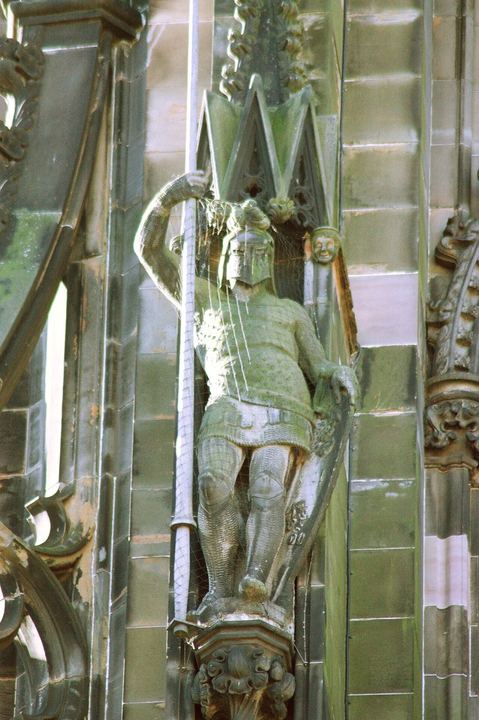
Significance. Its pageantry of knights and outlaws shaped the nineteenth century's image of the Middle Ages and fed the Gothic Revival in art and architecture. Rebecca, wiser and braver than the hero, became one of the most admired heroines of the age, and Scott defended her unrewarded fate in his 1830 introduction.
Main characters
- Wilfred of Ivanhoe: Disowned crusader son of Cedric, loyal to Richard
- Rebecca: Jewish healer and Isaac's daughter, tried as a witch
- Rowena: Saxon heiress of Alfred's line, beloved of Ivanhoe
- Cedric: Saxon thane dreaming of a restored Saxon kingdom
- Isaac of York: Persecuted moneylender, timid but devoted father
- Brian de Bois-Guilbert: Templar consumed by desire for Rebecca
- Richard I: The king, disguised as the Black Knight
- Locksley: Archer and outlaw chief, revealed as Robin Hood
- Wamba and Gurth: Cedric's jester and swineherd, faithful thralls
- Prince John: Usurping regent and patron of the Norman barons

Summary
Ivanhoe is set in England in 1194, when King Richard the Lion-Hearted is making his way home in secret after captivity in Austria and his brother Prince John is scheming to take the crown. More than a century after the Norman Conquest, Saxons and Normans are still bitterly divided. Cedric the Saxon, of Rotherwood, has disinherited his son Wilfred of Ivanhoe for loving his ward, the Lady Rowena, and for following Richard on crusade; Cedric hopes to marry Rowena to Athelstane of Coningsburgh, heir of the old Saxon kings, and so restore Saxon rule. The novel opens with the swineherd Gurth and the jester Wamba in the forest, then a stormy night at Rotherwood where the Templar Brian de Bois-Guilbert, Prior Aymer, a disguised Palmer who is Ivanhoe himself, and the moneylender Isaac of York all take shelter; the Palmer saves Isaac from the Templar's servants. At Prince John's tournament at Ashby-de-la-Zouch a mysterious knight calling himself Desdichado, the Disinherited, overthrows every challenger, including Bois-Guilbert, and names Rowena Queen of Love and Beauty. On the second day a silent Black Knight saves him from defeat, and when he is unhelmed as Ivanhoe he falls wounded. The yeoman Locksley wins the archery contest. Isaac's daughter Rebecca, taught medicine by an old woman named Miriam, takes the wounded knight into her care. On the road the Saxons, Isaac and Rebecca are seized by the Norman knights Maurice de Bracy and Bois-Guilbert and carried to Reginald Front-de-Bœuf's castle of Torquilstone. There De Bracy courts Rowena, Front-de-Bœuf threatens Isaac with torture, and Bois-Guilbert presses his passion on Rebecca, who threatens to throw herself from the battlements rather than yield. Wamba changes clothes with Cedric so that his master can escape. The Black Knight, Locksley's outlaws and the hermit Friar Tuck storm the castle; Ulrica, an old Saxon woman long held there, sets it on fire, and Front-de-Bœuf dies in the flames. Bois-Guilbert carries Rebecca to the Templar preceptory of Templestowe, where the Grand Master, Lucas de Beaumanoir, tries her as a sorceress, partly on the evidence of her cures, and she claims trial by combat. The Black Knight reveals himself as King Richard and Locksley as Robin Hood, and Athelstane, thought dead, reappears at his own funeral feast and yields his claim to Rowena. Ivanhoe, barely healed, rides to Templestowe as Rebecca's champion; Bois-Guilbert falls at the first encounter and dies untouched, killed by his own warring passions. Ivanhoe marries Rowena, and Rebecca, after a last visit to the bride, leaves England with her father for Granada, resolved to spend her life tending the sick. Published in Edinburgh in December 1819 with 1820 on the title page, the novel was an immediate success.
Virtues in this work
- Fortitude: Rebecca stands on the battlement ready to die rather than yield to Bois-Guilbert in Chapter XXIV.
- Charity: Rebecca nurses the wounded Ivanhoe though his people despise hers, and leaves England to serve the sick.
- Friendship: Wamba exchanges clothes with Cedric at Torquilstone, risking his life so his master can escape.
- Justice: Ivanhoe rides out still weak from his wound to defend an innocent woman at Templestowe.
- Piety: Rebecca prays and sings the hymn of the Exodus while awaiting judgment, and refuses to abandon the faith of her fathers.
Plot or Argument
- Chapters I-VI: Rotherwood
Gurth and Wamba talk of Saxon and Norman words in the forest. Cedric receives the Templar, Prior Aymer, the Palmer and Isaac of York; the Palmer warns Isaac of the Templar's plan to rob him and guides him away at dawn.
- Chapters VII-XIII: The tournament at Ashby
The Disinherited Knight defeats the Norman challengers and crowns Rowena; in the general melee the Black Knight rescues him, and he is revealed as Ivanhoe and swoons from his wound. Locksley splits the willow wand at the archery contest, and Prince John learns that Richard is free.
- Chapters XIV-XIX: Forest and ambush
Prince John's banquet sours; Isaac and Rebecca take the wounded Ivanhoe in their litter. The Black Knight feasts and trades songs with the Clerk of Copmanhurst, Friar Tuck, while De Bracy and Bois-Guilbert capture Cedric's party in the woods.
- Chapters XX-XXXI: The siege of Torquilstone
Front-de-Bœuf threatens Isaac in his dungeon, De Bracy woos Rowena, and Bois-Guilbert tempts Rebecca, who stands at the edge of the battlement. Rebecca tends Ivanhoe and describes the siege to him from the window. Wamba frees Cedric; the outlaws and the Black Knight take the castle, Ulrica fires it and Front-de-Bœuf dies.
- Chapters XXXII-XXXIV: Outlaws and ransoms
Locksley divides the spoil of Torquilstone, and Friar Tuck brings in Prior Aymer and Isaac to be ransomed against each other. At York, Prince John's party learns that De Bracy and the Templar have failed.
- Chapters XXXV-XXXIX: The trial of Rebecca
Isaac seeks his daughter at Templestowe, where Lucas de Beaumanoir tries Rebecca for sorcery on testimony about her cures and the Templar's infatuation. She claims trial by combat, and Bois-Guilbert, named champion against her, begs her in vain to flee with him.
- Chapters XL-XLII: The king revealed
The Black Knight survives Waldemar Fitzurse's ambush with the help of Wamba's horn and Locksley's men, reveals himself as Richard, and learns that Locksley is Robin Hood. Athelstane returns alive to his own funeral feast at Coningsburgh and renounces Rowena.
- Chapters XLIII-XLIV: Judgment and parting
Ivanhoe arrives as Rebecca's champion and Bois-Guilbert dies in the lists without a wound. Richard orders the Grand Master to dissolve his chapter, Ivanhoe marries Rowena, and Rebecca bids Rowena farewell before leaving England.
Characters
- Wilfred of Ivanhoe, disinherited Saxon knight
Crusader and follower of King Richard, who fights in disguise, lies wounded through much of the story, and rises to defend Rebecca.
- Rebecca, daughter of Isaac of York
A learned, devout and courageous Jewish healer who nurses Ivanhoe, resists the Templar, and is tried as a sorceress.
- The Lady Rowena, Cedric's ward
A Saxon lady of royal descent who loves Ivanhoe and is courted by force by De Bracy.
- Cedric the Saxon, thane of Rotherwood
Ivanhoe's proud father, devoted to the restoration of Saxon rule.
- Isaac of York, Jewish moneylender
A fearful, persecuted father whose love for Rebecca outweighs even his wealth.
- Brian de Bois-Guilbert, Knight Templar
A brave, ambitious and passionate warrior whose obsession with Rebecca destroys him.
- The Black Knight, King Richard I in disguise
The Lion-Hearted king, called Le Noir Faineant, who fights incognito beside the outlaws.
- Locksley, yeoman and outlaw
The champion archer, revealed as Robin Hood, who leads the siege of Torquilstone.
- Friar Tuck, the Clerk of Copmanhurst
A jovial hermit who feasts with the Black Knight and fights with the outlaws.
- Wamba, Cedric's jester
A witty fool whose loyalty leads him to take his master's place in captivity.
- Gurth, swineherd
Cedric's thrall, who serves Ivanhoe as squire and is given his freedom.
- Prince John, Richard's brother
A shallow, scheming regent who hopes his brother will never return.
- Reginald Front-de-Bœuf, Norman baron
The brutal lord of Torquilstone, who dies in his burning castle.
- Athelstane, Saxon noble of Coningsburgh
Heir of the old Saxon line, sluggish and fond of feasting, whom Cedric intends for Rowena.
- Lucas de Beaumanoir, Grand Master of the Templars
A stern ascetic who sincerely believes Rebecca a witch and presides over her trial.
Lessons
Two kinds of courage
Ivanhoe's courage is the knight's courage of the lance and the lists. Rebecca's is that of the threatened woman on the battlement and the prisoner before the Grand Master, who refuses to save herself by sin or apostasy. Scott sets them side by side in Chapter XXIX, where she questions the worth of the glory he praises.
- What does Rebecca say remains of a knight's glory after death?
- How does Ivanhoe defend chivalry, and is his answer convincing?
- Which character in the book shows the greatest courage?
Faithfulness under pressure
Rebecca refuses the Templar's offer of safety and power if she will give herself to him and abandon her faith, and at the end refuses Rowena's kind offer of a home if she will convert. Scott honors her constancy as integrity, not obstinacy.
- Why does Rebecca refuse to flee with Bois-Guilbert before the combat?
- Why does she decline Rowena's offer in Chapter XLIV?
- What does her constancy cost her?
Healing the enemy
Rebecca tends Ivanhoe though he is a Christian and his people despise hers, and she leaves England to give her life to the sick and the hungry. Her skill is turned against her as evidence of witchcraft. The novel honors mercy given across hatred and shows how fear can twist good works into accusations.
- Why does Rebecca care for a stranger whose people mistreat hers?
- How does the trial use her medicine as evidence against her?
- What does her final vocation show about her character?
One people out of two
Wamba's joke about swine and pork shows Saxon laborers and Norman masters divided even by their words. By the end Richard rules with Saxon and Norman support, Gurth is freed, and Ivanhoe's marriage joins the old line to the new court. Scott presents England's unity as something won by justice and loyalty, not by conquest alone.
- What does Wamba's joke about animal names show about Saxon and Norman life?
- Why does Cedric's dream of a Saxon restoration fail?
- What makes Richard the right king in the novel's eyes?
Context
The novel's background is real: Richard I was captured in Austria on his way back from the Third Crusade in 1192, held by the Emperor Henry VI, and released in early 1194, while his brother John intrigued to replace him. The Knights Templar were a powerful military order of the crusades, suppressed in 1312. Scott freely compressed history: Saxon and Norman hostility was much less sharp by the 1190s than he shows it, and Robin Hood belongs to ballad and legend, not to any record of Richard's reign.
Composition
Scott wrote Ivanhoe in 1819 while recovering from a severe illness, dictating parts of it. It was published in three volumes in Edinburgh by Archibald Constable in December 1819, with 1820 on the title page, as by the Author of Waverley and with a mock dedicatory epistle from Laurence Templeton to the antiquary Dr. Jonas Dryasdust. Scott added an introduction for the collected edition of 1830, included in the library text, in which he discusses his sources and the reactions to Rebecca's fate.
Reception
Ivanhoe was enormously popular across Europe and America and did much to create the nineteenth-century romance of the Middle Ages, influencing the Gothic Revival, painting, opera and tournament revivals. Readers from the beginning wished that Ivanhoe had married Rebecca, and Scott replied in the 1830 introduction that her virtue was nobler for going unrewarded in this world. The book long remained a staple of school reading in Britain and the United States.
Comparisons
- the-merchant-of-venice
Both works pair a Jewish moneylender with a daughter, but where Jessica leaves Shylock and her faith, Rebecca stays loyal to both Isaac and the faith of her fathers.
- the-merry-adventures-of-robin-hood
Pyle's Robin Hood and Scott's Locksley share the outlaw band, Friar Tuck and loyalty to the true king against Prince John.
- le-morte-darthur
Malory's knights live by the code Ivanhoe defends in Chapter XXIX; Scott sets that ideal beside the cruelty of Norman barons and the questions Rebecca puts to it.
- the-black-arrow
Stevenson's tale of the Wars of the Roses follows Scott's model of a medieval romance built on real political conflict and an outlaw fellowship in the forest.
- the-last-of-the-mohicans
Cooper, often called the American Scott, likewise sets a romance amid peoples in conflict, with captives, rescues and a doomed love across a cultural divide.
Quotes
Frequently cited
“when the brute lives, and is in the charge of a Saxon slave, she goes by her Saxon name; but becomes a Norman, and is called pork, when she is carried to the Castle-hall to feast among the nobles”
Frequently cited
“Chivalry!—why, maiden, she is the nurse of pure and high affection—the stay of the oppressed, the redresser of grievances, the curb of the power of the tyrant”
Frequently cited
“When Israel, of the Lord beloved, Out of the land of bondage came, Her father’s God before her moved, An awful guide, in smoke and flame.”
Frequently cited
“Unscathed by the lance of his enemy, he had died a victim to the violence of his own contending passions.”
“Remain where thou art, proud Templar, or at thy choice advance!”
“I will not cast away the gift of God, while he affords me the means of defending it.”
“tending the sick, feeding the hungry, and relieving the distressed”
“May He, who made both Jew and Christian, shower down on you his choicest blessings!”
For Students
A reading companion for classical Christian high school students. See the student guide.
Reading Guide
Watch for
- Wamba's joke about Saxon and Norman names for animals in Chapter I, and how it frames the whole novel.
- How long Ivanhoe himself is absent, disguised or wounded, and who acts in his place.
- Rebecca's description of the siege from the window in Chapter XXIX and her argument with Ivanhoe about glory.
- The trial at Templestowe and how the Grand Master's sincere zeal differs from the Templar's ambition.
- Rebecca's farewell to Rowena in Chapter XLIV and the novel's last paragraph about Ivanhoe's memory of her.
Key terms and names
- Desdichado
- A Spanish word meaning Disinherited, written on the shield of the unknown knight who wins the first day at Ashby.
- Knights Templar
- A crusading military order of monks; Bois-Guilbert and the Grand Master Lucas de Beaumanoir belong to it.
- Preceptory
- A house of the Templars; Rebecca is tried and imprisoned at the preceptory of Templestowe.
- Trial by combat
- A medieval judicial custom in which the outcome of a fight between champions was taken as God's verdict.
- Thane
- A Saxon lord holding land; Cedric of Rotherwood is a proud thane who resents Norman rule.
- Palmer
- A pilgrim returned from the Holy Land, carrying a palm branch; Ivanhoe comes home disguised as one.
- Le Noir Faineant
- French for the Black Sluggard, the name the crowd gives the idle-seeming Black Knight, who is King Richard.
Seminar Questions
- Comprehension Why has Cedric disinherited his son, and what does he hope to achieve through Rowena's marriage?
- Comprehension How do the captives escape or survive at Torquilstone, and what part do Wamba and Ulrica play?
- Comprehension On what grounds is Rebecca accused at Templestowe, and how does she answer?
- Interpretation Why does Scott make Bois-Guilbert die without being wounded? What judgment does the novel pass on him?
- Interpretation Who wins the argument about chivalry in Chapter XXIX, Rebecca or Ivanhoe?
- Interpretation Why does Ivanhoe marry Rowena and not Rebecca, and why might Scott have refused to change that ending?
- Big Question Can a code of honor be truly good if men like Front-de-Bœuf and Bois-Guilbert live under it?
Faith Connections
- Exodus 13:21-22 (Scripture)
The Lord went before Israel in a pillar of cloud by day and of fire by night. Rebecca's hymn in Chapter XXXIX recalls this guidance as she awaits judgment in a hostile land.
- Matthew 25:35-36 (Scripture)
Christ names feeding the hungry and visiting the sick as service done to him. Rebecca, who is not a Christian, lives out these works more faithfully than the knights and churchmen around her.
- Leviticus 19:33-34 (Scripture)
Israel is commanded to love the stranger. The novel shows a Christian England failing that duty toward Isaac and Rebecca while Rebecca shows it toward Ivanhoe.
- Bernard of Clairvaux, In Praise of the New Knighthood (Church Fathers)
Bernard wrote this treatise in the 1130s for the Templars, calling them to poverty, discipline and holy war. The Grand Master's severe ideals echo it, while Bois-Guilbert has betrayed it.
Logic and Rhetoric
Central argument: England is torn by conquest, greed and pride, and the knightly code is too often a cover for violence. True nobility appears where loyalty, mercy and faithfulness are kept at a cost, in a jester, a swineherd, a wounded knight and a persecuted Jewish woman. Therefore the novel argues that a nation is made whole by justice and loyalty to a rightful king, and that the noblest virtue may go unrewarded on earth.
Rhetorical device: personification. In Chapter XXIX Ivanhoe makes Chivalry a woman, the nurse of affection and the curb of the tyrant, to answer Rebecca's attack on martial glory.
Debate: Resolved: that Rebecca, not Ivanhoe, is the hero of Ivanhoe.
Memory Work
When Israel, of the Lord beloved, Out of the land of bondage came, Her father’s God before her moved, An awful guide, in smoke and flame.
I will not cast away the gift of God, while he affords me the means of defending it.
Writing Prompts
Essay: Scott's title hero spends much of the novel wounded or disguised. Argue what the book gains by placing its moral center in Rebecca, Wamba and the Black Knight.
Comparison with The Merchant of Venice: Compare Isaac and Rebecca with Shylock and Jessica. Argue what each work suggests about faith, family and the treatment of Jews by a Christian society.
Medical Lens
Rebecca is one of the best-known healers in English fiction. Scott explains in Chapter XXVIII that medieval Christians often sought out Jewish physicians while suspecting them of occult knowledge, and that Rebecca learned the healing art from Miriam, a celebrated doctor's daughter who was herself put to death in the fanaticism of the age. Rebecca dresses Ivanhoe's tournament wound with Miriam's balsam and sends him a draught Scott calls sedative and narcotic, and he wakes free of feverish symptoms; at Templestowe her cures, including the treatment of a Saxon peasant for palsy, become evidence in her trial for sorcery. The novel thus touches the history of medicine in its picture of Jewish medical learning, of the healer under suspicion, and of the ethic of treating an enemy. Front-de-Bœuf's wounded deathbed, the threat of the iron bars over glowing charcoal for Isaac, and Bois-Guilbert's death in the lists without a wound, which Scott attributes to his contending passions, complete the medical picture; the last is a romantic convention, not a diagnosis.
- Chapter XXVIII
Scott's account of Jewish physicians in medieval England, Rebecca's training under Miriam, her balsam for Ivanhoe's wound and her sedative draught.
- Chapter XXII
Front-de-Bœuf shows Isaac the iron bars over glowing charcoal in his dungeon to extort a ransom.
- Chapter XXX
The wounded Front-de-Bœuf lies dying in remorse while Ulrica taunts him and sets his castle ablaze.
- Chapter XXXVII
At Rebecca's trial a Saxon peasant she treated for palsy is dragged forward, and her cures and balms are offered as proof of witchcraft.
- Chapter XLIII
Bois-Guilbert falls in the lists and dies with no wound, flushed and then pallid, victim of his own passions.
Listen to the book
Public-domain audiobook from LibriVox, read by Various volunteers. Recording: Ivanhoe on LibriVox (Internet Archive).
LibriVox recordings are volunteer readings released into the public domain. The reading may follow a different edition from the text in this library.
Creative Prompts
- Classroom
Hold a mock trial of Rebecca at Templestowe, with one team presenting the Grand Master's evidence and another answering it from the text.
- Essay
Is Rebecca or Ivanhoe the true hero of the novel? Argue from Chapters XXIX, XXXVII and XLIV.
- Dialogue
Write the conversation between Ivanhoe and Rowena after she tells him of Rebecca's farewell.
- Fiction
Retell the siege of Torquilstone from Wamba's point of view.
Further Reading
- Waverley, Walter Scott
Scott's first novel, on the Jacobite rising of 1745.
- The Talisman, Walter Scott
Richard the Lion-Hearted on crusade, with a Templar villain.
- The Life of Sir Walter Scott, J. G. Lockhart
- The Historical Novel, Georg Lukács
Verification notes
Plot, publication details and the history of Richard's captivity are standard. Chapter locators follow the attached Gutenberg text, which includes Scott's 1830 introduction with his remark that virtue is degraded by an attempt to reward it with temporal prosperity. The palsied peasant at the trial (Chapter XXXVII), the sedative draught (Chapter XXVIII) and Richard's order to dissolve the chapter (Chapter XLIV) were checked in the text. Quotes were checked against the attached text.
No verification flags recorded.