Work record
In Flanders Fields
1915 · Early 20th Century · Poetry · English
Abstract
Background. A Canadian medical officer and McGill pathologist, McCrae composed the lines while running an artillery brigade's aid post on the Yser canal bank, shortly after reading the burial service for Alexis Helmer, a young officer killed by shellfire. Punch printed the piece without his name late that year.
Content. Red flowers bloom in the soil between rows of grave markers while birds rise singing above the artillery. Only then does the voice identify itself as belonging to the fallen, who remember mornings, evenings and affection that ended mere days earlier. The final stanza becomes a summons: those still alive must continue the fight, grasp the flame passed to them, and keep their pledge, or the buried will find no rest.
Form. McCrae adapts a medieval French pattern, restricting himself to two rhyme sounds and returning the opening three words as a truncated refrain.
Themes. Obligation owed to the fallen, the brevity of life, nature's persistence in a ruined landscape, and fidelity. Restraint governs the whole: no wound, gas cloud or hospital appears, though its author spent those weeks treating the injured within sight of the graves.
Significance. Among the best-known English verses of the First World War, it helped make the poppy the Allied emblem of remembrance and is recited annually at Commonwealth ceremonies each November 11.
Main characters
- The Dead: Fallen soldiers who speak the poem from their graves
- The living: Surviving comrades charged to carry on the struggle

Summary
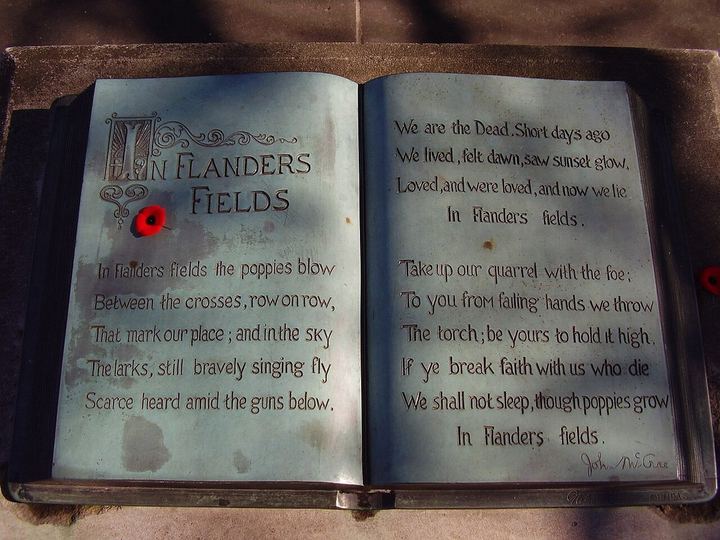
In Flanders Fields is a fifteen-line poem written in early May 1915 by John McCrae, a Canadian army doctor, during the Second Battle of Ypres in Belgium, the battle in which German forces first used chlorine gas on the Western Front. By the traditional account, McCrae wrote it the day after burying his friend and former student Lieutenant Alexis Helmer, killed by a shell on 2 May, in a small cemetery near his dressing station beside the Yser canal, where wild poppies were blooming among the graves. The poem was published anonymously in the London magazine Punch on 8 December 1915 and quickly became the most quoted English poem of the war. It is spoken by the dead themselves. The first stanza sets the scene: poppies grow between the rows of crosses that mark their place, and larks still sing overhead, barely heard above the guns. In the second the dead introduce themselves with the stark words We are the Dead, and in a few plain verbs recall that only days ago they lived, saw dawn and sunset, loved and were loved. In the third they turn to the living with a charge: take up our quarrel with the foe, and hold high the torch thrown from their failing hands. If the living break faith, the dead will not sleep, though poppies grow. The form is a rondeau, an old French pattern with only two rhyme sounds and a short refrain drawn from the opening words, here In Flanders fields, which returns at the end of the second and third stanzas. The poem was used in Allied recruiting and war-bond appeals, and it gave the remembrance poppy its meaning: Moina Michael in the United States answered it with a poem of her own and campaigned for the poppy as a memorial emblem, which spread through the Allied nations after the war. McCrae died of illness in France in January 1918 and was buried at Wimereux. The poem is read every year on Remembrance Day in Canada and across the Commonwealth.
Virtues in this work
- Fortitude: The dead ask the living to take the torch from their failing hands and hold it high in the face of the foe.
- Justice: The poem treats keeping faith with those who died as a debt the living owe them.
- Honor: To break faith with the dead would be a betrayal of the trust they placed in their comrades.
- Charity: The dead remember first that they loved and were loved, setting love at the centre of the lives they gave.
Plot or Argument
- Lines 1-5: The field of graves
Poppies grow between rows of crosses in Flanders, and larks still sing bravely overhead, scarcely heard over the guns below.
- Lines 6-9: The dead speak
The speakers reveal themselves as the Dead, who a few days ago lived, saw dawn and sunset, loved and were loved, and now lie in Flanders fields.
- Lines 10-15: The charge to the living
The dead pass the torch from failing hands, call on the living to take up their quarrel, and warn that if faith is broken they will not sleep beneath the poppies.
Characters
- The Dead, collective speakers
Soldiers buried in Flanders who recall their lives and address the living.
- The living, those addressed
The comrades and nations to whom the dead throw the torch.
Lessons
The dead are owed fidelity
The third stanza turns remembrance into obligation: the living are asked not only to grieve but to keep faith with those who died. McCrae's poem treats a promise to the dead as binding, a conviction that shaped how the war was remembered and fought.
- What exactly do the dead ask of the living in lines 10-12?
- What would it mean to break faith with them?
- Do we have obligations to people who have died?
Ordinary lives behind the crosses
In four short lines the dead name what they have lost: dawn, sunset, love given and received. By listing simple goods instead of heroic deeds, McCrae makes each cross stand for a whole human life.
- Why does McCrae choose such ordinary experiences for the dead to remember?
- How does the short line In Flanders fields. at line 9 affect the stanza?
- How do small details make large numbers of deaths imaginable?
Nature continuing amid war
Poppies grow and larks sing in a landscape of graves and guns. The poem neither sentimentalizes nature nor denies war; it sets them side by side, and the poppy that grows over the dead became the emblem by which they are remembered.
- Why are the larks described as singing bravely?
- What does the poppy mean at the start of the poem and at the end?
- Why did the poppy, rather than the cross or the torch, become the symbol of remembrance?
Context
The Second Battle of Ypres (April-May 1915) was the first major action of the Canadian Division on the Western Front, and the battle in which chlorine gas was first used there. Canadian losses were heavy. McCrae, a physician serving as brigade surgeon with the artillery, worked for over two weeks in a dugout dressing station on the bank of the Yser canal, treating the wounded under constant shellfire.
Composition
The traditional account, drawn from fellow officers' recollections, holds that McCrae wrote the poem on or about 3 May 1915, after conducting the burial of Lieutenant Alexis Helmer. Accounts of the exact circumstances differ in details. After The Spectator declined it, Punch printed it anonymously on 8 December 1915. It was collected in In Flanders Fields and Other Poems (1919), published after McCrae's death with an essay by his friend Sir Andrew Macphail; printings differ in a few words, and the stored text follows the 1919 book.
Reception
The poem was reprinted throughout the Allied world, used in recruiting and Victory Loan campaigns, and answered by other poets. Moina Michael's response, We Shall Keep the Faith (1918), and her campaign for the memorial poppy, taken up by veterans' organizations in the following years, made the red poppy the emblem of remembrance. The poem remains central to Remembrance Day ceremonies in Canada, and some later critics, notably Paul Fussell in The Great War and Modern Memory, contrasted its third stanza with the quieter tone of its opening.
Comparisons
- pericles-funeral-oration
Pericles tells Athenian survivors to take the fallen as their model and never decline the dangers of war; McCrae puts the same charge in the mouths of the dead themselves.
- gettysburg-address
Lincoln resolves that the dead shall not have died in vain; McCrae's dead demand that the living not break faith, a closely related idea of unfinished work.
- o-captain-my-captain
Both short rhymed war elegies use a returning refrain; Whitman's living sailor speaks to the dead, while McCrae's dead speak to the living.
- testament-of-youth
Vera Brittain, a nurse in France during the same war, records in prose the loss of her fiancé, brother and friends, the private grief behind the rows of crosses.
Quotes
Frequently cited
“In Flanders fields the poppies grow Between the crosses, row on row”
Frequently cited
“We are the Dead. Short days ago We lived, felt dawn, saw sunset glow, Loved, and were loved, and now we lie In Flanders fields.”
Frequently cited
“If ye break faith with us who die We shall not sleep, though poppies grow In Flanders fields.”
“Take up our quarrel with the foe: To you from failing hands we throw The Torch: be yours to hold it high!”
For Students
A reading companion for classical Christian high school students. See the student guide.
Reading Guide
Watch for
- The contrast in lines 3-5 between larks singing in the sky and the guns below.
- The sudden revelation of the speakers in line 6, We are the Dead, after a first stanza that could be spoken by anyone.
- The plain verbs of line 7-8 (lived, felt, saw, loved) that summarize a whole life.
- The image of the torch thrown from failing hands in lines 11-12, borrowed from relay races.
- How the refrain In Flanders fields returns in lines 9 and 15, shortened and set alone.
Key terms and names
- Flanders
- The low, flat region of western Belgium around Ypres where some of the heaviest fighting of the First World War took place.
- Rondeau
- A French verse form of fifteen lines on only two rhymes, with a short refrain taken from the opening words; McCrae's refrain is In Flanders fields.
- Second Battle of Ypres
- The battle of April-May 1915 in which the poem was written, where the Canadian Division fought its first major action and chlorine gas was first used on the Western Front.
- Poppy
- The red wildflower that grows in disturbed soil; through this poem it became the emblem of remembrance for the war dead.
- Dressing station
- A forward medical post where wounded soldiers received first treatment; McCrae ran one on the bank of the Yser canal.
Seminar Questions
- Comprehension Who is speaking in the poem, and at what point do we learn it?
- Comprehension What do the dead ask the living to do in the third stanza?
- Interpretation Why might McCrae delay revealing the speakers until line 6?
- Interpretation What is the torch, and what does it mean to hold it high?
- Interpretation Is the third stanza continuous with the first two, or a change of tone? Defend your answer from the text.
- Interpretation Why will the dead not sleep if faith is broken? What kind of rest are they imagining?
- Big Question What does it mean to keep faith with those who died for a cause, and is the debt paid by continuing their fight, by preserving peace, or by remembering them?
Faith Connections
- John 15:13 (Scripture)
Greater love hath no man than this, that a man lay down his life for his friends: this verse is carved on many First World War memorials and gives a Christian frame to the sacrifice McCrae's dead describe.
- Hebrews 12:1 (Scripture)
The cloud of witnesses who surround those still running the race resembles the dead of Flanders watching the living take up the torch, though Hebrews points the race toward Christ rather than a battle.
- 1 Thessalonians 4:13-14 (Scripture)
Paul speaks of the Christian dead as asleep and tells believers not to grieve as those without hope; McCrae's dead also speak of sleep, but make their rest depend on the faith of the living.
Logic and Rhetoric
Central argument: The dead lived full lives and gave them up in a cause that is not yet finished. The living now hold what the dead let fall. If the living abandon the cause, the sacrifice is betrayed and the dead cannot rest. Therefore the living must take up the quarrel and keep faith.
Rhetorical device: prosopopoeia. The whole poem gives a voice to the buried soldiers, who announce We are the Dead in line 6 and address the living directly in lines 10-15.
Debate: Resolved: that the best way to honour the war dead is to continue the cause for which they died.
Memory Work
We are the Dead. Short days ago We lived, felt dawn, saw sunset glow, Loved, and were loved, and now we lie In Flanders fields.
If ye break faith with us who die We shall not sleep, though poppies grow In Flanders fields.
Writing Prompts
Essay: Analyze how McCrae's choice of the rondeau, with its two rhymes and returning refrain, shapes the meaning of the poem, especially the final return of In Flanders fields.
Comparison with Pericles' Funeral Oration: Pericles speaks for the dead of Athens; McCrae lets the dead of Flanders speak for themselves. Compare what each text asks of the living and how the choice of speaker changes the appeal.
Medical Lens
The poem was written by a working physician at a front-line artillery dressing station during the Second Battle of Ypres, where the wounded included some of the first soldiers poisoned by chlorine gas. McCrae was a trained pathologist and medical teacher, and his letters from the battle describe exhaustion, continuous shelling and the dead buried close by; the poem itself contains no clinical detail, and its restraint is part of its effect. He later served at No. 3 Canadian General Hospital, the McGill unit, in France, and died there of pneumonia complicated by meningitis in January 1918. Some biographers have read the change in his letters after Ypres as a sign of lasting strain; that reading is interpretive, and the poem should not be taken as a clinical record. The work is a useful starting point for the history of military medicine and of physician-poets.
- Lines 1-5
The graves and guns of the field near the dressing station, written in the midst of the battle the poet was treating casualties from.
- Lines 6-9
The dead recall their lives and their sudden end, a few days after living and loving.
Listen to the book
Public-domain audiobook from LibriVox, read by Various volunteers. Recording: In Flanders Fields (version 2) on LibriVox (Internet Archive).
LibriVox recordings are volunteer readings released into the public domain. The reading may follow a different edition from the text in this library.
Creative Prompts
- Classroom
Map the rondeau form on the board: mark the two rhyme sounds (grow/row/below and sky/fly/lie) and the refrain, then discuss why McCrae chose such a strict French form for a battlefield poem.
- Poetry
Write a reply to McCrae's dead in the voice of the living, as Moina Michael did, keeping the rondeau's two rhymes and a refrain.
Further Reading
- In Flanders Fields and Other Poems, John McCrae, with an essay in character by Sir Andrew Macphail
- In Flanders Fields: The Story of John McCrae, John F. Prescott
- The Great War and Modern Memory, Paul Fussell
Verification notes
The date of composition and the link to Alexis Helmer's burial rest on the recollections of McCrae's fellow officers, which differ in details; the poem is dated 3 May 1915, the day after Helmer's death, by Veterans Affairs Canada and most accounts. Printings differ in a few words (notably blow or grow in line 1); quotes follow the stored 1919 text, which reads grow. Line numbers count the stored 15-line text. The stored text's double spaces after some colons and full stops are kept in the quotes. All quotes are found verbatim in the stored text.
No verification flags recorded.