Work record
Pericles' Funeral Oration
delivered 431 BC; recorded by Thucydides c. 431-400 BC · Ancient · Oratory · Ancient Greek
Abstract
Background. Each year of war Athens buried its dead together and appointed an eminent citizen to praise them. At the close of the conflict's opening season the honour fell to Pericles, whose words Thucydides reconstructs while admitting he gives their substance rather than exact wording.
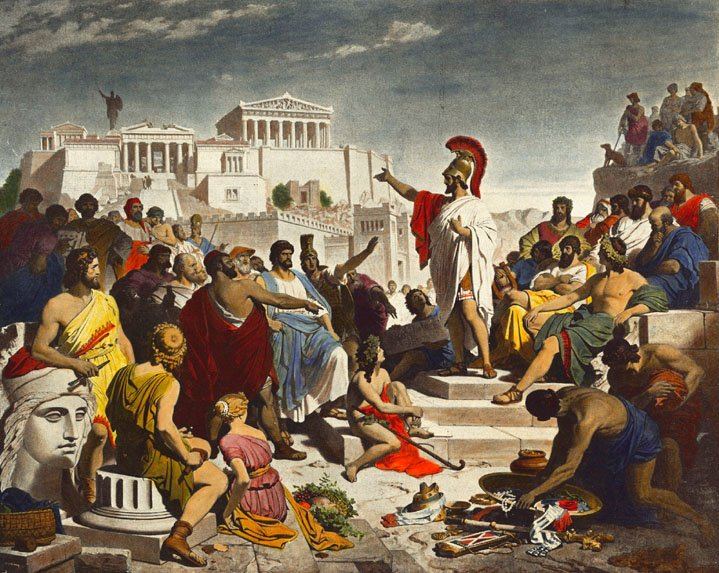
Occasion. After a frame describing the bones, tribal coffins and empty bier, the general mounts a platform to address citizens, foreigners and grieving families.
Content. Most of the address celebrates the polity rather than individual soldiers: rule for the many, advancement by ability, tolerance in private life, open gates to strangers, festivals, generosity and debate preceding decisions. Only then does it turn to the men themselves, who preferred death to surrender, and closes with counsel for mourners and a pledge that orphans will be reared at public cost.
Themes. Civic love grounded in knowledge of the city's excellence, glory as the reward of sacrifice, and duties of the survivors. Pericles also reflects on envy, which tolerates praise of others only so far as listeners believe they could match the deeds described.
Significance. Read as the classic self-portrait of Athenian democracy, the speech gains irony from what Thucydides narrates next, the plague that would soon kill its speaker, and it has shaped later commemorations, Gettysburg among them.
Key figures
- Pericles: Athenian general and statesman chosen to give the eulogy
- Thucydides: Athenian historian who reports the funeral and the speech
- The fallen Athenians: Citizens killed in the war's first campaigns
- The bereaved: Parents, sons, brothers and widows addressed near the end

Summary
Pericles' Funeral Oration is the speech that the Athenian statesman Pericles delivered in the winter of 431/430 BC at the public burial of the citizens who had died in the first year of the Peloponnesian War against Sparta. It survives only in the History of Thucydides, who heard Pericles speak and who says of the speeches in his work that he kept as close as he could to the general sense of what was actually said. Thucydides first describes the ancestral custom (II.34): the bones of the dead lie in a tent for three days, cypress coffins are carried for each of the ten tribes along with an empty bier for the missing, and the dead are buried in the public cemetery outside the city, after which a man chosen by the state speaks. Pericles opens (II.35) by doubting that words can match deeds and noting how hard it is to praise without provoking envy or disbelief. After brief honour to the ancestors and fathers who built the empire (II.36), he devotes most of the speech to praising Athens itself. Its constitution is called a democracy because it favours the many; offices go by merit, not class or wealth; citizens are tolerant in private and law-abiding in public (II.37). The city enjoys festivals and draws goods from the whole world (II.38), keeps its gates open to foreigners and trusts native courage over Spartan drill (II.39), and unites daring with deliberation, believing that discussion prepares for wise action (II.40). Athens, he says, is the school of Hellas (II.41). The fallen proved worthy of such a city, choosing to die resisting rather than live submitting (II.42). The living should gaze on Athens until they love her, for heroes have the whole earth for their tomb (II.43). He then offers comfort to bereaved parents, a hard charge to sons and brothers, and a brief word to widows (II.44-45), and ends with the promise that the city will raise the children of the dead (II.46). Thucydides immediately follows with the plague that devastated Athens the next summer.
Virtues in this work
- Fortitude: The fallen chose to die resisting rather than live submitting, and Pericles calls on survivors never to decline the dangers of war.
- Prudence: Pericles praises the Athenian union of daring with deliberation and the habit of discussion before action.
- Honor: He tells the aged parents that only the love of honour never grows old and that their sons' fame will cheer them.
- Industry: Athenians, he says, find disgrace not in poverty but in declining the struggle against it.
Plot or Argument
- II.34: The ancestral funeral
Thucydides describes the Athenian public burial for the war dead, from the three days of laying out to the procession of tribal coffins and the empty bier, and introduces Pericles as the chosen speaker.
- II.35-36: The difficulty of praise and the ancestors
Pericles questions whether one speech should carry the reputations of many brave men, then honours the forefathers who kept the land free and the fathers who won the empire.
- II.37-41: The praise of Athens
He praises the democratic constitution, equality before the law, tolerance in private life, open gates, native courage, the union of thought and action, generosity to friends, and Athens as the school of Hellas.
- II.42-43: The praise of the fallen
The dead proved worthy of the city by choosing death over submission; the living must love Athens, imitate their courage, and know that heroes have the whole earth for their tomb.
- II.44-46: Consolation and dismissal
He offers comfort to parents, warns sons and brothers that the dead will be hard to equal, counsels widows briefly, announces that the city will raise the orphans, and dismisses the mourners.
Characters
- Pericles, speaker
Son of Xanthippus and leading general of Athens, chosen to deliver the eulogy.
- Thucydides, historian and narrator
Athenian historian who records the funeral and the speech.
- The fallen, those honoured
Athenian citizens killed in the first year of the war.
Key claims
The main steps of the argument, in order, and how they fit together.
- Words can hardly match the deeds of brave men, and praise easily stirs envy or disbelief in listeners.How it is supported: Reflection on how hearers accept praise only of deeds they think they could match.
- The ancestors kept the land free and the fathers won the empire the present generation inherits.How it is supported: Appeal to Athenian history and inherited achievement.
- Athens is a democracy that rules for the many, advances citizens by merit and keeps the law in public life.How it is supported: Description of the Athenian constitution and equality before the law.
- Athenians enjoy tolerance in private life, festivals, open gates to strangers and a union of daring with deliberation.How it is supported: Contrast with Spartan secrecy and drill, and praise of debate before action.
- Athens is the school of all Greece, uniquely excellent in government, freedom, culture and character.How it is supported: Summary of the city's way of life and influence.
- The fallen proved worthy of the city by choosing death over submission, and their sacrifice earns undying fame.How it is supported: Their courage in battle; famous men have the whole earth as their tomb.
- The survivors should love Athens, imitate the dead, and bear grief with the comfort of honour.How it is supported: Counsel to parents, sons, brothers and widows, and the pledge to raise orphans publicly.
Argument map
Supported by
- 5Athens is the school of all Greece, uniquely excellent in government, freedom, culture and character.
which rests on
- 2The ancestors kept the land free and the fathers won the empire the present generation inherits.
- 3Athens is a democracy that rules for the many, advances citizens by merit and keeps the law in public life.
- 4Athenians enjoy tolerance in private life, festivals, open gates to strangers and a union of daring with deliberation.
- 6The fallen proved worthy of the city by choosing death over submission, and their sacrifice earns undying fame.
which rests on
- 1Words can hardly match the deeds of brave men, and praise easily stirs envy or disbelief in listeners.
- 7The survivors should love Athens, imitate the dead, and bear grief with the comfort of honour.
Therefore
Plain-language summaries of the author's argument, not quotations.
Lessons
A city worth dying for
Pericles praises the dead chiefly by praising Athens, arguing that their sacrifice makes sense only if the city they defended is worthy of it. The structure of the speech teaches that civic courage depends on a clear understanding of what one's community is and why it deserves love.
- Why does Pericles spend more time praising Athens than describing the dead?
- What features of Athens does he single out as most worthy of admiration?
- Can a person love a country without first knowing what is good in it?
Discussion as preparation for action
In II.40 Pericles claims that Athenians see debate not as an obstacle to action but as its necessary preliminary, and that they unite daring with deliberation. The claim is a lasting statement of what self-government asks of ordinary citizens.
- Why does Pericles call the man who takes no part in public affairs useless rather than unambitious?
- Is discussion really a preliminary to wise action, or can it delay action too long?
- How should a citizen today prepare to judge public matters?
Praise read in the light of what follows
Thucydides places this confident portrait of Athens immediately before his account of the plague, which killed many citizens and eventually Pericles himself. Readers learn to watch how a historian's arrangement of material can comment on a speech without a word of editorial judgment.
- How does the account of the plague in II.47-54 change the way you read the oration?
- Is Thucydides admiring Pericles, testing him, or both?
- What does the speech promise that the city may not be able to keep?
Context
The Peloponnesian War between Athens and Sparta with their allies began in 431 BC. Pericles' strategy was to bring the Attic countryside's population within the city walls, avoid pitched battle with Sparta's army on land, and rely on Athenian sea power. The first year saw Spartan invasion of Attica and Athenian raids by sea, and its dead were honoured by the customary state funeral in the Kerameikos, the public cemetery outside the walls.
Composition
Thucydides wrote his History during and after the war, which he expected from its start to be the greatest conflict yet. In I.22 he explains that he could not recall speeches word for word and so made speakers say what the occasion demanded, keeping as close as possible to the general sense of what was really said. The oration is therefore Pericles' speech as Thucydides chose to present it. Crawley's translation of 1874 is the stored version.
Reception
The oration has been read for centuries as the classic statement of Athenian democratic ideals. Nineteenth-century British and American readers admired it; Edward Everett, who spoke before Lincoln at Gettysburg in 1863, modelled his oration on the Athenian funeral tradition, and scholars have often compared Lincoln's address with it. Plato's Menexenus offers a playful parody of the genre of the Athenian funeral speech, and modern historians continue to debate how much of the speech is Pericles' and how much Thucydides'.
Comparisons
- gettysburg-address
Both are funeral speeches for war dead that turn into definitions of a political order, Athens as the school of Hellas and America as a nation dedicated to a proposition.
- the-history-of-the-peloponnesian-war
The oration's full force appears only in its setting, between the war's first year and the plague at Athens that Thucydides narrates next.
- friends-romans-countrymen
Two funeral orations with opposite purposes: Pericles uses the dead to bind the city in shared resolve, while Antony uses Caesar's body to break the city into riot.
- in-flanders-fields
Pericles urges survivors to take the fallen as their model and never decline the dangers of war; McCrae's dead make the same demand in their own voices.
Quotes
Frequently cited
“Its administration favours the many instead of the few; this is why it is called a democracy.”
Frequently cited
“In short, I say that as a city we are the school of Hellas”
Frequently cited
“For heroes have the whole earth for their tomb”
“Our constitution does not copy the laws of neighbouring states; we are rather a pattern to others than imitators ourselves.”
“wealth we employ more for use than for show, and place the real disgrace of poverty not in owning to the fact but in declining the struggle against it.”
“instead of looking on discussion as a stumbling-block in the way of action, we think it an indispensable preliminary to any wise action at all.”
“judging happiness to be the fruit of freedom and freedom of valour, never decline the dangers of war.”
“For it is only the love of honour that never grows old; and honour it is, not gain, as some would have it, that rejoices the heart of age and helplessness.”
For Students
A reading companion for classical Christian high school students. See the student guide.
Reading Guide
Watch for
- Pericles' opening doubt in II.35 that words can match deeds, a modest move that wins the audience's trust.
- The decision in II.36 to pass quickly over military history and dwell instead on the form of government and national habits.
- The series of contrasts with Sparta in II.39: open gates against expulsion of foreigners, native courage against painful drill.
- The claim that Athens is the school of Hellas in II.41, which sums up the praise of the city.
- The turn from praise to consolation in II.44, addressed in turn to parents, sons and brothers, and widows.
Key terms and names
- Epitaphios
- The Greek name for the funeral oration delivered by a chosen citizen at the Athenian state burial of the war dead.
- Hellas
- The Greek name for the Greek world as a whole; Pericles calls Athens its school.
- Lacedaemonians
- The Spartans and their territory, Athens' rival, whose rigid military training Pericles contrasts with Athenian freedom in II.39.
- Democracy
- Rule by the people; Pericles defines the Athenian constitution by its favouring the many rather than the few.
- Unwritten law
- The code that, in II.37, cannot be broken without acknowledged disgrace, though it is not on the statute book.
- Peloponnesian War
- The war of 431-404 BC between Athens and Sparta with their allies, whose first-year dead the speech honours.
Seminar Questions
- Comprehension What happens at an Athenian public funeral, according to Thucydides in II.34?
- Comprehension What qualities of Athens does Pericles praise in II.37-41?
- Interpretation Why does Pericles say it is hard to praise the dead without arousing envy or disbelief?
- Interpretation How does the contrast with Sparta in II.39 shape Pericles' picture of Athens?
- Interpretation What does Pericles mean when he tells the living to feed their eyes upon Athens until love of her fills their hearts?
- Interpretation Is the consolation offered to parents in II.44 comforting or demanding?
- Big Question Should love of country be the highest love a citizen has, and what place does it leave for family, friendship, or God?
Faith Connections
- Augustine, City of God V.18 (Church Fathers)
Augustine recalls the Romans who gave up wealth and life for the earthly city's glory and asks Christians whether they will do as much for the heavenly city; his argument converses with Pericles' charge to love Athens.
- Hebrews 11:13-16 (Scripture)
The faithful confess themselves strangers and pilgrims seeking a better country, a heavenly city God has prepared; Pericles asks for devotion to Athens as the highest city.
- Jeremiah 29:7 (Scripture)
God tells the exiles to seek the peace of the city where they live and pray for it, a measured civic loyalty to set beside Pericles' call for wholehearted love of Athens.
Logic and Rhetoric
Central argument: Athens is uniquely excellent in government, freedom, culture and character. The fallen gave their lives to preserve this city and so proved worthy of it. Their sacrifice is the measure of their virtue and earns undying fame. Therefore the survivors should love Athens, imitate the dead, and bear their grief with the comfort of honour.
Rhetorical device: antithesis. Throughout II.37-40 Pericles builds balanced contrasts, as in wealth used for use rather than show, and poverty disgraceful not in admitting it but in declining the struggle against it.
Debate: Resolved: that Pericles' praise of Athens is a sound basis for a citizen's willingness to die for his country.
Memory Work
For heroes have the whole earth for their tomb
instead of looking on discussion as a stumbling-block in the way of action, we think it an indispensable preliminary to any wise action at all.
Writing Prompts
Essay: Pericles praises the dead largely by praising Athens. Analyze how the structure of the oration supports his central claim, and whether the praise of the city is a fair foundation for the praise of the men.
Comparison with The Gettysburg Address: Compare Pericles' oration with Lincoln's Gettysburg Address. How does each speaker define the political community the dead died for, and what does each ask of the living?
Medical Lens
The oration is a public consolation for the bereaved, and II.44 offers an ancient account of grief: loss is felt most for goods long enjoyed rather than goods never known, and Pericles advises younger parents to hope for other children and older ones to take comfort in the fame of the dead. Crawley's 1874 phrase that festivals help to banish the spleen (II.38) uses the older English humoral idiom for low spirits; the Greek speaks more generally of driving away distress. The speech's main importance for the history of medicine is its placement: Thucydides follows it directly with his account of the plague of 430 BC (II.47-54), one of the earliest detailed descriptions of an epidemic, in which Pericles himself later died. The identity of that disease is still debated.
- Book II.34
Thucydides describes the Athenian rites for the war dead: the laying out of the bones, tribal coffins, the empty bier for the missing, and the public burial.
- Book II.44
Pericles consoles the parents of the fallen and reflects on why grief is sharpest for blessings long possessed.
Creative Prompts
- Classroom
Divide the class into groups for the praise of the constitution (II.37), daily life (II.38), military policy (II.39), and character (II.40-41); have each group list Pericles' claims and present which they find most persuasive.
- Essay
Read the oration and then II.47-54 on the plague. Write an essay on what Thucydides achieves by placing them side by side.
- Dialogue
Write a conversation between a mother who has lost a son in the war and a citizen who heard the oration, in which they discuss whether Pericles' comfort is enough.
Further Reading
- The Landmark Thucydides, Robert B. Strassler (ed.), trans. Richard Crawley
- Pericles of Athens and the Birth of Democracy, Donald Kagan
- The Invention of Athens: The Funeral Oration in the Classical City, Nicole Loraux
- Lincoln at Gettysburg: The Words That Remade America, Garry Wills
Verification notes
The speech is known only through Thucydides, who states in I.22 that his speeches give the general sense of what was said in words suited to the occasion; how closely it reflects Pericles' actual words is uncertain. Quotes are from Crawley's 1874 translation as stored, located by the standard book and chapter divisions of Book II, which match the stored paragraphs. The date is the winter of 431/430 BC by the Athenian reckoning used by Thucydides. All quotes are found verbatim in the stored text.
No verification flags recorded.