Work record
Silas Marner
1861 · 19th Century · Novel · English
Abstract
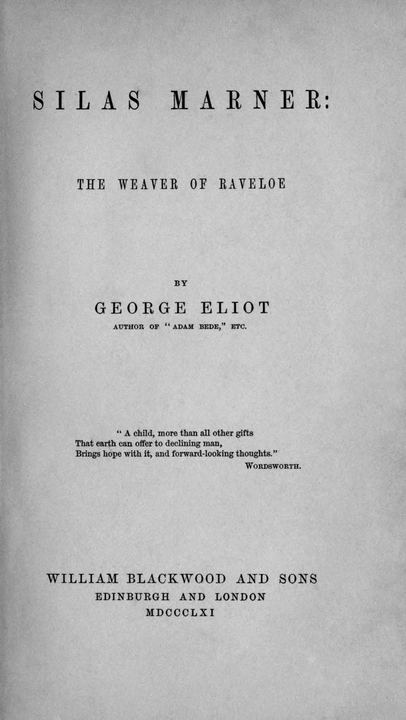
Background. Eliot set aside her research for Romola to write this short book, prompted by a childhood memory of a linen-weaver walking the lanes with a bag on his back. Blackwood issued it in one volume, headed by lines from Wordsworth's Michael.
Narrative. When drawn lots confirm a theft that William Dane committed during one of Silas's trances, the weaver loses his chapel, his betrothed and his faith, and retreats to Raveloe. Fifteen solitary years of counting guineas end when Dunstan Cass robs him. On New Year's Eve Molly Farren dies in a drift, and her toddler finds her way to Silas's hearth; he keeps the girl and names her Eppie.
Structure. Part One closes with the child's arrival and Godfrey's decision to stay silent. Part Two leaps sixteen years: the drained stone-pit yields Dunstan's skeleton and the lost money, Godfrey confesses to Nancy, and Eppie declines to leave the man who reared her.
Themes. Hoarded gold against a living child, providence perceived through ordinary neighbourliness, the slow healing of a mind closed by injustice, and the price of concealment in the Red House.
Significance. A fixture of British and American classrooms for generations, the novel is often read as a modern parable and remains Eliot's most compact study of how affection and community restore a damaged life.
Main characters
- Silas Marner: Short-sighted linen-weaver, falsely accused, who hoards gold until a child arrives
- Eppie (Hephzibah): Foundling raised by Silas who chooses him over her natural father
- Godfrey Cass: Squire's heir who conceals his secret marriage and his daughter
- Dunstan Cass: Godfrey's idle, blackmailing brother who steals the weaver's guineas
- Nancy Lammeter: Godfrey's principled, childless wife
- Dolly Winthrop: Wheelwright's wife whose plain faith and kindness guide Silas
- Molly Farren: Godfrey's opium-dependent secret wife, who dies in the snow
- William Dane: Lantern Yard friend who commits the theft and lets Silas bear the blame
- Aaron Winthrop: Dolly's son, a gardener, who marries Eppie

Summary
Silas Marner is George Eliot's short novel of a lonely linen-weaver restored to human fellowship by a child. In his youth Silas belonged to a strict dissenting congregation at Lantern Yard in a northern manufacturing town, where he was respected for his piety and for the cataleptic fits the brethren took for spiritual visitations. His close friend William Dane, during one of these trances, steals the church's money from the bedside of a dying deacon and contrives that Silas's knife and the empty bag point to him. The church draws lots, the lots declare Silas guilty, and his betrothed Sarah marries William. Silas cries out that there is no just God and leaves for the Midland village of Raveloe. There, for fifteen years, he weaves at his loom, shuns his neighbors and hoards gold, which he counts each night as his only companion. The villagers suspect him of strange knowledge, especially after his foxglove remedy eases a neighbor's heart disease. Squire Cass's eldest son Godfrey has secretly married Molly Farren, a woman enslaved to opium, and is blackmailed by his wastrel brother Dunstan. Dunstan kills Godfrey's horse while hunting, walks home in the dark past Silas's cottage, steals the gold and vanishes. Silas's loss draws the village to him; Dolly Winthrop brings lard-cakes and gentle counsel. On New Year's Eve, while the Squire holds his dance, Molly carries her little daughter through the snow to expose Godfrey, takes laudanum and dies in the drifts. The child toddles through Silas's open door to his hearth, where the short-sighted weaver, just recovering from a fit, takes her golden hair for his returned gold. Godfrey keeps his secret and marries Nancy Lammeter. Silas keeps the child, names her Hephzibah, Eppie, after his mother and sister, and with Dolly's help brings her up and is drawn back to church and neighbors. Sixteen years later the stone-pit near Silas's cottage is drained and Dunstan's skeleton is found with the gold. Shaken, Godfrey confesses to Nancy that Eppie is his daughter, and the childless couple offer to adopt her as a lady. Eppie refuses: she will cleave to the father who loved her from the first. Silas takes her to see Lantern Yard and finds it swept away for a factory, its truth still dark to him. Eppie marries Dolly's son Aaron, and the novel closes with her happy words about their pretty home.
Virtues in this work
- Charity: Silas takes in an orphan and gives her sixteen years of patient, self-forgetting care.
- Faith: Dolly Winthrop teaches Silas to trust in a goodness larger than he can see, and he comes to say there are dealings with us.
- Piety: Eppie honors the father who raised her and vows to cleave to him as long as he lives.
- Industry: Silas's steady labor at his loom supports Eppie, and Aaron's gardening makes their home pleasant.
Plot or Argument
- Lantern Yard and the lots (Chapter I)
Silas is betrayed by William Dane, condemned by the drawing of lots and loses his faith in God and man before settling in Raveloe.
- The miser and the robbery (Chapters II-X)
Silas hoards gold in isolation; Godfrey's secret marriage and Dunstan's blackmail lead to the death of Wildfire and the theft of the gold, and Raveloe begins to visit the bereft weaver.
- New Year's Eve (Chapters XI-XV)
At the Red House dance Godfrey courts Nancy while Molly dies in the snow; her child comes to Silas's hearth, and he claims and names her.
- Sixteen years later (Chapters XVI-XX)
Eppie has grown up with Silas; the stone-pit gives up Dunstan and the gold, Godfrey confesses, and Eppie chooses to stay with Silas.
- Lantern Yard revisited and the wedding (Chapter XXI and Conclusion)
Silas finds his old chapel replaced by a factory; Eppie marries Aaron Winthrop and they settle in the enlarged cottage.
Characters
- Silas Marner, The weaver of Raveloe
A gentle, short-sighted man embittered by false accusation, who becomes a miser and is restored by the love of a foundling child.
- Eppie (Hephzibah), Silas's adopted daughter
Molly's golden-haired child, raised by Silas, who chooses him over her wealthy natural father.
- Godfrey Cass, The Squire's eldest son
A good-natured but irresolute young man who hides his marriage and his child and pays for his silence later.
- Dunstan Cass, Godfrey's brother
A spiteful, idle youth who blackmails Godfrey and steals Silas's gold.
- Nancy Lammeter, Godfrey's wife
A neat, principled young woman of firm rules and sincere goodness.
- Dolly Winthrop, Wheelwright's wife
A patient, kindly neighbor of simple faith who teaches Silas to trust and to bring up Eppie.
- Aaron Winthrop, Dolly's son
A cheerful young gardener who marries Eppie.
- William Dane, Silas's friend at Lantern Yard
A self-righteous church member who frames Silas for theft.
- Molly Farren, Godfrey's secret wife
A woman ruined by opium who dies in the snow on her way to the Red House.
- Squire Cass, Greatest landowner of Raveloe
Godfrey's blustering, careless father.
Lessons
From gold to a child
Silas's hoard narrows his life to his loom and his coins; Eppie draws him outward to his neighbors, the fields and the church. Eliot shows that love for a person can restore what love of money had shrunk.
- How does Silas's life change after the gold is stolen and before Eppie arrives?
- Why does the narrator say the gold had turned into the child?
Trusting in the dark
Dolly Winthrop cannot explain why Silas was falsely condemned, but she teaches him to do the right thing as far as he knows and to trust. Her simple faith helps him live with a wrong that is never set right in this life.
- What does Dolly mean by trusten?
- Why does Silas say there are dealings with us?
The cost of concealment
Godfrey's refusal to own his marriage and child brings him a comfortable life but leaves him childless and without his daughter's love. When he finally confesses, he learns that a duty refused cannot always be taken up again later.
- What does Godfrey hope will save him from the consequences of his secret?
- What does he mean by saying he wanted to pass for childless once?
Who is a father?
Eppie chooses the weaver who fed, taught and loved her over the gentleman whose blood she shares. The novel honors fatherhood as faithful care given day after day.
- What reasons does Eppie give for refusing the Casses?
- Was Godfrey right to claim a father's rights after sixteen years?
Context
The novel is set around 1800 to the 1820s, during the wars with Napoleon and the early Industrial Revolution, when hand-loom weavers wandered from the towns to sell their skill in country villages. Raveloe is a remote Midland parish of old customs, folk beliefs and Church of England habits, contrasted with the evangelical dissent and growing factories of the northern town Silas leaves. Eliot drew on her Warwickshire childhood for its farmers, inn-talk and dialect.
Composition
Eliot wrote Silas Marner in 1860-61, interrupting her work on Romola, after an idea that she said came to her quite suddenly as a sort of legendary tale, suggested by her recollection of a linen-weaver with a bag on his back seen in early childhood. Blackwood published it in one volume in April 1861. The title-page carries an epigraph from Wordsworth's Michael on the hope a child brings,.
Reception
The book sold well at once and was praised for its humor, its village scenes and its moral clarity. Its brevity and its clear contrast of gold and love made it a standard school text in Britain and the United States for much of the twentieth century, and it has been widely read as a modern parable.
Comparisons
- great-expectations
Dickens's novel of the same year also turns on hidden parentage and secret money, and on the gap between a natural and a loving father.
- a-christmas-carol
Both stories redeem a solitary miser at the turn of the year, Scrooge through spirits and Silas through a child.
- the-pilgrims-progress
Eliot's image of angels leading men from the city of destruction recalls Bunyan's pilgrim, though the guide here is a little child.
- the-scarlet-letter
Both novels concern a concealed parent whose silence wounds himself and his child, with Godfrey as a milder figure than Dimmesdale.
- middlemarch
George Eliot's larger novel of provincial life (1871-72) widens Silas Marner's village into a whole town, following Dorothea Brooke and the doctor Lydgate through vocation, marriage and duty.
Quotes
Frequently cited
“there is no just God that governs the earth righteously, but a God of lies, that bears witness against the innocent”
Frequently cited
“Favourable Chance, I fancy, is the god of all men who follow their own devices instead of obeying a law they believe in.”
Frequently cited
“the child was come instead of the gold—that the gold had turned into the child”
Frequently cited
“In old days there were angels who came and took men by the hand and led them away from the city of destruction. We see no white-winged angels now. But yet men are led away from threatening destruction: a hand is put into theirs, which leads them forth gently towards a calm and bright land, so that they look no more backward; and the hand may be a little child’s.”
Frequently cited
“And he’s took care of me and loved me from the first, and I’ll cleave to him as long as he lives, and nobody shall ever come between him and me.”
Frequently cited
“what a pretty home ours is! I think nobody could be happier than we are.”
“And all as we’ve got to do is to trusten, Master Marner—to do the right thing as fur as we know, and to trusten.”
“That drawing o’ the lots is dark; but the child was sent to me: there’s dealings with us—there’s dealings.”
“Marner was in the right in what he said about a man’s turning away a blessing from his door: it falls to somebody else. I wanted to pass for childless once, Nancy—I shall pass for childless now against my wish.”
For Students
A reading companion for classical Christian high school students. See the student guide.
Reading Guide
Watch for
- How Silas's trust in God and man is broken in Chapter I, and what he says when the lots condemn him.
- Every mention of the hearth, the loom and the gold, and how their meaning changes after Eppie comes.
- Godfrey's habit of hoping that chance will rescue him, and what the narrator says about it in Chapter IX.
- Dolly Winthrop's visits and her counsel in Chapters X and XVI.
- Eppie's answer to the Casses in Chapter XIX and Godfrey's reflection in Chapter XX.
Key terms and names
- Dissenter
- A Protestant outside the Church of England; Lantern Yard is a small, strict dissenting congregation.
- Drawing of lots
- Deciding a question by chance in the belief that God directs the outcome, as in Acts 1:26; the Lantern Yard church uses it to judge Silas.
- Catalepsy
- A trance or seizure in which the body becomes rigid and the person unaware; Silas's fits shape his fate.
- Hand-loom weaver
- A craftsman weaving cloth on a hand-worked loom, a trade being displaced by factories in Silas's lifetime.
- Squire
- The chief landowner of a country parish; Squire Cass is the greatest man in Raveloe.
- Dialect
- Regional speech; Eliot renders Raveloe's in spellings such as trusten and o'.
Seminar Questions
- Comprehension How is Silas falsely convicted at Lantern Yard, and who is really guilty?
- Comprehension What happens to Silas's gold, and when is the truth discovered?
- Comprehension How does Eppie come to Silas's cottage on New Year's Eve?
- Interpretation Why does the loss of the gold begin Silas's recovery rather than complete his ruin?
- Interpretation How are Godfrey and Silas contrasted as fathers?
- Interpretation Why does Eliot let the truth about Lantern Yard remain unknown to Silas?
- Big Question Does Silas Marner suggest that providence works through ordinary people? Use Dolly and Eppie as evidence.
Faith Connections
- Matthew 6:19-21 (Scripture)
Lay not up treasures upon earth; Silas's buried gold is the treasure that holds his heart until a child gives him a better one.
- Ruth 1:16 (Scripture)
Whither thou goest, I will go; Eppie's vow to cleave to Silas echoes Ruth's choice of loyalty over kinship.
- Proverbs 3:5 (Scripture)
Trust in the Lord with all thine heart and lean not unto thine own understanding, the counsel Dolly gives when she tells Silas to trusten.
- Bunyan, The Pilgrim's Progress (Great Conversation)
The narrator's angels who lead men away from the city of destruction take Bunyan's opening image and apply it to a child's hand.
Logic and Rhetoric
Central argument: Silas, falsely condemned, loses faith and fills the emptiness with gold. When the gold is taken, a child takes its place and draws him back into fellowship with neighbors, church and nature. Godfrey, who hid his child, loses her love. Therefore love given faithfully restores a life, while concealment and reliance on chance leave it poorer.
Rhetorical device: parallel scenes. The gold vanishes from the hearth on one dark night and a golden-haired child appears on the same hearth on another, so that the second scene answers the first.
Debate: Resolved: that Eppie was right to refuse Godfrey and Nancy Cass.
Memory Work
In old days there were angels who came and took men by the hand and led them away from the city of destruction. We see no white-winged angels now. But yet men are led away from threatening destruction: a hand is put into theirs, which leads them forth gently towards a calm and bright land, so that they look no more backward; and the hand may be a little child’s.
And all as we’ve got to do is to trusten, Master Marner—to do the right thing as fur as we know, and to trusten.
Writing Prompts
Essay: Trace the hearth from the night of the robbery to the last chapter and argue what Eliot makes it stand for.
Comparison with A Christmas Carol: Both Scrooge and Silas are misers changed in winter. Compare what causes each change and argue which conversion is more convincing.
Medical Lens
Silas's cataleptic fits are central to the plot: at Lantern Yard they are taken for spiritual visitations and give William Dane his chance to frame him, in Raveloe they make him seem uncanny, and on New Year's Eve a fit at his open door lets Eppie toddle in unseen. The novel shows two older ways of interpreting such seizures, religious and folk, beside the village doctor's practice. Silas's foxglove preparation, learned from his mother, eases Sally Oates's heart disease and dropsy, which wins him an unwanted reputation as a cunning man. Molly Farren's enslavement to opium and her death in the snow after a dose of laudanum set the second half of the story in motion.
- Chapter I
Silas's cataleptic trance at the dying deacon's bedside and the brethren's reading of his fits as visitations.
- Chapter II
Silas prepares foxglove for Sally Oates's heart disease and dropsy and is then besieged by neighbors seeking charms and cures.
- Chapter XII
Molly's opium habit and her collapse and death in the snow.
- Chapter XIII
Doctor Kimble is called from the dance to the dead woman at Silas's cottage.
Listen to the book
Public-domain audiobook from LibriVox, read by rachelellen. Recording: Silas Marner on LibriVox (Internet Archive).
LibriVox recordings are volunteer readings released into the public domain. The reading may follow a different edition from the text in this library.
Creative Prompts
- Classroom
Read aloud the Rainbow inn conversation in Chapter VI in parts, then discuss what the villagers' talk about ghosts and law shows about Raveloe.
- Essay
Compare the scene of the theft in Chapter IV with the scene of Eppie's arrival in Chapter XII and argue how Eliot uses the hearth and the gold to connect them.
- Dialogue
Write a conversation between Nancy and Godfrey on the evening after Eppie's wedding.
Further Reading
- Adam Bede, George Eliot
- Michael, William Wordsworth
- George Eliot: A Biography, Gordon S. Haight
Verification notes
Plot, setting and publication history are standard. Chapter locators follow the attached Gutenberg text. Quotes are verified against that text, which preserves Eliot's rendering of Raveloe dialect.
No verification flags recorded.