Work record
A Model of Christian Charity
1630 · Renaissance Early Modern · Oratory · English
Abstract
Background. The newly chosen governor of a chartered trading company wrote this address for settlers who intended to carry their charter, magistrates, and churches across the ocean. A surviving copy, not in the author's own handwriting, lay unpublished until a Boston historical society printed it two centuries later.
Content. Inequality of rank, Winthrop argues, exists by divine design so that people depend on one another. He sets out how believers should give, lend, and cancel debts, demanding special openhandedness when danger is shared. A second movement grounds such mercy in love, pictured as the sinew joining Christ's members, and finds its pattern in the son of Saul. Finally he applies all this to the voyage: a covenant has been sealed, God will hold the colonists to its terms, and their unity will be watched by the world.
Method. Scholastic divisions, numbered reasons, and objections answered in turn carry the argument, illustrated by analogies from clocks, mothers, and the digestive work of the mouth.
Themes. Stewardship of wealth, mutual obligation, covenant fidelity, and public witness.
Significance. Barely mentioned for two hundred years, the address became a modern touchstone of American identity once scholars and politicians seized on its hilltop image, and debate over that image's meaning continues.
Key figures
- John Winthrop: Elected governor of the Massachusetts Bay Company and author of the discourse
- The emigrant company: Puritan families bound for New England, the discourse's audience
- Jonathan and David: Scriptural friends offered as the model of self-giving love
- Saul: King who lost his throne by failing in one article of his commission
- Moses: Lawgiver whose farewell charge to Israel closes the address

Summary
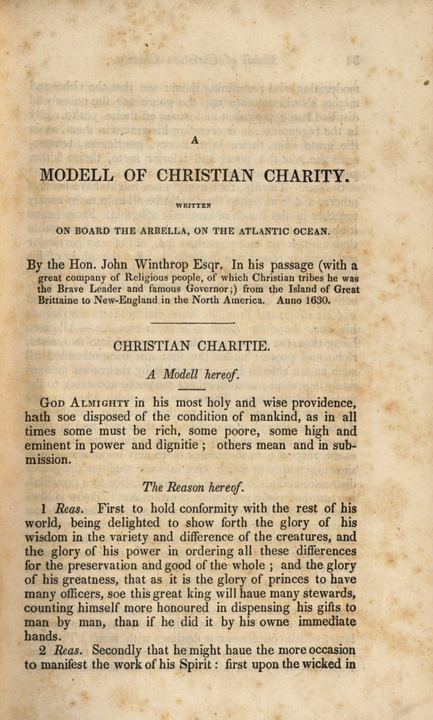
A Model of Christian Charity is a lay sermon or discourse that John Winthrop composed in 1630 for the company of Puritan emigrants he was leading from England to Massachusetts Bay. The surviving heading says it was written in his passage across the Atlantic, and it has traditionally been pictured as preached aboard the flagship Arbella, though some historians think it was delivered before the fleet sailed or circulated in manuscript. It was printed only in 1838, from a copy not in Winthrop's hand. Winthrop begins with a proposition: God in his providence has ordered mankind so that some are rich and some poor, some in power and others in submission. He gives three reasons, chief among them that every man might need others and all be knit together in brotherly affection. He then distinguishes the two rules of justice and mercy and the two laws of nature and grace, and answers practical questions in catechism form about giving, lending, and forgiving debts, with special generosity required in times of common peril. The second part turns from the outward work of mercy to its inward source. Love, Winthrop says, quoting Colossians, is the bond of perfection, the ligament that knits the body of Christ together so that its members share each other's strength and weakness. He traces this love to regeneration in Christ, illustrates it with Jonathan and David, and argues that it always brings its own reward. The application names the persons (fellow members of Christ), the work (a new plantation under civil and church government), the end (to serve the Lord more fully), and the means (to practice what they had only professed in England). The company has entered into covenant with God, and he will expect strict performance. Winthrop urges them to follow Micah, to do justly, love mercy, and walk humbly, to be knit together as one man, and to remember that they shall be as a city upon a hill with the eyes of all people upon them. He closes with Moses's charge in Deuteronomy 30 to choose life. Little noticed for two centuries, the city upon a hill passage was taken up by twentieth-century historians and presidents and became one of the most quoted texts in American political speech.
Virtues in this work
- Charity: Winthrop defines love as the bond of perfection and calls the company to make other's conditions their own, rejoicing, mourning, laboring, and suffering together.
- Justice: The discourse distinguishes the rule of justice in commerce from the rule of mercy toward the needy and gives careful rules for lending and forgiving debts.
- Humility: Winthrop holds that no man is made richer or more honorable for his own sake and names Micah's walk humbly with our God as the way to avoid shipwreck.
- Piety: The company's whole enterprise is framed as a covenant and commission from God whose articles must be kept, ending with Moses's charge to choose life by cleaving to Him.
Plot or Argument
- The providential order of rich and poor (opening)
Winthrop states that God has disposed mankind into rich and poor, high and low, and gives three reasons: to display the glory of his wisdom and power, to exercise the graces of both the great and the humble, and to make every man need others so that all are knit together.
- Justice, mercy, and the two laws (pp. 34-35)
He distinguishes justice from mercy and the law of nature from the law of the gospel, which adds brotherhood in Christ and love even of enemies, and notes that the gospel calls for different degrees of giving in different seasons.
- Giving, lending, and forgiving (pp. 35-39)
In question-and-answer form he sets rules for each, answering objections about providing for posterity, insisting that times of common peril demand extraordinary liberality, and citing Isaiah 58 and the generosity of the early church.
- Love as the bond of perfection (pp. 39-44)
Turning to the affection behind mercy, he defines love as the ligament of the body of Christ, traces it from Adam's fall to the new birth, describes the soul's delight in its likeness in another, and illustrates it with Jonathan and David.
- Application: persons, work, end, and means (pp. 44-46)
He applies the doctrine to the emigrants: as members of Christ seeking a new plantation under due government, they must let the public good overrule private interest and practice in New England what they had only professed in old England.
- Covenant, the city upon a hill, and the choice of life (pp. 46-48)
The company has a covenant and commission from God that will be strictly enforced. They must be knit together as one man, remembering that the eyes of all people are on them, and choose life as Moses urged Israel.
Characters
- John Winthrop, Speaker; governor of the company
Leader of the 1630 emigration, who addresses the company as a fellow member of Christ and as their civil head.
- The company of emigrants, Audience
The Puritan families sailing to Massachusetts Bay, whom Winthrop calls to covenant faithfulness and mutual love.
Key claims
The main steps of the argument, in order, and how they fit together.
- God orders mankind into rich and poor, powerful and subject, so that all people need one another and are knit together in affection.How it is supported: Three reasons from providence: the display of God's wisdom, the exercise of graces in both high and low, and mutual dependence.
- Beyond justice and the law of nature, the gospel's law of grace calls believers to treat one another as brothers in Christ and even to love enemies.How it is supported: A scholastic distinction between justice and mercy and between the laws of nature and grace.
- Christians must give, lend, and forgive debts generously, and times of shared danger demand extraordinary liberality beyond ordinary rules.How it is supported: Questions and answers that reply to objections, with Isaiah 58 and the generosity of the early church.
- True mercy flows from love, the bond of perfection that joins the members of Christ's body so they share one another's strength and weakness.How it is supported: Colossians and the analogy of ligaments knitting a body together.
- This love comes from new birth in Christ, delights in seeing its own likeness in another, and always brings its own reward.How it is supported: The example of Jonathan and David and the analogy of a mother's love for her child.
- As members of Christ founding a new plantation under due government, the emigrants must let the public good overrule private interest.How it is supported: An application covering the persons, the work, its end, and its means.
- The company has entered a covenant with God and received a commission from him, and he will strictly enforce its terms.How it is supported: Comparison to Israel's covenant and to a binding commission.
- Because the eyes of all people are on them, like a city set on a hill, their unity or failure will become a public witness.How it is supported: The hilltop image from Matthew 5 and Moses' charge to Israel to choose life.
Argument map
Supported by
- 4True mercy flows from love, the bond of perfection that joins the members of Christ's body so they share one another's strength and weakness.
which rests on
- 2Beyond justice and the law of nature, the gospel's law of grace calls believers to treat one another as brothers in Christ and even to love enemies.
- 5This love comes from new birth in Christ, delights in seeing its own likeness in another, and always brings its own reward.
- 6As members of Christ founding a new plantation under due government, the emigrants must let the public good overrule private interest.
which rests on
- 1God orders mankind into rich and poor, powerful and subject, so that all people need one another and are knit together in affection.
- 3Christians must give, lend, and forgive debts generously, and times of shared danger demand extraordinary liberality beyond ordinary rules.
- 7The company has entered a covenant with God and received a commission from him, and he will strictly enforce its terms.
- 8Because the eyes of all people are on them, like a city set on a hill, their unity or failure will become a public witness.
Therefore
Plain-language summaries of the author's argument, not quotations.
Lessons
Inequality as an occasion for love
Winthrop accepts differences of wealth and rank as part of God's ordering of the world, but he argues that their purpose is mutual need. The rich are stewards, the poor are brothers, and both are bound by the duties of mercy, so that difference becomes a reason for knitting together rather than for pride or envy.
- What three reasons does Winthrop give for the existence of rich and poor?
- How does the idea of stewardship change what it means to own wealth?
- Does Winthrop's view of inequality make love easier or harder to practice?
Love as the ligament of a community
Winthrop's central image is the body, in which love is the sinew that joins the parts so that they share pleasure and pain. Rules of giving and lending can compel acts of mercy, he says, but only love produces a settled habit of mercy.
- Why does Winthrop say argument can move a person to one act of mercy but not form a habit of it?
- What does the example of the mouth that chews for the whole body teach about the reward of love?
- How does the friendship of Jonathan and David illustrate the love Winthrop describes?
Covenant and public witness
The famous city upon a hill passage is a warning as much as a promise: because the eyes of all people are on the colony, its failure would make it a story and a byword through the world. Winthrop links the community's public reputation to its faithfulness in ordinary charity.
- Why does Winthrop compare the company's mission to Saul's commission against Amalek?
- Is the city upon a hill a boast, a burden, or both?
- What would it mean for any community today to live as if the eyes of all people were upon it?
Context
The Great Migration of the 1630s carried some twenty thousand English Puritans to New England, many of them families of middling wealth who hoped to build churches and towns reformed according to Scripture. The Massachusetts Bay Company took its royal charter with it across the Atlantic, so that its governor and assistants became the government of the colony. Winthrop's discourse sets out the moral basis of that venture before the first town was laid out.
Composition
Winthrop was elected governor in October 1629 and sailed in the Arbella in the spring of 1630, reaching Salem in June. The surviving manuscript, a contemporary copy held by the New-York Historical Society, bears a heading saying the discourse was written on the passage; scholars debate whether it was preached at sea, delivered in England before departure, or circulated in writing. The Massachusetts Historical Society first printed it in 1838, the text used here.
Reception
The discourse was little cited in the colonial period. Nineteenth- and twentieth-century historians, especially Perry Miller, made it a founding text of New England, and its city upon a hill was quoted by John F. Kennedy in his January 1961 address to the Massachusetts legislature and repeatedly by Ronald Reagan, who added the word shining. Abram Van Engen's study traces how the sermon became a national text only in the modern era.
Comparisons
- the-bible
Winthrop's argument is woven from Scripture: Colossians 3:14 for love as the bond of perfection, 1 Corinthians 12 for the body, Micah 6:8 for justice and mercy, Matthew 5:14 for the city on a hill, and Deuteronomy 30 for the closing choice of life.
- lincoln-second-inaugural-address
Lincoln, like Winthrop, reads a nation's fortunes in terms of providence and divine judgment, though Lincoln speaks after a covenant broken in war while Winthrop speaks before the work begins.
- democracy-in-america
Tocqueville opens his account of American democracy with the Puritan founding of New England, seeing in men like Winthrop the union of religious and civil liberty that shaped the townships.
- the-scarlet-letter
Hawthorne sets his novel in Winthrop's Boston and marks the governor's death in the scaffold chapter, testing the covenant community's ideals against a story of hidden sin and public shame.
Quotes
Frequently cited
“Wee must delight in eache other; make other's conditions our oune; rejoice together, mourne together, labour and suffer together, allwayes haueving before our eyes our commission and community in the worke, as members of the same body.”
Frequently cited
“For wee must consider that wee shall be as a citty upon a hill. The eies of all people are uppon us.”
“GOD ALMIGHTY in his most holy and wise providence, hath soe disposed of the condition of mankind, as in all times some must be rich, some poore, some high and eminent in power and dignitie; others mean and in submission.”
“Love is the bond of perfection.”
“for to love and live beloved is the soule's paradise both here and in heaven.”
“For it is a true rule that particular Estates cannot subsist in the ruin of the publique.”
“Now the onely way to avoyde this shipwracke, and to provide for our posterity, is to followe the counsell of Micah, to doe justly, to love mercy, to walk humbly with our God.”
“Therefore lett us choose life that wee, and our seede may liue, by obeyeing His voyce and cleaveing to Him, for Hee is our life and our prosperity.”
For Students
A reading companion for classical Christian high school students. See the student guide.
Reading Guide
Watch for
- The opening proposition about rich and poor and the third reason, that every man might need others.
- The question-and-answer passages on giving, lending, and forgiving, and how each answer handles an objection.
- The clock simile, in which love is the main wheel that makes the hammer strike, and the definition of love as the bond of perfection.
- The portrait of Jonathan and David as the pattern of love that seeks another's good.
- The covenant language of commission and articles, the example of Saul and Amalek, and the city upon a hill warning that follows.
Key terms and names
- Charity
- In Winthrop's usage, Christian love (Latin caritas) toward God and neighbor, the inward affection from which works of mercy flow, not merely almsgiving.
- Law of nature and law of grace
- Winthrop's pair: the moral law given to man in innocence, which commands love of neighbor, and the gospel law for the regenerate, which adds brotherhood in Christ and love of enemies.
- Community of perill
- A time of shared danger, such as the voyage and settlement, when Winthrop says believers must give with more enlargement and less regard for their own rights.
- Bond of perfection
- Love as described in Colossians 3:14, which Winthrop treats as the ligament that knits the parts of Christ's body into one.
- Covenant
- A solemn agreement; Winthrop says the company has entered into covenant with God for this work and that God will require strict performance of its articles.
- Commission
- A charge given for a specific task; Winthrop compares the company's mission to the commission given Saul against Amalek.
- Plantation
- A new settlement or colony; Winthrop imagines later colonists praying that their plantations might be like New England.
Seminar Questions
- Comprehension What rules does Winthrop give for lending, and how do they change depending on whether the borrower can repay?
- Comprehension What are the four heads of Winthrop's application to the company?
- Interpretation Why does Winthrop say that drawing men to works of mercy by argument alone is like laying a hand on the clock's hammer instead of the main wheel?
- Interpretation What does Winthrop mean when he says particular estates cannot subsist in the ruin of the public, and how does the claim fit the circumstances of the emigrants?
- Interpretation Why does the city upon a hill passage move immediately from the eyes of all people to the danger of becoming a by-word?
- Interpretation How does Winthrop use the story of Saul and Amalek to explain what the covenant demands?
- Big Question Can a political community be held together by love, or only by law and interest?
- Big Question What responsibilities come with being watched and imitated by others?
Faith Connections
- Colossians 3:14 (Scripture)
Paul calls charity the bond of perfectness, the verse Winthrop builds his whole second part upon.
- Matthew 5:14-16 (Scripture)
Christ tells his disciples that they are the light of the world and a city set on a hill that cannot be hid, the source of Winthrop's image; in Matthew the light is meant to lead others to glorify the Father.
- 1 Corinthians 12:12-26 (Scripture)
Paul's image of one body with many members, where if one suffers all suffer, supplies Winthrop's picture of the company knit together and sharing each other's conditions.
- Calvin, Institutes of the Christian Religion III.7 (Church Fathers)
Calvin teaches that whatever gifts we have are given as stewards for the common good of the church, a doctrine of self-denial that underlies Winthrop's rules of giving and lending.
Logic and Rhetoric
Central argument: God has made men unequal so that they will need and serve one another; mercy toward one another must flow from love, which is the bond that knits Christ's body together; the company has entered a special covenant with God to build a community under his ordinances; therefore it must practice that love fully, or it will suffer God's judgment before the watching world.
Rhetorical device: Anaphora. On p. 47 of the 1838 printing a run of sentences opens with Wee must (entertaine each other, be willing to abridge ourselves, uphold a familiar commerce, delight in eache other), building the practical program of love clause by clause.
Debate: Resolved: Winthrop's city upon a hill is better understood as a warning than as a promise.
Memory Work
For wee must consider that wee shall be as a citty upon a hill. The eies of all people are uppon us.
Wee must delight in eache other; make other's conditions our oune; rejoice together, mourne together, labour and suffer together, allwayes haueving before our eyes our commission and community in the worke, as members of the same body.
Writing Prompts
Essay: Explain how Winthrop moves from the rules of mercy in the first part of the discourse to the doctrine of love in the second and the covenant in the application, and argue whether the structure makes his final warning more persuasive.
Comparison with Second Inaugural Address: Winthrop and Lincoln both interpret their people's situation through providence and divine judgment. Compare how each speaker understands what God requires of a community and what happens when it fails.
Creative Prompts
- Essay
Compare the full city upon a hill paragraph, with its warning of becoming a story and a by-word through the world, to the way the phrase is used in modern political speeches, and explain what changes when the warning is left out.
- Classroom
Divide the class into the four heads of Winthrop's application (persons, work, end, means) and have each group restate its head as a charter for a school or club, then test whether the charters require the love Winthrop describes or only rules.
- Fiction
Write a short scene aboard a crowded ship in 1630 in which two emigrants of different rank argue over a shared need, such as food, water, or a sick child, using Winthrop's rules of giving, lending, and forgiving.
Further Reading
- The Journal of John Winthrop, 1630-1649, Richard S. Dunn, James Savage, and Laetitia Yeandle (eds.)
- City on a Hill: A History of American Exceptionalism, Abram C. Van Engen
Traces the manuscript, its rediscovery, and its modern political career.
- The Puritan Dilemma: The Story of John Winthrop, Edmund S. Morgan
- John Winthrop: America's Forgotten Founding Father, Francis J. Bremer
Verification notes
The 1630 date and first printing in 1838 are standard, and Winthrop's authorship is generally accepted, though a few scholars have proposed other authors. Whether the discourse was delivered aboard the Arbella, before departure in England, or at all is debated, and the record presents the shipboard setting as tradition. Quotations follow the 1838 printing as stored, with its spelling (soe, wee, citty, uppon) and its scriptural references, some of which are misnumbered in that printing; page locators refer to its [Page n] markers. The opening proposition precedes the first marker.
No verification flags recorded.