Work record
Mécanisme de la physionomie humaine
Guillaume-Benjamin Duchenne de BoulogneMécanisme de la physionomie humaine by Guillaume-Benjamin Duchenne de Boulogne (1862)In 1862 the French physician Guillaume-Benjamin Duchenne de Boulogne published Mécanisme de la physionomie humaine, ou Analyse électro-physiologique de l’expression des passions, at Paris with Veuve Jules Renouard, “with an atlas composed of 74…1862 · 19th Century · Essays · French
Abstract
The work. The 1862 treatise argues that the soul expresses itself through particular facial muscles, and that localized electrical stimulation, recorded by photography, can reveal the laws of human physiognomy. A passage of the Considérations générales explains the universality of that facial language by referring to the Creator.
This edition. The library hosts the 1862 French typographic text from a public-domain Glasgow / Internet Archive copy, cleaned from OCR and not offered as a critical edition. English renderings of quotations are our paraphrases, clearly marked, and are not taken from the 1990 Cuthbertson translation, which is still in copyright.
The plates. Five milder atlas figures are shown from the 1862 icono-photographic atlas: 3 and 4 (faces at rest), 7 and 12 (attention, rest, and reflection), and 80 (the compassionate smile of charity). Child subjects, pain, grimace, weeping, and the Lady Macbeth series are omitted.
For students. Intended for grades 11–12 as history of medicine. Some plates show electrodes on a living face. Read with Darwin’s later book on expression, not as if that book were an English version of Duchenne. Featured French lines were checked on 1862 page images, including the preface and the Créateur passage at printed page 31.
Key figures
- G.-B. Duchenne de Boulogne: French physician who photographed facial muscles under localized electrical stimulation
- Charles Darwin: Later reader who used some of Duchenne’s photographs in 1872
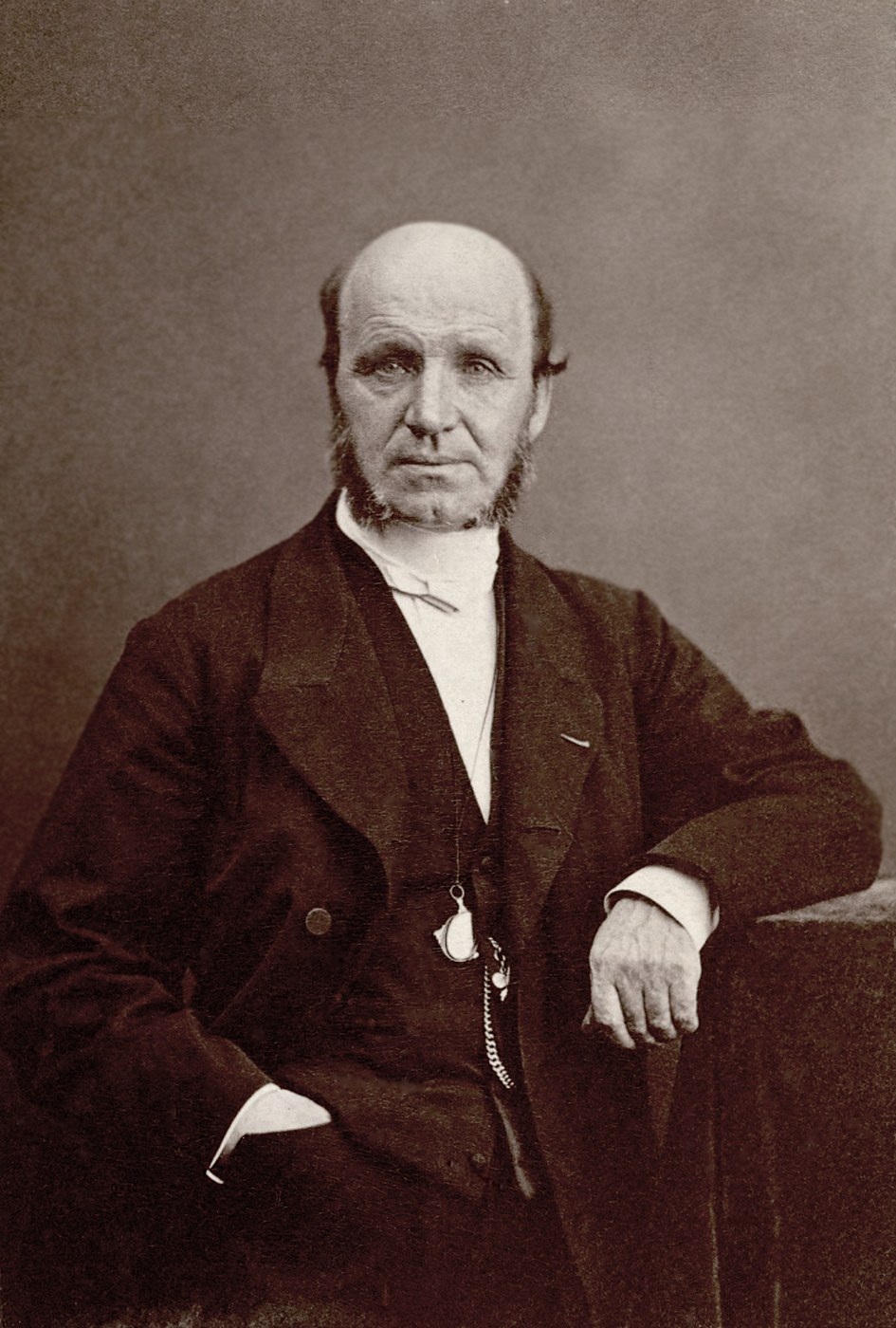

Summary
In 1862 the French physician Guillaume-Benjamin Duchenne de Boulogne published Mécanisme de la physionomie humaine, ou Analyse électro-physiologique de l’expression des passions, at Paris with Veuve Jules Renouard, “with an atlas composed of 74 electro-physiological figures photographed.” The book is an attempt to found the study of facial expression on the localized electrical stimulation of individual muscles, recorded by photography. Duchenne had already used “localized electrization” in the clinic. Here he turned the same method to the face, arguing that the soul is the source of expression, that it sets the muscles in play and makes them paint the passions on the face, and that the laws of human physiognomy can therefore be sought in muscular action. In a carefully worded passage of the Considérations générales he goes further, speaking of the Creator who, according to his wisdom—or, “if I may be allowed this way of speaking,” by a divine fancy—could set one muscle or several in action when he wished the signs of even the most fleeting passions to be written momentarily on the human face, and who made that language universal by giving every human being the instinctive faculty of expressing feeling through the same muscles. The library hosts the 1862 French text, prepared from a public-domain copy of the typographic volume (Glasgow University Library / Internet Archive b2491941x_0001, Public Domain Mark). The transcription is a cleaned optical-character-recognition text, not a letterpress-proofed critical edition; hyphenation and other defects may remain except where a passage has been checked on a page image. English sentences on this page that render Duchenne’s French are our paraphrases. They are clearly marked as such. They are not drawn from the 1990 English translation by R. Andrew Cuthbertson, which is still in copyright and is not used or quoted here. The accompanying atlas is a sequence of albumen photographic plates. Many of them record the application of electrodes to the face; some record pain, grimace, weeping, aggression, or theatrical scenes, and some use child subjects. This library page presents only a small, milder, age-appropriate set: figures 3, 4, 7, 12, and 80, taken from the 1862 icono-photographic atlas (Glasgow University Library / Internet Archive b2491941x_0002, Public Domain Mark). Figures 3 and 4 show faces at rest; 7 and 12 study attention, rest, and reflection in an older man, with the electrical stimulation visible; 80 is the compassionate smile of charity. Child subjects, grimace and tic, pain, aggression, weeping, figure 79, and the Lady Macbeth series (figures 81–84) are not reproduced here. Charles Darwin later used and discussed Duchenne’s photographs in The Expression of the Emotions in Man and Animals (1872); the two works should be read together, without treating Darwin’s book as a translation of Duchenne.
Virtues in this work
- Prudence: Duchenne insists on isolating particular muscles and on comparing stimulated expressions with the face at rest, rather than treating a grimace as evidence.
- Industry: The treatise and atlas are the product of long experimental work, combining clinical electrization, anatomical analysis, and photography plate by plate.
Plot or Argument
- A muscular account of expression
The preface and the Considérations générales argue that the soul is the source of expression and that it makes the muscles paint the passions on the face. If that is so, the laws of human physiognomy can be sought in muscular action, and they can be tested by causing particular muscles to contract.
- Localized electrization and photography
Duchenne used localized electrical stimulation, already familiar from his clinical work, to bring individual facial muscles into action, and he photographed the results. The 1862 title page announces an atlas of 74 electro-physiological figures. The method is offered as more precise than earlier artistic or physiognomic description alone.
- The Creator and a universal language of the face
In a passage of the Considérations générales, verified on the 1862 printed page, Duchenne writes of the Creator who could set one muscle or several in action when he wished even fleeting passions to be written on the face, and who made that language universal by giving every human being the instinctive faculty of expressing feeling through the same muscles. The English given on this page is our paraphrase, not a published translation.
- The atlas, and the plates shown here
Many plates in the atlas show electrodes on the face; some record pain, grimace, weeping, or theatrical scenes, and some use child subjects. This page presents five milder, age-appropriate plates from the 1862 atlas: figures 3 and 4 (faces at rest), 7 and 12 (attention, rest, and reflection), and 80 (the compassionate smile of charity). Child subjects, grimace and tic, pain, aggression, weeping, figure 79, and the Lady Macbeth series are not reproduced.
- French text, English abstract, and Darwin
The hosted full text is the 1862 French, cleaned from a public-domain typographic copy. This work page is an English abstract and guide. Quotations are French and verbatim; any English is marked as our paraphrase. Darwin’s Expression of the Emotions in Man and Animals (1872) later used Duchenne’s photographs and should be read beside this book, not as a translation of it.
Lessons
Expression can be studied muscle by muscle
Duchenne’s central claim is that the play of the face can be analyzed by the action of particular muscles, made visible by localized electrical stimulation and fixed by photography. Students should separate that experimental claim from later popular uses of his images.
- What, according to the preface, is the source of expression, and why does that lead Duchenne to the muscles?
- What does photography add that a verbal description of a muscle’s action would lack?
A theological idiom in a laboratory book
The Créateur passage explains the universality of facial signs by referring to the Creator’s wisdom and to a divine fancy, then to an instinctive human faculty. It is a serious sentence in the treatise, not a decorative motto, and it should be read as written, without being turned into a full confession of the author’s inner life.
- What work does the word Créateur do in the argument about a universal language of the face?
- How is this different from a merely mechanical account of muscles?
How to look at the plates
The atlas is historical evidence, not a gallery of human types. This page shows only a milder set, with a note that several plates record electrical stimulation. Students should describe what is actually on the plate—rest, attention, a smile—and should not treat omitted images as if they were hidden lessons.
- What can figures 3 and 4, which show faces at rest, teach before one looks at a stimulated expression?
- Why might a school library show figure 80 and not the theatrical or painful plates?
Context
Duchenne worked in mid-nineteenth-century French medicine, after the first clinical uses of electricity and before Darwin’s 1872 book on expression. Physiognomy already had a long artistic and medical history; Duchenne’s claim was that the living action of named muscles, photographed under localized stimulation, could give that history a physiological basis.
Composition
The treatise and atlas were published at Paris in 1862 by Veuve Jules Renouard. The typographic volume and the icono-photographic atlas were issued together; the title page of the copy used here states that the atlas is composed of 74 electro-physiological figures photographed by the author.
Reception
The book was read by physicians, artists, and, later, by Charles Darwin, who discussed and reproduced some of Duchenne’s photographs in The Expression of the Emotions in Man and Animals (1872). Modern English readers often meet the work through a 1990 translation that this library does not use.
Comparisons
- The Expression of the Emotions in Man and Animals
Darwin’s 1872 book used and discussed Duchenne’s photographs while developing a comparative account of expression in humans and other animals; it is a later conversation with this atlas, not an English version of it.
- On Medicine
Celsus’s De Medicina shows an older medical concern with the visible body and with the physician’s judgment, without photography or electrical stimulation; the contrast helps students see what is new in Duchenne’s method.
Quotes
Frequently cited
“Le Créateur n’a donc pas eu à se préoccuper ici des besoins de la mécanique; il a pu, selon sa sagesse, ou — que l’on me pardonne cette manière de parler — par une divine fantaisie, mettre en action tel ou tel muscle, un seul ou plusieurs muscles à la fois, lorsqu’il a voulu que les signes caractéristiques des passions, même les plus fugaces, fussent écrits passagèrement sur la face de l’homme Ce langage de la physionomie une fois créé, il lui a suffi, pour le rendre universel et immuable, de donner à tout être humain la faculté instinctive d’exprimer toujours ses sentiments par la contraction des mêmes muscles”
“L’âme est donc la source de l’expression; c’est elle qui met en jeu les muscles et qui leur fait peindre sur la face, en traits caractéristiques, l’image de nos passions. En conséquence, les lois qui régissent l’expression de la physionomie humaine peuvent être recherchées par l’étude de l’action musculaire”
For Students
A reading companion for classical Christian high school students. See the student guide.
Reading Guide
Watch for
- The difference between Duchenne’s own French sentences and the clearly marked English paraphrases on this page.
- How localized electrical stimulation is supposed to isolate a single muscle’s contribution to an expression.
- What the five curated plates actually show, including visible electrodes, and what this page deliberately omits.
- The later conversation with Darwin, which is not an English edition of this book.
Key terms and names
- Localized electrization
- Duchenne’s method of stimulating a particular muscle, here a facial muscle, without cutting the skin.
- Physiognomy in movement
- Duchenne’s phrase for the living play of the face, which he contrasts with the study of the face at rest.
- Icono-photographic atlas
- The 1862 volume of photographic figures issued with the treatise; this page reproduces five milder plates from it.
- Rheophore
- The electrode or conducting point visible on some plates, used to deliver the localized stimulus to a muscle.
- Our paraphrase
- An English rendering written for this library page and clearly marked as such; not the 1990 Cuthbertson translation.
Seminar Questions
- Comprehension What, in the preface, does Duchenne say is the source of expression, and what method does he say can discover its laws?
- Comprehension Which five atlas figures are shown on this page, and which kinds of plates are deliberately omitted?
- Interpretation Why does Duchenne think photography is needed in addition to electrical stimulation and anatomical description?
- Interpretation In the Créateur passage, what is meant by a language of physiognomy that is universal and unchanging?
- Big Question What are the moral limits of using electricity and photography on a living face in order to study expression?
- Big Question Can a theological sentence about the Creator and a laboratory method of muscle stimulation belong to the same argument without one canceling the other?
Faith Connections
- Genesis 1:26–27 (Scripture)
Duchenne’s Créateur passage explains a universal human language of the face by referring to the Creator; students may set that claim beside the scriptural account of humankind as made in the image of God, without forcing the 1862 sentence into a full doctrinal statement.
- The Creator, mechanism, and expression (Great Conversation)
The same passage distinguishes the needs of mechanics from a divine wisdom or fancy that writes even fleeting passions on the face, a useful text for asking how nineteenth-century physiology still spoke of creation.
Logic and Rhetoric
Central argument: Because the soul expresses itself through particular facial muscles, the laws of human physiognomy can be discovered by isolating those muscles with localized electrical stimulation and recording the result by photography.
Rhetorical device: illustrated experiment. The atlas plate is not an ornament; figures such as 7 and 12 are meant to show, on the same face, rest or attention on one side and a stimulated expression on the other.
Debate: Resolved: That the laws of human facial expression can be established by the localized electrical stimulation of named muscles, recorded by photography.
Memory Work
Le Créateur n’a donc pas eu à se préoccuper ici des besoins de la mécanique; il a pu, selon sa sagesse, ou — que l’on me pardonne cette manière de parler — par une divine fantaisie, mettre en action tel ou tel muscle, un seul ou plusieurs muscles à la fois, lorsqu’il a voulu que les signes caractéristiques des passions, même les plus fugaces, fussent écrits passagèrement sur la face de l’homme Ce langage de la physionomie une fois créé, il lui a suffi, pour le rendre universel et immuable, de donner à tout être humain la faculté instinctive d’exprimer toujours ses sentiments par la contraction des mêmes muscles
Writing Prompts
Essay: Taking only the verified French quotations and the five curated plates, explain Duchenne’s method and his claim that expression has laws. Mark any English you use as your own paraphrase.
Comparison with The Expression of the Emotions in Man and Animals: How does Darwin’s later use of Duchenne’s photographs change, or fail to change, the question Duchenne was asking in 1862?
Medical Lens
A primary source for the history of neurology, facial expression, and medical photography: Duchenne uses localized electrical stimulation and the camera to analyze the muscular mechanism of the passions.
- Préface
States that the soul is the source of expression and that the laws of physiognomy can be investigated through muscular action.
- Considérations générales, printed p. 31
The Créateur passage on a universal language of facial muscles. Quote from the page image, not from later English translations.
- Icono-photographic atlas, figs. 3, 4, 7, 12, 80
The milder plates presented on this page: rest, attention, reflection, and the compassionate smile of charity.
Creative Prompts
- Essay
In your own words, and without borrowing a published English translation, explain what Duchenne claims in the preface about the soul, the muscles, and the possibility of finding laws of expression.
- Classroom
Give students the five curated plates and Duchenne’s own 1862 captions. Ask them to describe only what they can see, and to note when an electrode is visible.
- Essay
Compare Duchenne’s Créateur passage with Darwin’s later use of the photographs: what question is each writer trying to answer, and where must a student refuse to treat Darwin as a translator of Duchenne?
Further Reading
- Mécanisme de la physionomie humaine, G.-B. Duchenne de Boulogne
The 1862 Paris edition (Veuve Jules Renouard), typographic volume and photographic atlas; the text hosted here.
- The Expression of the Emotions in Man and Animals, Charles Darwin
1872; discusses and reproduces some of Duchenne’s photographs. Read beside this work, not as a translation of it.
- Essays on the Anatomy and Philosophy of Expression, Charles Bell
An earlier, well-known British attempt to connect facial muscles with expression, which Duchenne himself discusses.
Verification notes
The two featured French quotations were transcribed from 1862 page images (preface; Considérations générales, printed p. 31) and then aligned in the hosted text so that they match exactly. English on this page is our paraphrase and is marked as such; Cuthbertson 1990 was not used. The five plates were identified on the Glasgow 1862 atlas (PDF pages 7, 9, 15, 25, 167) by their printed figure numbers. The hosted French text is a cleaned OCR of the typographic volume, not a critical edition; defects may remain outside the verified passages. No wording has been invented.
- The hosted French text still needs a fuller proof against the 1862 typographic volume beyond the verified quotations.
- Duchenne’s day of death is reported as 15 or 17 September 1875 in different reference works and should be checked in a standard biographical source.
- The 1862 title page states 74 atlas figures; later copies and descriptions of the atlas sometimes give other counts, which should not be silently harmonized.