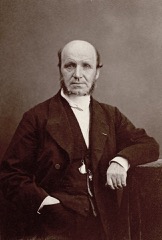
Duchenne de Boulogne
1806–1875 · French physician who used localized electrical stimulation and photography to study facial expression (1862).
Guillaume-Benjamin Duchenne was born at Boulogne-sur-Mer on 17 September 1806 and is usually called Duchenne de Boulogne. He studied medicine and then devoted himself to the clinical use of localized electrical stimulation, a method he used to examine individual muscles in disease and, later, in the living face. In 1862 he published Mécanisme de la physionomie humaine, a treatise issued with a photographic atlas, in which he argued that the soul expresses itself through particular facial muscles and that those muscles can be isolated by electricity and recorded by the camera. He wrote, in a passage of the Considérations générales, of the Creator who made the language of the face universal. Charles Darwin later used some of the photographs in The Expression of the Emotions in Man and Animals (1872). Duchenne’s name is also attached to the form of muscular dystrophy later associated with him. He died at Paris in mid-September 1875; reference works differ on whether the day was the 15th or the 17th.
Faith: Lived and practiced in nineteenth-century Catholic France. In the 1862 Considérations générales he writes of “le Créateur” when explaining why the language of facial expression is universal; that is a theological idiom in the treatise, not a full personal confession documented here. Source: Duchenne, 1862, printed p. 31
See also: Charles Darwin · William Harvey

Key dates
- 17 September 1806 Born at Boulogne-sur-Mer
- 1862 Publishes Mécanisme de la physionomie humaine, with a photographic atlas
- 1872 Darwin discusses and reproduces some of Duchenne’s photographs in The Expression of the Emotions in Man and Animals
- mid-September 1875 Dies at Paris; sources differ on 15 or 17 September
In their words
“L’âme est donc la source de l’expression; c’est elle qui met en jeu les muscles et qui leur fait peindre sur la face, en traits caractéristiques, l’image de nos passions.”
Read about them
Grades 9–12
- Mécanisme de la physionomie humaine · In the library
- The Expression of the Emotions in Man and Animals · In the library
More lives
Clara Barton · Claude Bernard · Elizabeth Blackwell · Eugen Bleuler · Josef Breuer · Jean-Martin Charcot
Notes: The day of death is reported as 15 September or 17 September 1875 in different reference works. The faith note is based on the 1862 Créateur passage and on the fact that he lived and practiced in Catholic France; a fuller personal confession is not claimed here.