Work record
Nostromo
Joseph ConradNostromo: A Tale of the SeaboardNostromo by Joseph Conrad (1904)Nostromo, published in 1904, is Joseph Conrad’s long novel of Sulaco, a seaboard town in the occidental province of the fictional South American republic of Costaguana.Also known as: Nostromo: A Tale of the Seaboard
1904 · Early 20th Century · Novel · English
Read this when a trusted man is left alone with a treasure.
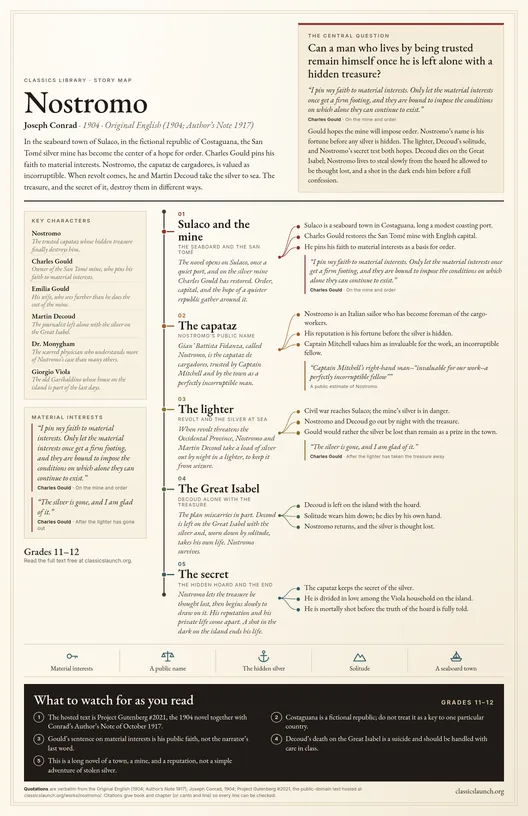 Story mapSee the story mapThe whole book on one page: the story in movements, the characters, and what to watch for. Free to print.
Abstract
Background. Joseph Conrad published Nostromo in 1904, after Lord Jim and Heart of Darkness, both also hosted in this library. The scene is Sulaco, a seaboard town in the fictional republic of Costaguana, and the San Tomé silver mine that has come to rule its fortunes. Conrad, a Polish-born British novelist writing in English, here gives a large public canvas
Plot. When revolt threatens the town, the capataz Nostromo and the journalist Decoud take a load of silver to sea. Decoud dies alone on an island; Nostromo hides the treasure, lets it be thought lost, and is at last destroyed by the secret he keeps. In the last movement the Viola family, Nostromo’s divided love, and a shot in the dark bring the secret to a close without a full confession.
Ideas. The novel tests a public faith in material interests, and a man’s faith in his own incorruptible name. It is a book of honor, reputation, and political disorder, not a simple adventure of a stolen hoard. Emilia Gould sees further than her husband; Decoud’s solitude is as central as the fighting in the streets.
Text. The original is English; no translator is used. The hosted file is Project Gutenberg #2021, the 1904 novel together with the Author’s Note of 1917. Both are in the public domain in the United States. The book is long and asks for older high-school readers. Students who have already read Lord Jim or Heart of Darkness will be better prepared for the length and the large cast.
Main characters
- Nostromo: the trusted capataz whose secret finally destroys him
- Charles Gould: owner of the San Tomé mine, who pins his faith to material interests
- Martin Decoud: the journalist left alone with the silver on the Great Isabel
Summary
Nostromo, published in 1904, is Joseph Conrad’s long novel of Sulaco, a seaboard town in the occidental province of the fictional South American republic of Costaguana. The San Tomé silver mine, restored by Charles Gould with English capital, has become the center of the town’s hopes for order. Gould says he pins his faith to material interests; his wife Emilia sees more clearly the human cost of that faith. Into this world comes Nostromo, born Gian’ Battista Fidanza, an Italian sailor who has become the capataz de cargadores, the foreman of the cargo-workers, and who is valued as a perfectly incorruptible man. When civil war comes, and the Monterist forces threaten the town, Gould and his allies try to save a great load of silver from seizure. Nostromo and Martin Decoud, a young journalist attached to Antonia Avellanos, take the treasure out by night in a lighter. The plan miscarries. Decoud is left on the Great Isabel with the silver and, worn down by solitude, takes his own life. Nostromo returns and allows it to be thought that the treasure has been lost. He then begins, slowly, to help himself to the hidden silver, and the man who had lived by his reputation for trustworthiness is changed by the secret. The later pages turn to the Viola family on the island, to Nostromo’s divided love, and to a shooting in the dark that ends his life before the truth of the treasure is fully told. The book is a study of honor, reputation, political disorder, and the power of a mine to shape a town. This library also hosts Heart of Darkness and Lord Jim; Nostromo is the longer and more public of the three, less a voyage tale than a book of a city, a mine, and a seaboard. The hosted text is the Project Gutenberg file, which includes Conrad’s Author’s Note of October 1917, itself in the public domain. Students should be ready for a large cast, a shifting chronology, and a tragedy that is moral as well as political.
Virtues in this work
- Honor: The book is built on a man’s public name and on what happens when that name is no longer true.
- Justice: A republic in revolt, a mine, and a hidden treasure all raise the question of what is owed, and to whom.
- Prudence: Gould, Decoud, and Nostromo each make a calculation under pressure; the novel shows where those calculations fail.
Plot or Argument
- Sulaco and the mine
The novel opens on the seaboard town of Sulaco and the San Tomé silver mine, which Charles Gould has restored. Order, capital, and the hope of a quieter republic gather around the mine.
- Nostromo’s reputation
Gian’ Battista, called Nostromo, is the capataz de cargadores, trusted by Captain Mitchell and by the town as an incorruptible man. His name is his fortune before any silver is hidden.
- Revolution and the lighter
When revolt reaches the Occidental Province, Nostromo and Martin Decoud take a load of silver out by night in a lighter, to keep it from seizure.
- The island and Decoud
The plan fails in part. Decoud is left with the treasure on the Great Isabel and, in isolation, takes his own life. Nostromo survives and lets the silver be thought lost.
- The secret and the end
Nostromo begins to draw on the hidden silver. His reputation and his private life come apart. A shot in the dark on the island ends his life before the treasure is fully confessed.
Characters
- Nostromo (Gian’ Battista Fidanza), capataz de cargadores
An Italian sailor trusted as incorruptible, who takes the silver to sea, hides it, and is at last destroyed by the secret.
- Charles Gould, owner of the San Tomé mine
The Englishman who restores the mine and pins his faith to material interests as a basis for order.
- Emilia Gould, his wife
The more clear-eyed of the Goulds, who sees what the mine costs in human terms and who is present at Nostromo’s end.
- Martin Decoud, journalist
A young man attached to Antonia Avellanos, who goes out with the silver and dies by his own hand on the Great Isabel.
- Dr. Monygham, doctor
A scarred physician, useful in the town’s crisis, who understands more of Nostromo’s case than many others.
- Antonia Avellanos, patriot and beloved of Decoud
Daughter of Don José Avellanos, loyal to the idea of a better Costaguana.
- Giorgio Viola, old Garibaldino
An Italian innkeeper, father of Linda and Giselle, whose house on the island becomes part of Nostromo’s last days.
Lessons
A reputation can be a kind of treasure
Nostromo lives by the town’s trust before he ever hides a bar of silver. The novel asks what happens when a man who is praised as incorruptible is left alone with a secret hoard.
- What does Nostromo’s name, and his reputation, do for him at the start?
- When does the secret begin to change him, and how do we know?
“Material interests” are not a complete faith
Charles Gould hopes that the mine will impose order. The book lets that hope be stated in his own words, and then shows what the mine and the treasure do to a town and to particular souls. Students should follow the story, not be lectured ahead of it.
- What does Gould mean by pinning his faith to material interests?
- Where does Emilia see further than he does?
Honor in a time of disorder
Costaguana is in revolt; plots, fear, and sudden authority run through the middle of the book. The moral question is not only who wins the province, but what a trusted man will do when the ordinary rules have failed.
- Who, besides Nostromo, is tested when the town is in danger?
- What is left of honor when the silver is thought to be lost?
Context
Conrad published Nostromo in 1904, after Heart of Darkness and Lord Jim. He had left the sea, settled in England, and was writing, in English, large novels of conscience and public life. The republic of Costaguana is invented, though it draws on what a widely travelled seaman could know of ports, mines, and unstable governments on the American seaboard in the later nineteenth century.
Composition
The hosted text is Project Gutenberg #2021, the novel of 1904 together with Conrad’s Author’s Note dated October 1917. Both the novel and the note were published before 1930 and are in the public domain in the United States. No translator is used; the original is English.
Reception
The book has long been counted among Conrad’s major novels, and is often called his largest canvas. It is less often assigned in high school than Lord Jim or Heart of Darkness because of its length and its many named figures. This library hosts all three, so a class can move from the shorter books to this one.
Comparisons
- Heart of Darkness
A much shorter Conrad narrative of a journey, a report, and a moral shock; Nostromo is a public novel of a town and a mine rather than a voyage up a river.
- Lord Jim
Another Conrad study of a man’s reputation and of a failure that cannot be lived down; Jim’s crisis is a jump from a ship, Nostromo’s is a hidden treasure.
- The Secret Agent (Joseph Conrad)
A later Conrad novel of politics in a city, useful to mention as part of the same author’s public themes, though it is not hosted in this batch.
- War and Peace
A far larger book of public crisis and private lives; the comparison is only of scope, to help a student see that Nostromo, though long, is still a single seaboard tale.
Quotes
“In the time of Spanish rule, and for many years afterwards, the town of Sulaco--the luxuriant beauty of the orange gardens bears witness to its antiquity--had never been commercially anything more important than a coasting port with a fairly large local trade in ox-hides and indigo”
“I pin my faith to material interests. Only let the material interests once get a firm footing, and they are bound to impose the conditions on which alone they can continue to exist”
“Captain Mitchell’s right-hand man--“invaluable for our work--a perfectly incorruptible fellow”
“The silver is gone, and I am glad of it”
For Students
A reading companion for classical Christian high school students. See the student guide.
Reading Guide
Watch for
- The difference between Nostromo’s public name and his private secret
- Gould’s faith in material interests, and Emilia’s doubts
- Decoud’s solitude on the island
- The large cast: keep a list of names as you read
Key terms and names
- Sulaco
- The seaboard town in Costaguana where the novel is set, beside the San Tomé mine.
- Costaguana
- Conrad’s fictional South American republic, whose occidental province is the scene of the book.
- San Tomé mine
- The silver mine restored by Charles Gould, around which the town’s fortunes turn.
- Capataz de cargadores
- Foreman of the cargo-workers; Nostromo’s title and public place in Sulaco.
- Great Isabel
- The island where the silver is hidden and where Decoud is left alone.
- Material interests
- Gould’s phrase for the mine and the order he hopes it will impose.
Seminar Questions
- Comprehension Where is Sulaco, what is the San Tomé mine, and who is the capataz de cargadores?
- Comprehension Why is the silver taken out in a lighter, and what happens to Decoud?
- Interpretation What does Gould mean by pinning his faith to material interests, and how does the novel test that faith?
- Interpretation When does Nostromo stop being the man the town thinks he is, and what signs does Conrad give?
- Interpretation What is the part of Emilia Gould in a book so full of public action?
- Big Question Can a man live by his reputation once he has a secret that would destroy it?
- Big Question What sort of order, if any, can a mine or a fortune impose on a disordered republic?
Faith Connections
- Matthew 6:19–21 (Scripture)
Treasure on earth, and the heart that follows it; a careful parallel to the hidden silver, not a claim that Conrad wrote a parable.
- 1 Timothy 6:9–10 (Scripture)
The snare of wanting to be rich; useful beside Nostromo’s slow theft, if the novel’s own terms are kept first.
- Lord Jim and Heart of Darkness (in this library) (Great Conversation)
Conrad’s other hosted books on reputation, testing, and public words; Nostromo should be read as a companion, not a repeat.
Logic and Rhetoric
Central argument: The novel shows a town, a mine, and a trusted man under the pressure of revolt and of a hidden treasure, and asks whether ‘material interests’ and a public name can bear that pressure.
Rhetorical device: irony of reputation. Nostromo is praised as perfectly incorruptible just where the plot is about to leave him alone with the silver.
Debate: Resolved: That Nostromo’s tragedy is the corruption of a man who lived by being trusted, and not merely the story of a mine or a revolution.
Memory Work
I pin my faith to material interests. Only let the material interests once get a firm footing, and they are bound to impose the conditions on which alone they can continue to exist
Writing Prompts
Essay: Trace the silver from the mine to the lighter to the island and into Nostromo’s secret. What does each stage do to the people who touch it?
Comparison with Lord Jim: Compare Jim’s jump with Nostromo’s hidden treasure as two tests of a man’s name. What is alike, and what is different, in the two failures?
Medical Lens
Decoud’s death on the Great Isabel is a study of solitude and despair, not a clinical case. Nostromo’s later restlessness is moral and secret, not a diagnosis. Teachers should handle the suicide with care.
- Decoud on the Great Isabel
Left alone with the treasure, Decoud is worn down by solitude and takes his own life.
- Nostromo’s last days
The hidden silver works on a man who had lived by being trusted; he is restless, divided, and at last mortally shot.
Creative Prompts
- Essay
Explain how Nostromo’s reputation as an incorruptible man prepares the tragedy of the hidden silver.
- Classroom
Have students map the lighter’s voyage, the Great Isabel, and the town, and mark where each principal figure is at the moment the silver is thought lost.
- Dialogue
Write a short original dialogue, not copied from Conrad, in which Emilia Gould and Dr. Monygham try to say, without full proof, what has happened to a trusted man.
Further Reading
- Lord Jim, Joseph Conrad (in this library)
A shorter Conrad novel of reputation, already hosted here.
- Heart of Darkness, Joseph Conrad (in this library)
Conrad’s shorter narrative of a journey and a report, also hosted here.
Verification notes
The hosted text is Gutenberg #2021, the 1904 novel plus the 1917 Author’s Note, both PD in the United States. Quotations will be verified against the hosted file. Editorial prose avoids verdict language and sticks to the story’s own terms (mine, republic, revolt, treasure, reputation).
- Costaguana is fictional; any resemblance to particular countries should not be treated as a key.
- The Gutenberg file includes the 1917 Author’s Note; that note is part of the hosted text and is itself PD.