Work record
Romeo and Juliet
c. 1595 (published 1597) · Renaissance Early Modern · Drama · English
Abstract
Background. Shakespeare reworked Arthur Brooke's long 1562 poem on Romeus and Juliet, itself descended from Italian novellas by Da Porto and Bandello, shrinking nine months of story into less than a week.
Plot. Masked at an enemy's feast, Romeo falls for Juliet; by the next afternoon Friar Lawrence has married them. A street duel leaves Mercutio and Tybalt dead and Romeo exiled to Mantua, and Capulet, misreading his daughter's tears, hastens her marriage to Paris. The Friar's sleeping draught lays her in the family vault, but quarantine keeps his messenger from Mantua. Romeo, believing her dead, poisons himself at her side; she wakes and uses his dagger.
Form. The lovers first speak in a single shared sonnet, and Shakespeare mixes lyric set pieces, such as the aubade at dawn, with Mercutio's bawdy prose and the Nurse's rambling memories. The first two acts move with the energy of comedy, full of puns, masks and matchmaking, until a single swordstroke in Act III sends everything downhill toward the tomb.
Themes. Fortune against choice, the destructiveness of an inherited quarrel, the speed of desire, and counsel failing the young.
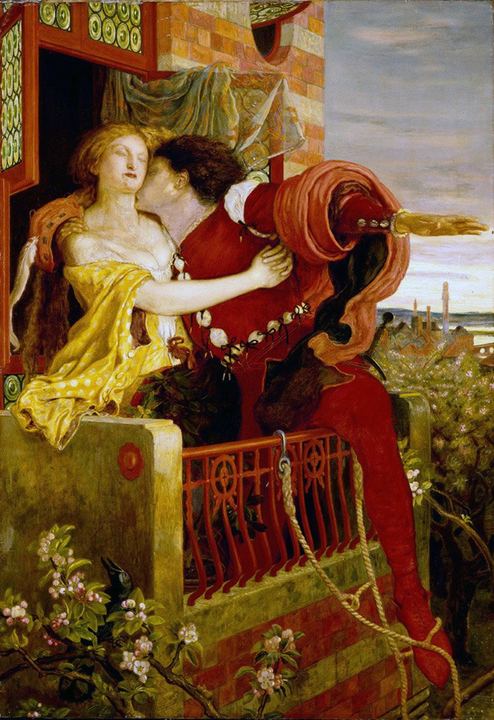
Significance. Popular from its first performances, the tragedy has become the Western archetype of young love opposed by family, retold in Gounod's opera, Prokofiev's ballet and West Side Story, and its balcony scene is perhaps the most recognized moment in English drama.
Main characters
- Romeo: Montague heir, quick to love and quick to despair
- Juliet: Capulet daughter, not yet fourteen, who weds in secret
- Friar Lawrence: Herb-gathering confessor who marries the pair and plans the sleeping draught
- The Nurse: Juliet's garrulous servant and go-between
- Mercutio: Prince's kinsman, master of wordplay, slain by Tybalt
- Tybalt: Juliet's quarrelsome cousin, killed by Romeo
- Lord Capulet: Father who insists on the match with Paris
- Count Paris: Approved suitor who dies at the Capulet monument
- Prince Escalus: Ruler of Verona who forbids further brawls

Summary
Romeo and Juliet is a tragedy of two young lovers from feuding families in Verona, compressed by Shakespeare into about four days. A sonnet Prologue announces that a pair of star-crossed lovers will end their parents' strife by their deaths. In Act I servants of the Capulets and Montagues brawl in the street, and Prince Escalus decrees death for anyone who breaks the peace again. Romeo, Montague's son, is moping for love of Rosaline; his cousin Benvolio and his witty friend Mercutio, who mocks dreams in the Queen Mab speech, bring him masked to the Capulets' feast. Meanwhile Count Paris has asked Lord Capulet for his daughter Juliet, not yet fourteen, and her mother and talkative Nurse urge the match. At the feast Romeo and Juliet meet, share a sonnet and two kisses, and only then learn each other's names; Juliet's cousin Tybalt recognizes Romeo and vows revenge. In Act II Romeo climbs into the Capulet orchard and overhears Juliet at her window wishing he had another name; they exchange vows, and the next day Friar Lawrence, an herbalist who warns that virtue misapplied turns to vice, agrees to marry them in hope of ending the feud. The Nurse carries messages, and the couple are secretly wed. In Act III Tybalt challenges Romeo, who refuses to fight his new kinsman; Mercutio fights instead and is killed under Romeo's arm, cursing both houses. Romeo kills Tybalt and is banished to Mantua. After one night with Juliet he leaves at dawn, and her father, thinking grief for Tybalt is the cause of her tears, orders her to marry Paris within days, threatening to disown her when she refuses; the Nurse advises her to forget Romeo. In Act IV Friar Lawrence gives Juliet a potion that will make her seem dead for forty-two hours, while he sends word to Romeo to rescue her from the family vault. She drinks it the night before the wedding and is mourned and entombed. In Act V Friar John is shut in a house suspected of plague and cannot deliver the letter, so Romeo hears only that Juliet is dead. He buys poison from a starving apothecary, goes to the tomb, kills Paris there, and drinks the poison beside Juliet. She wakes, refuses the Friar's plea to flee, and stabs herself with Romeo's dagger. The Friar explains everything to the Prince; Montague and Capulet are reconciled over their children's bodies and promise golden statues of them. The play was printed in a short quarto in 1597 and a fuller, corrected quarto in 1599.
Virtues in this work
- Prudence: Friar Lawrence's counsel to go wisely and slow in Act 2, Scene 3 names the virtue whose absence drives the tragedy.
- Fortitude: Juliet masters her terror of the vault in Act 4, Scene 3 and drinks the potion to stay faithful to her husband.
- Temperance: The Friar warns before the wedding that violent delights have violent ends and urges a moderate love.
Plot or Argument
- Prologue and Act I: The feud and the feast
A street brawl and the Prince's decree; Romeo's lovesickness for Rosaline; Paris's suit; the Nurse and the earthquake memory; Mercutio's Queen Mab speech; the lovers meet in a shared sonnet at the Capulet feast.
- Act II: Vows and a secret wedding
The orchard scene at Juliet's window; Friar Lawrence among his herbs agrees to marry them; Mercutio teases Romeo and the Nurse; the marriage in the Friar's cell.
- Act III: The turn
Mercutio and Tybalt die; Romeo is banished; Juliet hears the news from the Nurse; the Friar restrains Romeo's despair; the wedding night and the lark at dawn; Capulet commands the match with Paris.
- Act IV: The potion
The Friar's plan and the vial; Juliet's fears in her chamber before she drinks; the household finds her apparently dead on her wedding morning.
- Act V: The tomb
Romeo's dream and the false news; the apothecary; Friar John's failed errand; Paris and Romeo die at the monument; Juliet wakes and dies; the families make peace.
Characters
- Romeo, son of Montague
An impulsive, ardent young man whose love passes from Rosaline to Juliet in one night.
- Juliet, daughter of Capulet
A girl of thirteen who grows in a few days from obedient daughter to resolute wife.
- Friar Lawrence, Franciscan friar
Romeo's confessor and an herbalist, who marries the lovers and devises the plan of the potion.
- The Nurse, Juliet's nurse
A bawdy, affectionate servant who aids the marriage and then counsels bigamy.
- Mercutio, Romeo's friend
A kinsman of the Prince, brilliant and mocking, whose death turns the play to tragedy.
- Tybalt, Juliet's cousin
A hot-tempered swordsman, the Prince of Cats, who keeps the feud alive.
- Benvolio, Romeo's cousin
A would-be peacemaker who reports the fights to the Prince.
- Lord Capulet, Juliet's father
A hospitable but tyrannical head of house who forces the match with Paris.
- Lady Capulet, Juliet's mother
A cool, distant mother who presses Paris's suit and demands Romeo's death.
- Count Paris, suitor
A young nobleman, kinsman of the Prince, who dies at Juliet's tomb.
- Prince Escalus, ruler of Verona
Tries to end the feud by law and finally judges its cost.
- The Apothecary, poison-seller
A starving Mantuan druggist who breaks the law to sell Romeo poison.
Lessons
Haste and its harvest
Friar Lawrence warns Romeo that those who run fast stumble, yet he himself hurries the wedding and then a desperate plan. Nearly every disaster in the play comes from speed: a love sworn in one night, a duel in a moment, a wedding moved up a day, a letter delayed. Shakespeare compresses the source story's months into days so that haste becomes the tragedy's engine.
- List the decisions in Acts III-V made in the heat of the moment. Which one could most easily have gone otherwise?
- Does the Friar follow his own advice?
- Why do you think Shakespeare shortened the story's time so drastically?
Stars or choices?
The Prologue calls the lovers star-crossed, and Romeo defies the stars when he hears Juliet is dead. Yet the plot also turns on human choices: the parents' hatred, Romeo's revenge on Tybalt, Capulet's command, the Friar's scheme. The play holds fate and responsibility in tension rather than settling which is to blame.
- Who does the Prince blame at the end, and who does the Friar blame?
- Is chance, like the plague that stops Friar John, the same thing as fate?
Hatred inherited
No one in Verona remembers why the Capulets and Montagues are enemies, yet servants bite their thumbs and kinsmen draw swords. Mercutio, who belongs to neither house, dies cursing both. The play shows how a quarrel passed from parents to children consumes the very children it was meant to defend.
- Why does Mercutio curse both houses rather than only Tybalt's?
- What finally ends the feud, and what has it cost?
Counsel that fails the young
Juliet turns in turn to her mother, her father, the Nurse and the Friar, and each fails her in a different way. Her line that if all else fail, herself has power to die, follows the Nurse's advice to marry Paris. The play asks what the young need from the adults who guide them.
- What does the Nurse advise in Act III, Scene 5, and why does Juliet call her a most wicked fiend?
- Is Friar Lawrence a wise counselor, a meddler, or both?
- What should a good adult in Verona have done?
Context
The story of the lovers of Verona circulated in Italian novellas by Masuccio Salernitano and Luigi da Porto, and in Matteo Bandello's version (1554), which Pierre Boaistuau adapted into French. Shakespeare's direct source was Arthur Brooke's English poem The Tragicall Historye of Romeus and Juliet (1562), which spans about nine months and frames the lovers as a moral warning. Shakespeare wrote in the mid-1590s, the height of the English sonnet vogue, and builds love-sonnets into the Prologues and the lovers' first exchange.
Composition
The play is usually dated about 1595-96. It was printed in 1597 in a short, unauthorized-seeming first quarto, and in 1599 in a second quarto advertised as newly corrected, augmented and amended; that second quarto underlies most modern texts, and the play appeared in the First Folio in 1623.
Reception
It was popular from the first; the title pages of both early quartos advertise its public performances. Restoration and eighteenth-century versions changed the ending, but Shakespeare's text returned to the stage in the nineteenth century, and the play has been adapted in opera (Gounod), ballet (Prokofiev), musical theatre (West Side Story) and many films, including Franco Zeffirelli's of 1968.
Comparisons
- much-ado-about-nothing
In both plays a friar devises a feigned death for a slandered or desperate bride; in the comedy the plan works and Hero is restored, in the tragedy a delayed letter turns it to real death.
- a-midsummer-nights-dream
Written in the same years, the Dream's mechanicals stage Pyramus and Thisbe, a farcical version of the same plot of forbidden lovers, a wall and a double suicide by mistake.
- metamorphoses
Ovid's Pyramus and Thisbe in Book IV is the ancient pattern for the story of parted lovers, a misread sign of death and a double suicide at a tomb.
- troilus-and-criseyde
Chaucer's lovers, also brought together by a go-between and also undone by war between their peoples, end in betrayal rather than death, a different medieval answer to youthful love.
- tales-from-shakespeare
Charles and Mary Lamb's prose retelling of 1807 introduced generations of children to this plot before they met the verse.
- shakespeares-sonnets
Romeo and Juliet's Prologue and the shared sonnet at the Capulet feast use the same fourteen-line English form Shakespeare used throughout the 154 Sonnets of 1609, where love, time and constancy are also the main subjects.
Quotes
Frequently cited
“A pair of star-cross’d lovers take their life”
Frequently cited
“But soft, what light through yonder window breaks? It is the east, and Juliet is the sun!”
Frequently cited
“What’s in a name? That which we call a rose By any other name would smell as sweet”
Frequently cited
“These violent delights have violent ends”
Frequently cited
“A plague o’ both your houses.”
Frequently cited
“Thy drugs are quick. Thus with a kiss I die.”
“Virtue itself turns vice being misapplied, And vice sometime’s by action dignified.”
“Wisely and slow; they stumble that run fast.”
For Students
A reading companion for classical Christian high school students. See the student guide.
Reading Guide
Watch for
- The sonnets: the Prologue, the Act II Prologue, and the fourteen lines Romeo and Juliet share at the feast in Act 1, Scene 5.
- How Romeo's language about Rosaline in Act 1, Scene 1 differs from his language about Juliet in Act 2, Scene 2.
- Every mention of haste, from the Friar's warning in Act 2, Scene 3 to Capulet moving the wedding to Wednesday in Act 4, Scene 2.
- Images of light in darkness: Juliet as the sun, as a torch, as a lantern in the tomb.
- The point where Mercutio's death in Act 3, Scene 1 turns the play from comedy toward tragedy.
Key terms and names
- Star-crossed
- Thwarted by the stars; the Prologue's word for lovers whose fortunes seem set against them from the start.
- Queen Mab
- The tiny fairy of Mercutio's speech in Act 1, Scene 4, who drives through sleepers' brains bringing dreams that match their desires.
- Prince of Cats
- Mercutio's mocking name for Tybalt, after Tybert the cat in the Reynard fables.
- Shrift
- Confession to a priest; Juliet goes to Friar Lawrence's cell for shrift as the cover for her wedding.
- Banishment
- The Prince's sentence on Romeo after Tybalt's death; Romeo calls it worse than death because it parts him from Juliet.
- Apothecary
- A seller of drugs and remedies; in Mantua selling poison is punished by death, but the starving apothecary sells it to Romeo.
- Sonnet
- A fourteen-line poem in a set rhyme pattern, which Shakespeare uses for the Prologue and the lovers' first conversation.
Seminar Questions
- Comprehension How do Romeo and Juliet meet, and when does each learn who the other is?
- Comprehension What happens in Act 3, Scene 1, and why does Romeo first refuse to fight Tybalt?
- Comprehension What is Friar Lawrence's plan in Act 4, Scene 1, and why does it fail?
- Interpretation Why does Juliet say a rose by any other name would smell as sweet, and is she right about names in Verona?
- Interpretation Friar Lawrence says the same plant can heal or kill. How does that idea apply to love in this play?
- Interpretation The Prologue tells us how the play ends. Why would Shakespeare give away the ending, and how does knowing it change the way we watch?
- Big Question Is love that defies parents and law noble, foolish, or both?
- Big Question Can a whole community be guilty of a death that no single person intended?
Faith Connections
- Song of Songs 8:6-7 (Scripture)
Love is strong as death, and many waters cannot quench it. The play takes this line almost literally, yet asks whether love that leads to death has been rightly ordered.
- Proverbs 19:2 (Scripture)
He that hasteth with his feet sinneth. The Friar's warning that those who run fast stumble restates this proverb, and the whole plot illustrates it.
- Matthew 5:9 (Scripture)
Blessed are the peacemakers. Benvolio, the Prince and the Friar all try to make peace in Verona; only the lovers' deaths succeed, at a terrible cost.
- Augustine, Confessions IV (Church Fathers)
Augustine describes loving a friend as if he would never die and being undone by grief at his death. He calls such love a pouring out of the soul upon what must perish, which helps students weigh Romeo's claim that Juliet is his whole world.
Logic and Rhetoric
Central argument: An inherited feud makes love between a Montague and a Capulet impossible in public. The lovers therefore act in secret and in haste, and the adults who might guide them either command, abandon or scheme. Each hurried act makes the next one more desperate until chance completes the ruin. Therefore the play argues that hatred and haste together destroy what love might have healed, and that the peace bought by the children's deaths indicts the parents who made it necessary.
Rhetorical device: oxymoron. Romeo's speech about love in Act 1, Scene 1 piles up paired opposites such as brawling love and loving hate, and the Friar's warning in Act 2, Scene 6 that 'These violent delights have violent ends' carries the same doubleness into the action.
Debate: Resolved: that Friar Lawrence is more to blame for the deaths of Romeo and Juliet than their parents.
Memory Work
Wisely and slow; they stumble that run fast.
What’s in a name? That which we call a rose By any other name would smell as sweet
Writing Prompts
Essay: Trace the theme of haste through Romeo and Juliet, from the Friar's warning in Act 2, Scene 3 to the moved wedding day and the delayed letter, and argue whether the tragedy comes from fate or from choices made too fast.
Comparison with Much Ado About Nothing: Both plays use a friar's plan to make a young bride seem dead. Compare Friar Lawrence and Friar Francis and argue why the same device ends in marriage in one play and in death in the other.
Medical Lens
The play is a small compendium of Elizabethan ideas about drugs and the passions. Friar Lawrence's herb speech states the period's understanding that one plant may hold both medicine and poison according to dose and use, and his potion, which stops pulse, warmth and breath for forty-two hours, belongs to the folk and literary tradition of death-counterfeiting drugs rather than to any known preparation. Romeo's Mantuan apothecary, with his stuffed alligator, empty boxes and famine in his cheeks, is a famous picture of a poor druggist, and the scene shows that selling poison was a capital offense there. Montague's description of Romeo shutting out daylight in Act I uses the humoral language of love-melancholy, a recognized condition in Renaissance medicine. Friar John's detention by the town's searchers, in a house suspected of plague, reflects real quarantine practice. The two suicides, Juliet's earlier threats of self-destruction, and Lady Montague's death from grief at Romeo's exile give the play a recurring interest for discussions of youth, impulsivity and self-harm; such modern readings are interpretive.
- Act 1, Scene 1
Montague describes Romeo's sleeplessness, tears and darkened room, calling it a black and portentous humour; Benvolio prescribes looking at other beauties.
- Act 2, Scene 3
Friar Lawrence gathers herbs and reflects that a single flower contains poison and medicine.
- Act 4, Scenes 1 and 3
The Friar describes the potion's effects; Juliet, alone with the vial, fears poison, suffocation in the vault and madness among the bones.
- Act 5, Scene 1
Romeo seeks out the starving apothecary and buys a fast-acting poison against Mantua's law.
- Act 5, Scene 2
Friar John explains that the searchers sealed him in a house where pestilence was suspected, so the letter never reached Romeo.
- Act 5, Scene 3
Romeo poisons himself and Juliet stabs herself; Montague reports that his wife has died of grief.
Listen to the book
Public-domain audiobook from LibriVox, read by Sam Stinson. Recording: Romeo and Juliet (version 3) on LibriVox (Internet Archive).
LibriVox recordings are volunteer readings released into the public domain. The reading may follow a different edition from the text in this library.
Creative Prompts
- Classroom
Build a timeline of the play from Sunday to Thursday morning and mark each decision that hastened the end.
- Dialogue
Write the conversation in which Friar Lawrence explains to the Prince why he thought the potion plan was wise, in your own words.
- Poetry
Write a sonnet in Shakespeare's form from the point of view of Rosaline or Paris.
- Essay
Who bears most responsibility for the deaths of Romeo and Juliet? Argue from the text, weighing the parents, the Friar, the Nurse, the lovers and chance.
Further Reading
- The Tragicall Historye of Romeus and Juliet, Arthur Brooke
Shakespeare's main source (1562).
- A Midsummer Night's Dream, William Shakespeare
- Shakespeare: The Invention of the Human, Harold Bloom
- Will in the World, Stephen Greenblatt
Verification notes
Plot, sources and the 1597 and 1599 quartos are standard. Act and scene locators follow the attached Project Gutenberg #1513 text, which numbers the Act II Prologue separately. All quotes were found verbatim in that text, including its spelling sometime’s in Act 2, Scene 3. Readings of the suicides in modern clinical terms are interpretive.
- The usual composition date of about 1595-96 is conjectural.