Work record
The Blue Fairy Book
1889 · 19th Century · Collection · English
Abstract
Background. Andrew Lang, a Scottish man of letters who wrote widely on myth and folklore, assembled the volume for young readers in 1889. Its success launched a run of twelve coloured Fairy Books ending with the Lilac in 1910.
Sources. Lang's collaborators, many of them women translators including his wife Leonora, drew on Perrault ('Cinderella', 'Blue Beard', 'The Sleeping Beauty in the Wood'), the Grimms ('Rumpelstiltzkin', 'The Goose-Girl'), Madame d'Aulnoy ('The Yellow Dwarf', 'The White Cat'), Asbjørnsen and Moe ('East of the Sun and West of the Moon') and the Arabian Nights ('Aladdin', 'The Forty Thieves'). British material includes 'The History of Whittington' and 'The Red Etin', while 'The Terrible Head' retells Perseus and 'A Voyage to Lilliput' abridges Swift.
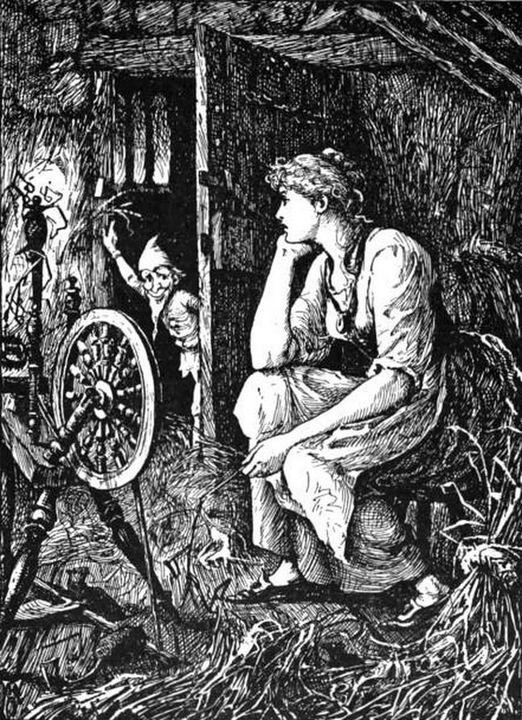
Structure. Each tale stands alone, from a few pages to near novella length, and French court elegance sits beside Norwegian and Scottish plainness. H. J. Ford's line drawings set the visual style of the whole series.
Themes. Youngest and slighted children are raised up, kindness to helpers is repaid, forbidden doors and broken bans bring trials, and fidelity undoes enchantment, as in 'Beauty and the Beast' and 'The Black Bull of Norroway'.
Significance. The book fixed a common stock of fairy tales for English-speaking households for generations. Tolkien's essay 'On Fairy-Stories', first given as the Andrew Lang Lecture of 1939, engages directly with Lang's collections.
Main characters
- Cinderella: Mistreated stepdaughter aided by a fairy godmother, from Perrault
- Beauty and the Beast: Merchant's daughter whose faithfulness breaks the enchantment on her monstrous host
- Aladdin: Idle youth who wins a palace and a princess through a magic lamp
- The Master Cat: Puss in Boots, whose trickery makes a miller's son a marquis
- Blue Beard: Wealthy husband whose forbidden closet hides the bodies of former wives
- Hansel and Grettel: Abandoned brother and sister who outwit a witch in the forest
- Rumpelstiltzkin: Dwarf who spins straw into gold and demands a queen's child
- Little Red Riding Hood: Girl devoured by the wolf in Perrault's unrescued version
- Jack the Giant Killer: Cornish hero of the English chapbook tradition who slays giants by cunning

Summary
The Blue Fairy Book (1889), edited by Andrew Lang, gathers European fairy tales into one household volume that became the first of the famous colored fairy books. Lang and his collaborators retell stories from Perrault, the Brothers Grimm, Madame d’Aulnoy, and other streams so that children meet Cinderella, Sleeping Beauty, Aladdin, and many less anthologized tales in a single readable English. The collection is not a scholarly apparatus; it is a curated doorway into wonder, with openings that name a lack or wish, middles that test courage and kindness under deadlines, and endings that restore or reward. For School Launch’s K–2 band it supplies shared mythic vocabulary—helpers, bans, transformations, true and false brides—without requiring a child to master every national tradition at once. Teachers can choose one tale for narration practice, another for comparing helper figures, and a third for noticing how tone shifts between French polish and German sternness. The book treats enchantment as moral theater: greed, envy, and broken promises carry consequences, while patience and pity often open the way home. Lang’s editorial spirit is appreciative of folk imagination rather than embarrassed by it. Because the volume is a collection, School Launch may emphasize a handful of tales while the Classics Library stores the full Gutenberg text for verification and wider browsing. Readers who later meet MacDonald or Andersen will recognize patterns first rehearsed here. The Blue Fairy Book remains a practical school and home treasury: short enough in units for bedtime, large enough as a whole to furnish years of revisiting. A strong unit pairs one Perrault tale with one Grimm tale and asks what changes when the helper is a fairy godmother rather than a talking animal. Key terms such as test, ban, and reward become tools for seminar without flattening wonder into slogans. Exact lines for memory should be taken from a single chosen tale in the stored text so quotation stays honest.
Virtues in this work
Plot or Argument
- A treasury of tales
Many independent stories share the volume; each has its own heroes, helpers, and tests.
- Wonder and justice
Enchantments raise stakes; endings often restore right order after suffering or folly.
- Choosing tales
School Launch invites parents to select; the library keeps the full collection for browsing.
Characters
- Various fairy-tale heroes, ensemble
Princesses, youngest sons, and clever helpers across the tales.
- Andrew Lang, editor
Compiler of the English collection.
Lessons
Choose and narrate
A collection teaches selection: pick a tale, narrate it whole, then name its virtue or vice.
- Which tale did you choose and why?
- What was the hero’s main test?
Enchantment has rules
Gifts, curses, and deadlines bind characters; breaking faith has costs.
- What rule did a character break?
- How is the ending just?
Kindness and envy
Cinderella and kindred tales contrast humility with envious sisters.
- Who shows envy?
- How is kindness shown in action?
Context
Late-Victorian folklorism for children, drawing on Perrault, Grimm, and other streams into English household reading.
Composition
First of Lang’s colored fairy books, 1889.
Reception
Opened a famous series and shaped English-speaking children’s fairy-tale canons.
Comparisons
- aesops-fables
Short morals versus wonder-tale plots; both form judgment.
- the-princess-and-the-goblin
Victorian children’s fantasy with fear and trust, as a single novel beside the anthology.
Quotes
“There were formerly a king and a queen, who were so sorry that they had no children; so sorry that it cannot be expressed.”
“Once there was a gentleman who married, for his second wife, the proudest and most haughty woman that was ever seen.”
“Once upon a time, in a very far-off country, there lived a merchant who had been so fortunate in all his undertakings that he was enormously rich.”
For Students
A reading companion for classical Christian high school students. See the student guide.
Reading Guide
Watch for
- How a tale’s opening names a lack or wish.
- Tests, deadlines, and helpers.
- How endings restore or reward.
- Differences among French and German tones.
- Words worth memorizing from one tale.
Key terms and names
- Fairy tale
- A traditional wonder-story with magic, tests, and a decisive ending.
- Perrault
- French source behind several Blue Fairy tales such as Sleeping Beauty and Cinderella.
- Motif
- A recurring story element, such as three tasks or a glass slipper.
- Selection
- Reading some tales deeply rather than rushing the whole book.
Seminar Questions
- Comprehension Name three tales in the Blue Fairy Book.
- Comprehension In Sleeping Beauty, why are the fairies invited?
- Comprehension What happens to Cinderella at the ball?
- Interpretation Why collect many cultures’ tales in one English book?
- Interpretation Is a hard ending ever kinder than a soft one?
- Interpretation How does a fairy tale teach without Aesop’s printed moral?
- Big Question Should children hear dark fairy-tale perils, or only gentle ones?
Faith Connections
- Psalm 19:1 (Scripture)
Wonder at made glory pairs with fairy-tale awe at gifts and skies—without confusing genres.
- Proverbs 31:30 (Scripture)
Favour is deceitful—Cinderella’s beauty of goodness over vain display.
- Tolkien, On Fairy-Stories (Great Conversation)
Later reflection on fairy-tale consolation; Lang supplies the tales themselves.
Logic and Rhetoric
Central argument: Wonder tales train moral imagination by showing courage, envy, and faithfulness under enchantment.
Rhetorical device: motif repetition. Three wishes, three sisters, or three nights recur so children learn story grammar.
Debate: Resolved: that fairy tales should keep their dangers as well as their joys.
Memory Work
There were formerly a king and a queen, who were so sorry that they had no children; so sorry that it cannot be expressed.
Writing Prompts
Essay: Retell one tale and name its chief virtue and vice with evidence.
Comparison with Aesop's Fables: Compare one Lang tale with an Aesop fable: what does wonder add to moral clarity?
Medical Lens
Sleeping Beauty’s enchanted sleep is plot magic, not medicine; mention only to distinguish curse from illness.
- Sleeping Beauty
The princess’s long sleep under enchantment.
Listen to the book
Public-domain audiobook from LibriVox, read by Various volunteers. Recording: Blue Fairy Book on LibriVox (Internet Archive).
LibriVox recordings are volunteer readings released into the public domain. The reading may follow a different edition from the text in this library.
Creative Prompts
- Classroom
Narrate one tale with three students as characters.
- Fiction
Write a new fairy-tale test of three nights for a humble hero.
- Essay
Why did Lang color-code fairy books rather than print one huge volume?
Further Reading
- The Princess and the Goblin, George MacDonald
A single Victorian fairy novel.
Verification notes
Quotes verified against PG #503.
No verification flags recorded.