Work record
Paul Revere's Ride
written 1860; published 1861 · 19th Century · Poetry · English
Abstract
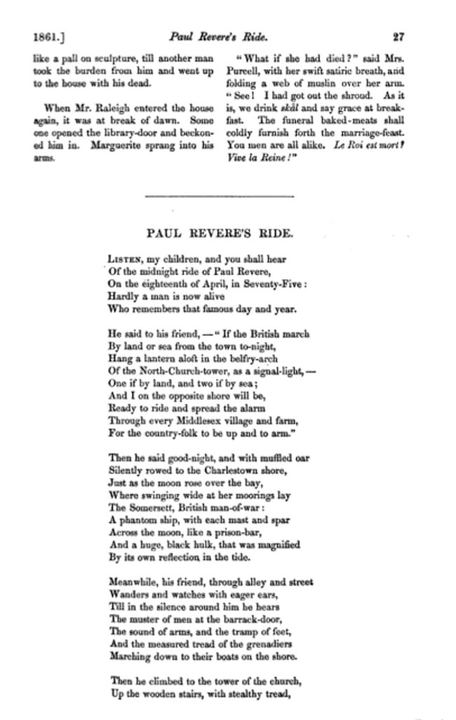
Background. Longfellow, then America's most popular poet, composed this ballad in 1860 while secession threatened the Union, and The Atlantic printed it at the turn of the year. Three years later it became the innkeeper's story opening his Wayside Inn sequence.
Content. A prearranged steeple signal tells the waiting horseman which route the troops are taking. After slipping past an anchored warship by rowboat, Revere watches from across the harbour until the second lamp shines, then gallops through sleeping towns, each arrival timed by a village clock. A brief sketch of the next day's skirmishing follows, and a final stanza promises that his warning will sound again whenever the country faces danger.
Form. Driving four-stress lines with frequent double unstressed syllables imitate hoofbeats, while the shifting stanza lengths let the narrative speed up for the ride and slow down for the watch in the tower.
Themes. Vigilance, the outsized consequence of small acts, the cooperation of watcher and messenger, and the handing on of national memory to the young as a summons to courage.
Significance. Recited in American classrooms for generations, it made Revere's name a household word. Historians since have restored the parts played by Dawes, Prescott and the signal-bearers, without displacing the ballad's hold on popular memory.
Main characters
- Paul Revere: Boston silversmith who carries the warning by horseback
- Revere's friend: Anonymous lookout who climbs the steeple and shows the lanterns
- The British grenadiers and Regulars: Crown troops crossing to the mainland to march inland
- The farmers of Middlesex: Country militia who answer the alarm and harry the retreat
- The storyteller: Narrator speaking to children; the innkeeper in the 1863 frame

Watch the summary
Paul Revere's Ride in 112 seconds · 1:52
Summary
Paul Revere's Ride is a narrative ballad that tells how a Boston silversmith carried the alarm of a British march into the Massachusetts countryside on the night of 18 April 1775. It opens like a story told aloud, Listen, my children, and notes that hardly anyone still alive remembers the day. Revere tells a friend to watch the British troops and hang a signal lantern in the belfry arch of the North Church, one if the troops go by land and two if by sea. Revere then rows quietly across to the Charlestown shore past the British warship Somerset, which looms across the moon like a prison bar. In Boston the friend hears the grenadiers marching to their boats and climbs the church tower, startling pigeons from the rafters, and looks down over the moonlit town and the churchyard where the dead lie like a sleeping army. Across the water Revere waits impatiently beside his horse until one light and then a second appear in the steeple. The central stanzas follow the ride itself: hoofbeats in a village street, a spark struck from the stones that the poem says kindled the land into flame. Revere crosses the Mystic and reaches Medford at twelve, Lexington at one and the bridge in Concord at two, each stop marked by sounds and sights of the sleeping countryside. The poem notes that one man asleep in his bed would be first to fall at the bridge that day. Then it says simply, You know the rest, and sketches the fighting as farmers fire from behind fences and walls while the Regulars retreat. The closing stanza turns the ride into a permanent national memory: in any hour of darkness and peril the people will hear the hoofbeats of that steed. Longfellow wrote the poem in 1860 as the Union neared civil war. He compressed and altered the history, giving Revere the whole ride and having him wait for the lantern signal he had in fact arranged, and the poem fixed Revere's name in American memory.
Virtues in this work
- Fortitude: Revere rows past a British man-of-war and rides through the night knowing that capture could follow.
- Prudence: The plan of one lantern for land and two for sea lets the alarm go out whichever route the troops take.
- Friendship: The unnamed friend climbs the dark belfry and risks discovery so that Revere can carry the warning.
Plot or Argument
- Lines 1-14: the invitation and the plan
The storyteller calls his listeners to hear of the ride on 18 April 1775. Revere instructs his friend to hang one lantern in the North Church tower if the British march by land and two if by sea, while he waits across the river to spread the alarm.
- Lines 15-56: the crossing and the watch in the tower
Revere rows silently to Charlestown past the warship Somerset. His friend hears the grenadiers mustering and climbs the belfry, where he looks down on the moonlit town and the churchyard dead before seeing boats on the rising tide.
- Lines 57-80: the signal and the spark
Revere paces beside his horse, watching the steeple, until two lamps appear. He mounts and rides; a spark struck from the pebbles by his horse becomes the image of a nation's fate kindled in one night.
- Lines 81-110: Medford, Lexington, Concord
The ride passes the Mystic River and reaches Medford at midnight, Lexington at one and the Concord bridge at two. Each town is drawn in sounds and moonlit sights, and the poem foreshadows the death of a man at the bridge the next day.
- Lines 111-130: the battle and the lasting echo
The poem summarizes the day's fighting as the farmers drive the Regulars back from fence and wall, then declares that Revere's cry of defiance will sound again whenever the people face darkness and peril.
Characters
- Paul Revere, Hero and rider
A Boston Patriot who waits on the Charlestown shore for the lantern signal and then rides through the night to rouse the countryside.
- Revere's friend, Watcher in the tower
An unnamed ally who tracks the British troops through Boston's streets and hangs the lanterns in the North Church belfry.
- The British grenadiers and Regulars, The marching army
Troops heard mustering at the barrack door and heading to their boats, later driven back by the farmers' fire.
- The farmers of Middlesex, Militia
The country people roused by the alarm, who give the Regulars ball for ball from behind fences and walls.
- The storyteller, Narrator
The voice that addresses its listeners as my children; in Tales of a Wayside Inn he is the Landlord of the inn.
Lessons
One alarm, many hands
The poem's plan depends on two people: a friend who watches and signals and a rider who carries the word. Neither succeeds alone, and the ride matters only because villages and farms answer the alarm. Longfellow shows that a single act of courage becomes history when others are ready to respond.
- What does the friend in the tower risk, and why does the poem leave him unnamed?
- Why does Revere wait across the river instead of carrying the signal himself?
- What would the ride have meant if no one had answered the knock at the door?
How a poem makes memory
Longfellow tells the story to children and claims that hardly anyone alive remembers the day; the poem itself will now do the remembering. He chooses vivid, repeatable details, the lanterns, the spark, the village clock, so that the event can be passed on. A nation's memory, the poem suggests, is carried as much by stories as by records.
- Why does the poem begin Listen, my children?
- Which details in the poem are easiest to remember, and why?
- When a poem simplifies history to make it memorable, what is gained and what is lost?
A word for the hour of peril
The final stanza turns a night in 1775 into a call that will echo in every hour of darkness and peril and need. Written as the Union moved toward war in 1860, the poem asks readers to wake as the Middlesex farmers did. Remembering past courage is presented as a summons to present duty.
- Why might Longfellow have told this story in 1860?
- What does it mean that the cry was one of defiance and not of fear?
- What would it mean for a people to waken and listen to hear in their own time?
Context
On the night of 18-19 April 1775, General Thomas Gage sent British troops from Boston to seize militia stores at Concord. Dr Joseph Warren dispatched Paul Revere and William Dawes to warn Lexington, where John Hancock and Samuel Adams were staying, and the countryside beyond. Revere had arranged beforehand for lanterns to be shown in the steeple of Christ Church, the Old North, to signal Patriots in Charlestown in case he could not get out. He rowed past HMS Somerset, rode to Lexington, and set out for Concord with Dawes and Samuel Prescott; a British patrol captured Revere near Lincoln, and Prescott carried the alarm on to Concord. Fighting at Lexington and Concord's North Bridge opened the Revolutionary War.
Composition
Longfellow wrote the poem in the spring of 1860, around the time he visited the Old North Church. It appeared in The Atlantic Monthly in the January 1861 issue, as Southern states were leaving the Union. In 1863 he placed it first in Tales of a Wayside Inn as The Landlord's Tale, told by the host of the Sudbury inn to a circle of guests. The verse is a loose four-beat line with many anapests, rhymed mostly in couplets and triplets, which gives it the rhythm of a galloping horse.
Reception
The poem was popular at once and became a schoolroom recitation piece for generations, making Revere a national hero far better known than Dawes or Prescott. Historians have long noted its changes to the record: Revere arranged the signal rather than received it, did not ride alone, and never reached Concord. David Hackett Fischer's Paul Revere's Ride (1994) restored the fuller history while acknowledging the poem's power in shaping how Americans remember the night.
Comparisons
- give-me-liberty-or-give-me-death
Patrick Henry's speech to the Virginia Convention came in March 1775, less than a month before Revere's ride, and called for the same readiness to resist that the Middlesex farmers showed in April.
- st-crispins-day-speech
Henry V promises that Crispin's day will be remembered to the ending of the world; Longfellow promises that Revere's hoofbeats will echo forevermore. Both texts make a single day into a permanent national memory.
- o-captain-my-captain
Whitman's elegy for Lincoln and Longfellow's ballad both belong to the Civil War years and use a single figure, captain or rider, to carry a nation's crisis in strongly rhythmic verse.
- gettysburg-address
Lincoln at Gettysburg, like Longfellow, reaches back to the founding generation of the 1770s to rouse the Union in its own hour of peril.
Quotes
Frequently cited
“Listen, my children, and you shall hear Of the midnight ride of Paul Revere, On the eighteenth of April, in Seventy-five;”
Frequently cited
“One, if by land, and two, if by sea;”
Frequently cited
“That was all! And yet, through the gloom and the light, The fate of a nation was riding that night; And the spark struck out by that steed, in his flight, Kindled the land into flame with its heat.”
Frequently cited
“In the hour of darkness and peril and need, The people will waken and listen to hear The hurrying hoof-beats of that steed, And the midnight message of Paul Revere.”
“A phantom ship, with each mast and spar Across the moon like a prison bar,”
“It was one by the village clock, When he galloped into Lexington.”
“A cry of defiance and not of fear, A voice in the darkness, a knock at the door, And a word that shall echo forevermore!”
For Students
A reading companion for classical Christian high school students. See the student guide.
Reading Guide
Watch for
- The opening address Listen, my children and the claim that hardly a man is now alive who remembers the day, which set up the poem as remembered story.
- The Somerset described as a phantom ship with masts across the moon like a prison bar (lines 20-21).
- The churchyard dead in their night-encampment on the hill (lines 42-56), seen from the belfry just before the signal.
- The spark struck from the pebbles in lines 75-80, where a tiny detail becomes the fate of a nation.
- The three stanzas that begin It was twelve, It was one, It was two by the village clock, and the sudden You know the rest that follows.
Key terms and names
- North Church
- Christ Church in Boston's North End, the Old North, whose tall steeple could be seen from Charlestown across the river; the lanterns hang in its belfry arch.
- belfry
- The bell chamber of a church tower. The friend climbs its wooden stairs and trembling ladder to the highest window to hang the signal.
- Somerset
- A British man-of-war anchored in the river between Boston and Charlestown, which Revere must row past unseen.
- grenadiers
- Tall, picked infantry soldiers. The friend hears their measured tread as they march to the boats that will carry them across the river.
- Middlesex
- The Massachusetts county west and north of Boston that includes Lexington and Concord, whose villages and farms Revere must rouse.
- Regulars
- Professional soldiers of the British army, as distinct from the local militia of farmers who fought them on 19 April 1775.
- The Landlord's Tale
- The title the poem carries in Tales of a Wayside Inn (1863), where the innkeeper tells it to his guests at Sudbury.
Seminar Questions
- Comprehension What does one lantern mean and what do two mean, and who hangs them?
- Comprehension Through which towns does Revere ride, and at what hours does he reach each?
- Comprehension What does the poem say about the man who was safe and asleep in his bed at Concord?
- Interpretation Why does the friend in the tower pause over the churchyard dead before seeing the boats? What does that scene add to the poem?
- Interpretation Lines 77-80 say the fate of a nation was riding that night. How does the image of a single spark support that claim?
- Interpretation Why does Longfellow cut the battle short with You know the rest rather than describing it fully?
- Big Question Is it right for a poem to change historical facts if it makes the truth of an event's courage more memorable?
Faith Connections
- Ezekiel 33:2-6 (Scripture)
God sets a watchman who, seeing the sword come, must blow the trumpet and warn the people; if he keeps silent, their blood is on his hands. Revere and his friend in the belfry act out the watchman's duty in the night.
- Joshua 4:6-7 (Scripture)
Israel sets up memorial stones so that when children ask what they mean, the story of deliverance can be told. Longfellow's Listen, my children makes the poem itself such a memorial.
- Psalm 78:4-7 (Scripture)
The psalmist resolves to show the generation to come the works of the Lord, so that children not yet born might know them and set their hope in God. The poem's promise that the people will waken and listen in every hour of need draws on this pattern of memory handed down.
Logic and Rhetoric
Central argument: A small act at the right moment can decide great events: one rider, one signal and one spark kindled a nation's resistance (lines 77-80). Because the day is passing out of living memory (lines 4-5), the story must be told to the young. Therefore the memory of Revere's ride should be kept alive, so that in any future hour of darkness and peril the people will waken to its message (lines 127-130).
Rhetorical device: anaphora. Lines 87, 93 and 101 each open It was twelve, It was one, It was two by the village clock, marking the ride's progress like the strokes of a bell and building suspense toward Concord.
Debate: Resolved: that Longfellow was justified in giving Paul Revere sole credit for the midnight ride.
Memory Work
Listen, my children, and you shall hear Of the midnight ride of Paul Revere, On the eighteenth of April, in Seventy-five;
In the hour of darkness and peril and need, The people will waken and listen to hear The hurrying hoof-beats of that steed, And the midnight message of Paul Revere.
Writing Prompts
Essay: Compare the poem's account of 18-19 April 1775 with the historical record of Revere, Dawes and Prescott. Argue why Longfellow made the changes he did and whether they serve or distort the meaning of the night.
Comparison with The St Crispin's Day Speech: Both Henry V's speech and Longfellow's poem promise that a single day will be remembered forever. Compare how each text persuades its hearers to make that memory their own, and what each asks them to do because of it.
Creative Prompts
- Classroom
Read the poem aloud while tapping the beat, then map the ride on a period map of Boston, Charlestown, Medford, Lexington and Concord, marking where the poem and the historical record agree and differ.
- Poetry
Write a short ballad in Longfellow's galloping four-beat line about a messenger in another moment of history, opening with a call to listeners as Listen, my children does.
- Fiction
Retell the night from the point of view of the unnamed friend in the North Church tower, from the sound of the grenadiers to the moment the second lantern is lit.
Further Reading
- Paul Revere's Ride, David Hackett Fischer
The standard modern history of the night of 18-19 April 1775.
- Tales of a Wayside Inn, Henry Wadsworth Longfellow
The 1863 collection in which the poem is The Landlord's Tale.
- Longfellow: A Rediscovered Life, Charles C. Calhoun
Verification notes
The historical outline of 18-19 April 1775 (Warren, Dawes, Prescott, Revere's capture near Lincoln, the prearranged signal) is well established. Publication in The Atlantic Monthly for January 1861 and in Tales of a Wayside Inn in 1863 is certain; the exact day of composition and of Longfellow's visit to the Old North Church in April 1860 are given only approximately. The people who hung the lanterns are commonly identified as the sexton Robert Newman and John Pulling, but the poem names no one and this record does not rely on it. Line numbers count 130 lines in the attached 1863 text.
No verification flags recorded.