Work record
Second Inaugural Address
1865 · 19th Century · Oratory · English
Abstract
Background. Reelected in November 1864, Lincoln spoke as Confederate resistance crumbled and as Congress had just approved abolition by amendment. Many in the crowd awaited celebration and a plan for the defeated states.
Content. Instead the president skips any account of battlefield gains and forecasts nothing. He reviews 1861, when neither section wanted conflict yet one chose it, then states that bondage was the root of the struggle. Since Union and Confederate believers alike asked heaven for success, he concludes that providence pursued an aim beyond either. Citing the Gospel of Matthew, he treats the carnage as a penalty laid on the entire country for slavery. A closing sentence asks for reconciliation, relief for veterans and bereaved families, and peace.
Themes. Divine sovereignty sits beside human guilt; righteous judgment yields to mercy; and conviction is held with humility, since the speaker claims only the right as God gives him to see it.
Form. Short words, balanced antitheses, and King James phrasing give the prose the sound of Scripture, and the brevity itself became part of its meaning.
Significance. Lincoln predicted the speech would wear well though it was not immediately popular. Forty-one days later he was assassinated, and the text now stands engraved inside his memorial.
Key figures
- Abraham Lincoln: Sixteenth president, beginning his second term
- Andrew Johnson: Vice president sworn in the same day
- Salmon P. Chase: Former Treasury secretary, named Chief Justice by Lincoln in 1864, who swore him in
- Frederick Douglass: Abolitionist in the audience who praised the speech that evening

Summary
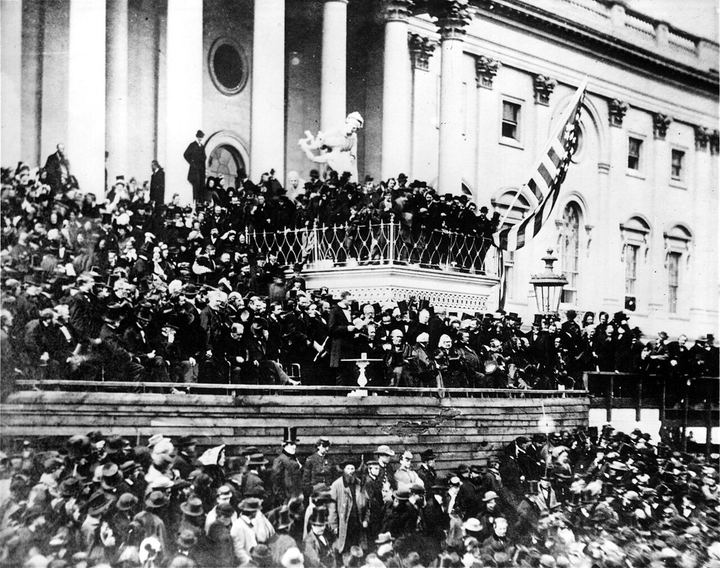
Abraham Lincoln took the oath for his second term on 4 March 1865 on the East Portico of the Capitol, under a newly finished dome, before a crowd standing in mud after a morning of rain. The war was nearly won: Sherman had marched through Georgia and the Carolinas, Grant held Lee at Petersburg, and Congress had sent the Thirteenth Amendment to the states five weeks earlier. Listeners might have expected a victory speech. Lincoln gave one of about 700 words, the second shortest inaugural address, and it claimed no triumph. He begins by declining to review the progress of the armies, which everyone already knows, and offers no prediction. He then recalls March 1861, when both sides dreaded war and one would make war rather than let the nation survive, while the other would accept war rather than let it perish; and the war came. The long third paragraph is the theological heart of the address. Lincoln names slavery as the interest everyone knew was somehow the cause of the war, notes that neither side expected so long or so fundamental a conflict, and observes that both read the same Bible and pray to the same God. He refuses to condemn the South (let us judge not, that we be not judged) and declares that the Almighty has His own purposes. Quoting Matthew 18:7, he proposes that American slavery is an offense God now wills to remove, and that the war is the woe due to North and South alike. If the war must go on until every drop of blood drawn with the lash is paid by another drawn with the sword, still the judgments of the Lord are true and righteous altogether, words from Psalm 19. The single-sentence final paragraph turns from judgment to mercy: with malice toward none and charity for all, the nation must bind up its wounds, care for the soldier, his widow and his orphan, and seek a just and lasting peace. Frederick Douglass, who heard it, called it a sacred effort. Six weeks later Lincoln was dead, and the address is carved in the north chamber of the Lincoln Memorial.
Virtues in this work
- Humility: Lincoln refuses to claim God as the Union's partisan, admitting that neither side's prayers were answered fully and that the Almighty has His own purposes.
- Charity: On the eve of victory he asks for malice toward none and charity for all toward a defeated enemy.
- Justice: He names two hundred and fifty years of unrequited toil as an offense that must be paid for, and judges the war's cost righteous.
- Piety: The whole argument rests on submission to God's judgments, which Lincoln calls true and righteous altogether in the words of Psalm 19.
Plot or Argument
- No review, no prediction (Paragraph 1)
Lincoln contrasts this occasion with his first inauguration, when a detailed statement of policy seemed fitting. The war's progress is already public and reasonably encouraging, and he deliberately ventures no forecast about the future.
- How the war came (Paragraph 2)
Looking back to March 1861, he recalls that all dreaded war and sought to avert it while insurgent agents worked to dissolve the Union by negotiation. One side would make war and the other would accept it, and the war came.
- Slavery and the shared Bible (Paragraph 3, first half)
Lincoln names slavery, one-eighth of the population held in bondage in the South, as the interest that was somehow the cause of the war. Neither side expected its scale; both pray to the same God against the other; and he checks his own judgment of the South with the words of Christ.
- The Almighty has His own purposes (Paragraph 3, second half)
Neither side's prayers have been fully answered. Lincoln reads the war as the woe God gives to both North and South for the offense of slavery, hopes and prays it may soon end, but accepts that if it must continue the judgments of the Lord are still true and righteous.
- With malice toward none (Paragraph 4)
In one long sentence Lincoln turns to the work ahead: to finish the war, bind up the nation's wounds, care for wounded soldiers, widows, and orphans, and achieve a just and lasting peace at home and among all nations.
Key claims
The main steps of the argument, in order, and how they fit together.
- The war's progress is already known to all, so this occasion calls for neither a long policy statement nor a prediction.How it is supported: Contrast with the detailed address given at his first inauguration.
- In 1861 everyone dreaded war, yet one side would make war to break up the nation while the other would accept war to save it.How it is supported: A recollection of the events surrounding his first inauguration.
- Slavery, holding one-eighth of the population in bondage, was the interest everyone knew was somehow the cause of the war.How it is supported: The well-known facts of Southern slavery and the effort to extend it.
- Both sides read the same Bible and pray to the same God, and neither side's prayers have been fully answered.How it is supported: Christ's warning against judging others, which Lincoln applies to himself.
- God has His own purposes, which differ from the aims of both North and South.How it is supported: Reasoning from the fact that neither side's prayers were fully granted.
- The war may be the woe God gives to both North and South for the offense of American slavery.How it is supported: Matthew 18:7 on the woe that comes to those through whom offenses come.
- God's judgments remain true and righteous even if the war must go on until the wrongs of slavery are fully repaid.How it is supported: Psalm 19:9 on the righteousness of the Lord's judgments.
- The nation should finish its work without malice and with charity, binding its wounds, caring for soldiers, widows and orphans, and seeking lasting peace.How it is supported: An appeal to duty and to firmness in the right as God gives the nation to see it.
Argument map
Supported by
- 6The war may be the woe God gives to both North and South for the offense of American slavery.
which rests on
- 2In 1861 everyone dreaded war, yet one side would make war to break up the nation while the other would accept war to save it.
- 3Slavery, holding one-eighth of the population in bondage, was the interest everyone knew was somehow the cause of the war.
- 5God has His own purposes, which differ from the aims of both North and South.
which rests on
- 4Both sides read the same Bible and pray to the same God, and neither side's prayers have been fully answered.
- 7God's judgments remain true and righteous even if the war must go on until the wrongs of slavery are fully repaid.
- 8The nation should finish its work without malice and with charity, binding its wounds, caring for soldiers, widows and orphans, and seeking lasting peace.
which rests on
- 1The war's progress is already known to all, so this occasion calls for neither a long policy statement nor a prediction.
Therefore
Plain-language summaries of the author's argument, not quotations.
Lessons
Humility in judgment
At the moment of victory Lincoln declines to claim that God is simply on the Union's side. Both armies pray to the same God, neither prayer has been answered fully, and the war is a woe due to North and South together. He condemns slavery plainly while refusing to set his own section above judgment.
- Why does Lincoln say the prayers of both sides could not be answered, and that neither has been answered fully?
- How can Lincoln call slavery an offense and still say let us judge not?
- What would have been lost if Lincoln had given a victory speech instead?
Providence and responsibility
Lincoln interprets the war as part of God's purposes without making human beings mere puppets: offenses must needs come, yet woe to the one by whom they come. He holds divine sovereignty and human guilt together, as the verse he quotes from Matthew does.
- What does Lincoln mean by The Almighty has His own purposes?
- How does the quotation from Matthew 18:7 allow him to speak of both providence and guilt?
- Is it wise for a political leader to interpret current events as the judgment of God? What safeguards does Lincoln use?
Mercy after justice
The address moves from the hard justice of blood for blood to a closing sentence of charity, healing, and care for the wounded and bereaved. Lincoln shows that a just verdict on the past does not cancel the duty of mercy toward former enemies and the war's victims.
- List the tasks named in the final sentence. Which look backward and which look forward?
- Why does Lincoln place malice toward none immediately after the darkest passage of the speech?
- What would it mean for a nation, and not only a person, to act with charity for all?
Context
By March 1865 the Confederacy was collapsing. Atlanta, Savannah, and Columbia had fallen, Lee's army was besieged at Petersburg, and the Thirteenth Amendment abolishing slavery had passed Congress on 31 January. Lincoln had been reelected in November 1864 over George McClellan. Questions of reconstruction, the treatment of the defeated South, and the future of the freed people were already dividing his own party.
Composition
Lincoln wrote the address himself in the weeks before the inauguration, and it shows the habits of his private reflection on providence, especially the undated fragment known as the Meditation on the Divine Will, usually placed in 1862. Its 701 words are built almost entirely from short Anglo-Saxon words and from the King James Bible, which it quotes or echoes repeatedly (Genesis 3:19, Matthew 7:1, Matthew 18:7, Psalm 19:9). The Avalon text stored here runs the address together as a single block; it is conventionally printed in four paragraphs.
Reception
Newspaper response divided along party lines, and Lincoln himself wrote to Thurlow Weed that he expected the speech to wear well but did not think it immediately popular, since men are not flattered to be told that their purposes differ from the Almighty's. Frederick Douglass, admitted to the White House reception that evening, told Lincoln it was a sacred effort. After the assassination on 14 April it came to be read as Lincoln's testament, and it was inscribed beside the Gettysburg Address in the Lincoln Memorial, dedicated in 1922.
Comparisons
- gettysburg-address
Both are brief, biblical in cadence, and concerned with the meaning of the war, but Gettysburg (1863) asks the living to finish the unfinished work, while the Second Inaugural asks what God intended by the war and how to end it in charity.
- narrative-and-fourth-of-july
Douglass, who heard the Second Inaugural and praised it, had argued in 1852 that slavery mocked the nation's professed faith; Lincoln's address names slavery as the offense for which the whole nation was paying.
- o-captain-my-captain
Whitman's elegy, written after the assassination six weeks later, mourns the leader whose last major speech had asked the nation to bind up its wounds.
- fdr-first-inaugural-address
Both inaugurals speak to a nation in crisis and draw on Scripture, but Roosevelt promises vigorous action, while Lincoln refuses prediction and submits the outcome to providence.
Quotes
Frequently cited
“Both read the same Bible and pray to the same God, and each invokes His aid against the other.”
Frequently cited
“With malice toward none, with charity for all, with firmness in the right as God gives us to see the right, let us strive on to finish the work we are in, to bind up the nation's wounds, to care for him who shall have borne the battle and for his widow and his orphan, to do all which may achieve and cherish a just and lasting peace among ourselves and with all nations.”
“Both parties deprecated war, but one of them would make war rather than let the nation survive, and the other would accept war rather than let it perish, and the war came.”
“It may seem strange that any men should dare to ask a just God's assistance in wringing their bread from the sweat of other men's faces, but let us judge not, that we be not judged.”
“The Almighty has His own purposes.”
“Fondly do we hope, fervently do we pray, that this mighty scourge of war may speedily pass away.”
“Yet, if God wills that it continue until all the wealth piled by the bondsman's two hundred and fifty years of unrequited toil shall be sunk, and until every drop of blood drawn with the lash shall be paid by another drawn with the sword, as was said three thousand years ago, so still it must be said "the judgments of the Lord are true and righteous altogether."”
For Students
A reading companion for classical Christian high school students. See the student guide.
Reading Guide
Watch for
- The refusal in Paragraph 1 to review the war's progress or predict its end, unusual for a president near victory.
- The four short words that end Paragraph 2, and the war came, after a long balanced sentence.
- The word somehow in the sentence naming slavery as the cause of the war, and Lincoln's careful restraint around it.
- The pivot from both sides praying to the same God to the brief sentence The Almighty has His own purposes.
- The single long sentence of Paragraph 4, built from a series of with phrases and then a series of to phrases.
Key terms and names
- Inaugural address
- The speech a president gives on taking the oath of office; Lincoln's second, on 4 March 1865, is about one-fifth the length of his first.
- Insurgents
- Lincoln's word for the leaders of secession, who in his account sought to dissolve the Union by negotiation and then by war.
- Peculiar and powerful interest
- Lincoln's phrase for slavery in the South, peculiar in the old sense of belonging to one region.
- Offenses
- In the King James wording of Matthew 18:7, stumbling blocks or causes of sin; Lincoln treats American slavery as one such offense.
- Unrequited toil
- Labor that was never paid for; Lincoln's phrase for two hundred and fifty years of enslaved work.
- Scourge
- A whip, and figuratively a punishment sent as chastisement; Lincoln calls the war a mighty scourge.
Seminar Questions
- Comprehension Why does Lincoln say there is less occasion for an extended address than at his first inauguration in 1861?
- Comprehension According to Paragraph 2, what did each side intend in 1861, and what does Lincoln say the Government claimed the right to do about slavery?
- Interpretation Why does Lincoln quote Matthew 18:7 rather than simply declaring that the South was wrong?
- Interpretation How does the sentence about blood drawn with the lash and blood drawn with the sword make the North as well as the South answerable for slavery?
- Interpretation What is the relationship between the stern justice of Paragraph 3 and the charity of Paragraph 4? Does one depend on the other?
- Big Question Can a nation, like a person, be guilty of a sin and need to repent of it?
- Big Question Lincoln claims firmness in the right as God gives us to see the right. How can someone act with conviction while admitting that God's purposes may differ from his own?
Faith Connections
- Matthew 18:7 (Scripture)
Lincoln quotes this saying of Jesus in full: offenses must needs come, but woe to the man by whom they come. It lets him affirm both that the war lies within providence and that those responsible for slavery are truly guilty.
- Psalm 19:9 (Scripture)
The phrase as was said three thousand years ago introduces David's psalm: the judgments of the Lord are true and righteous altogether. Lincoln uses it to accept even a prolonged war as just.
- Matthew 7:1; Genesis 3:19 (Scripture)
In one sentence Lincoln sets the curse on Adam, to eat bread in the sweat of his own face, against slaveholders who ate by the sweat of others, then checks himself with Christ's command not to judge.
- Augustine, City of God, Book V (Church Fathers)
Augustine argues that God grants and withholds victory and dominion according to purposes hidden from men, and that wars may chasten the righteous as well as the wicked; Lincoln's reading of the war as a judgment on both sections stands in that tradition.
Logic and Rhetoric
Central argument: Both sides prayed to the same God and neither prayer was fully answered, so God's purposes differ from both; slavery was the cause of the war and an offense God wills to remove; the war is the woe due to North and South alike for that offense, and God's judgments are just even if it continues; therefore the victors should end the war without malice, bind up its wounds, and seek a just peace.
Rhetorical device: Antithesis. In Paragraph 2 one side would make war rather than let the nation survive and the other would accept war rather than let it perish, a balance Lincoln repeats in Paragraph 3 with blood drawn with the lash and blood drawn with the sword.
Debate: Resolved: Lincoln was right to interpret the Civil War as a judgment of God on the whole nation, North and South alike.
Memory Work
With malice toward none, with charity for all, with firmness in the right as God gives us to see the right, let us strive on to finish the work we are in, to bind up the nation's wounds, to care for him who shall have borne the battle and for his widow and his orphan, to do all which may achieve and cherish a just and lasting peace among ourselves and with all nations.
The Almighty has His own purposes.
Writing Prompts
Essay: Lincoln quotes or echoes Scripture at least four times in a speech of about 700 words. Analyze how each biblical passage advances his argument about the cause of the war, its meaning, and the peace that should follow.
Comparison with The Gettysburg Address: Compare the Gettysburg Address (1863) and the Second Inaugural (1865). How does Lincoln's understanding of the war's purpose change between them, and what stays the same in his style?
Medical Lens
The closing charge to bind up the nation's wounds and to care for him who shall have borne the battle and for his widow and his orphan is a figure of national healing, but it also named a concrete task: the Union army had hundreds of thousands of wounded and disabled soldiers, cared for in general hospitals and by the US Sanitary Commission. The phrase on caring for the soldier was adopted as the motto of the Department of Veterans Affairs, making the address a reference point in the history of veterans' medical care.
- Paragraph 4
The charge to bind up the nation's wounds and care for the wounded soldier, his widow, and his orphan, later the motto of the Department of Veterans Affairs.
Creative Prompts
- Classroom
Read the address aloud twice, once as a victory speech might be read and once as a sermon. Then discuss which delivery fits the words, and mark every place where Lincoln quotes or echoes the King James Bible.
- Essay
Lincoln told Thurlow Weed that the address was not immediately popular. Using the text, explain which listeners in March 1865 would have been least pleased by it, and why Lincoln said it anyway.
- Fiction
Write the evening of 4 March 1865 from the point of view of a Union soldier on leave who heard the speech in the crowd, including his thoughts on the words about him who shall have borne the battle.
Further Reading
- Lincoln's Greatest Speech: The Second Inaugural, Ronald C. White Jr.
A book-length close reading of the address, its drafting, delivery, and theology.
- Abraham Lincoln: Redeemer President, Allen C. Guelzo
An intellectual biography attentive to Lincoln's religious thought and his view of providence.
- The Civil War as a Theological Crisis, Mark A. Noll
Explains how Northern and Southern Christians read the same Bible to opposite conclusions, the problem the address names.
- Lincoln's Sword: The Presidency and the Power of Words, Douglas L. Wilson
Verification notes
The date, setting, and reception details, including Douglass's praise and the letter to Thurlow Weed of 15 March 1865, are well documented. The word count of about 700 depends on the edition. The stored Avalon text prints the address as a single block; paragraph locations here follow the conventional four-paragraph division (Paragraph 2 begins On the occasion corresponding, Paragraph 3 begins One-eighth, Paragraph 4 is the final sentence). Quotations follow the stored text, including the double hyphen in without war--seeking.
No verification flags recorded.