Work record
The Wonderful Wizard of Oz
1900 · Early 20th Century · Novel · English
Abstract
Background. A Chicago journalist and former Dakota shopkeeper set out, as his preface says, to write an American wonder tale free of the grim morals of older fairy books. W. W. Denslow's colour pictures made the first edition unusually lavish.
Plot. Blown from a bleak homestead into an enchanted land, a girl sets out along a yellow-paved road to ask a powerful wizard for help. She gathers three companions, each sure he is missing something essential, and together they cross ravines, escape monsters and a sleep-inducing field of flowers. The wizard sets them to destroy a witch; once she is dissolved, they find him a fraud, yet he satisfies them with symbolic gifts. A southern sorceress finally shows the heroine that her own footwear could have taken her back at any time.
Themes. Longing for home, self-knowledge, friendship, and the gap between appearance and reality. Each companion's wish is answered less by magic than by the trials of the road, where his supposed lack is disproved in action.
Structure. Two journeys frame the book: the road west to the capital and the witch's castle, then a second road south through stranger lands, each country marked by its own colour.
Significance. It launched a fourteen-volume series, a 1902 stage musical and the 1939 film, and is often called the first great American fairy tale.
Main characters
- Dorothy: Orphaned farm girl swept away by a cyclone
- Toto: Her small black terrier
- The Scarecrow: Straw man convinced he lacks wits
- The Tin Woodman: Enchanted woodcutter made wholly of metal, seeking a heart
- The Cowardly Lion: Timid king of beasts in search of nerve
- Oz: Showman from Omaha posing as a mighty wizard
- The Wicked Witch of the West: Tyrant of the Winkies, undone by water
- Glinda: Good Witch of the South who reveals the way home

Summary
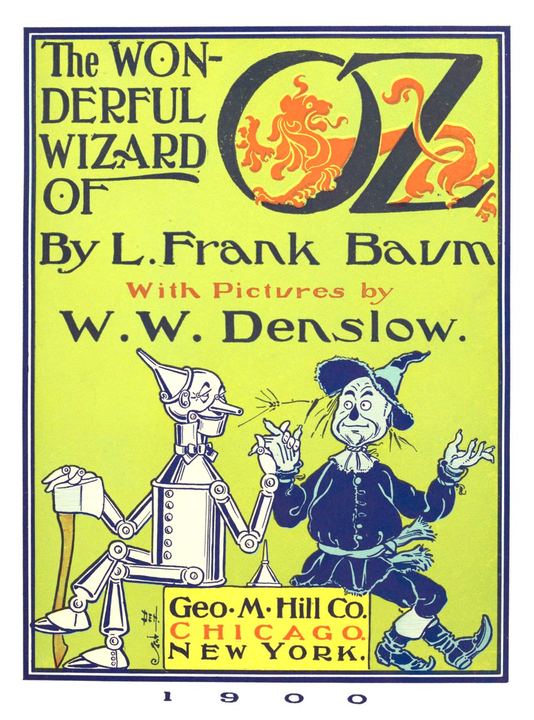
Dorothy lives on the grey Kansas prairie with her Uncle Henry, her Aunt Em and her little black dog Toto. When a cyclone strikes, Aunt Em and Uncle Henry reach the cellar, but Dorothy runs back for Toto, and the house is carried away with the two of them inside. It lands in the green and pleasant country of the Munchkins, right on top of the Wicked Witch of the East, killing her. The good Witch of the North gives Dorothy the dead witch's Silver Shoes and a protecting kiss on the forehead, and tells her that only the great Wizard Oz, in the Emerald City, can send her home. Dorothy follows the road of yellow brick. On the way she lifts a Scarecrow down from his pole, and he joins her to ask Oz for brains. She oils a Tin Woodman rusted stiff in the forest; he was once a Munchkin woodcutter whose enchanted axe, bewitched by the Wicked Witch of the East to stop his marriage, cut off his limbs one by one until a tinsmith had replaced him entirely with tin, and now he wants a heart. Then a Cowardly Lion springs at them, and Dorothy slaps his nose for trying to bite Toto; he comes along to ask for courage. After crossing a ditch and escaping the Kalidahs, they fall asleep in a field of deadly poppies; the Tin Woodman and Scarecrow carry Dorothy and the field mice drag the Lion on a wooden truck. In the Emerald City everyone wears green spectacles. Oz receives each traveller in a different terrible form and promises nothing until they kill the Wicked Witch of the West. That witch sends wolves, crows, bees and her Winkie soldiers against them, and at last uses the Golden Cap to call the Winged Monkeys, who scatter the Scarecrow's straw, dent the Tin Woodman, and carry off Dorothy and the Lion. Dorothy works as a servant until the witch steals one of her shoes; in anger Dorothy throws a bucket of water over her, and the witch melts away. The Winkies, freed, mend her friends. Back in the Emerald City, Toto knocks over a screen and reveals Oz as a little old man from Omaha, a ventriloquist and balloonist. He fills the Scarecrow's head with bran, pins and needles, gives the Tin Woodman a silk heart stuffed with sawdust, and gives the Lion a drink of courage, though each friend has already shown the quality he sought. Oz's balloon rises without Dorothy, so the friends travel south past fighting trees, living china people, a giant spider the Lion kills, and the Hammer-Heads, to Glinda. Glinda tells Dorothy that the Silver Shoes could have carried her home on the first day. Dorothy knocks her heels together three times and is home in Kansas, where Aunt Em runs to meet her. The book was published by the George M. Hill Company of Chicago in 1900, with colour pictures by W. W. Denslow.
Virtues in this work
- Fortitude: The Cowardly Lion, trembling, holds off the Kalidahs at the edge of the ravine so his friends can cross.
- Friendship: Dorothy refuses to leave the Lion in the Wicked Witch's yard and secretly brings him food until they can escape together.
- Charity: The Tin Woodman saves the Queen of the Field Mice from a wildcat, and he weeps when he accidentally steps on a beetle.
- Prudence: The Scarecrow plans the tree bridge over the ditch and the raft across the river, showing good sense before he has any brains.
Plot or Argument
- Chapters I-III: Kansas and the Munchkins
The cyclone carries Dorothy and Toto to Oz; the house kills the Wicked Witch of the East; the Witch of the North gives Dorothy the Silver Shoes and her kiss; Dorothy frees the Scarecrow.
- Chapters IV-VI: Three companions
The Scarecrow tells how he was made; Dorothy oils the Tin Woodman, who tells of his lost love and enchanted axe; the Cowardly Lion is shamed by Dorothy and joins the journey.
- Chapters VII-IX: Dangers on the road
The travellers leap a ditch, escape the Kalidahs by cutting a tree bridge, build a raft, and are rescued from the poppy field with the help of the Queen of the Field Mice.
- Chapters X-XI: The Emerald City
The Guardian of the Gates locks green spectacles on them; Oz appears as a Head, a Lady, a Beast and a Ball of Fire and sends them to kill the Wicked Witch of the West.
- Chapters XII-XIV: The Wicked Witch of the West
The friends defeat wolves, crows, bees and soldiers, but the Winged Monkeys capture Dorothy and the Lion; Dorothy melts the witch with a bucket of water, frees the Winkies, rescues her friends and learns the history of the Golden Cap.
- Chapters XV-XVII: The great humbug
Toto reveals Oz as an ordinary man from Omaha; he gives the Scarecrow brains, the Tin Woodman a heart and the Lion courage, and leaves by balloon without Dorothy.
- Chapters XVIII-XXII: Journey to the south
The friends pass the Fighting Trees and the Dainty China Country; the Lion kills a giant spider and becomes King of Beasts; the Winged Monkeys carry them over the Hammer-Heads to the Quadlings.
- Chapters XXIII-XXIV: Glinda and home
Glinda uses the Golden Cap to send each friend to his new kingdom and tells Dorothy the secret of the Silver Shoes; Dorothy returns to Kansas and Aunt Em.
Characters
- Dorothy, heroine
A brave, plain-spoken Kansas girl who wants above all to go home.
- Toto, Dorothy's dog
Little black dog whose curiosity unmasks the Wizard and almost strands Dorothy in Oz.
- The Scarecrow, companion
Straw man who believes he has no brains but solves most of the party's problems.
- The Tin Woodman, companion
Former Munchkin woodcutter, Nick Chopper in later books, who wants a heart and weeps over a crushed beetle.
- The Cowardly Lion, companion
Big beast who thinks himself a coward yet faces every danger for his friends.
- Oz, the Great and Terrible, the Wizard
A balloonist from Omaha who has ruled the Emerald City by tricks and illusions.
- The Wicked Witch of the West, villain
One-eyed ruler of the Winkies who enslaves Dorothy and covets the Silver Shoes.
- The Witch of the North, good witch
Kindly old witch who welcomes Dorothy and kisses her forehead.
- Glinda, Good Witch of the South
Beautiful ruler of the Quadlings who shows Dorothy the way home.
- Aunt Em and Uncle Henry, Dorothy's family
Hard-working, careworn Kansas farmers.
Lessons
You may already have what you are seeking
The Scarecrow makes the plans, the Tin Woodman shows tender feeling, and the Lion fights the Kalidahs and the spider, all before Oz gives them anything. The Wizard's gifts only help them believe what their actions had already shown. Children can learn that wisdom, love and courage grow by being used.
- Can you remember a time when the Scarecrow had a good idea before he got his brains?
- Why does the Lion feel braver after drinking from the green dish?
- Do you think the Tin Woodman always had a heart? Why?
Real courage
Oz tells the Lion that every living thing is afraid when it faces danger, and that true courage is facing danger when you are afraid. The Lion trembles before the Kalidahs and the spider and goes forward anyway. Being brave does not mean never feeling fear.
- What frightens the Lion, and what does he do anyway?
- What does Oz say true courage is?
- When have you needed to be brave while you were scared?
There is no place like home
The Scarecrow cannot understand why Dorothy would leave beautiful Oz for grey Kansas, and she tells him that people would rather live at home, however dreary, than anywhere else. All her adventures are a road back to Aunt Em. Love, not beauty, makes a place home.
- Why does Dorothy want to go back to Kansas when Oz is so beautiful?
- What does Aunt Em do when she sees Dorothy coming home?
Things are not always what they seem
The Emerald City looks green because of the spectacles, and the terrible Oz is a little man behind a screen. Yet the humbug does keep his promises as best he can. The story teaches children to look past appearances and to judge people by what they do.
- Why does everyone in the Emerald City wear green spectacles?
- Was Oz a good man or a bad man? What makes you think so?
- Has something ever turned out to be different from the way it first looked to you?
Context
Baum wrote in Chicago at the turn of the century, after years in the dry plains of Dakota Territory, and the grey, sunburnt Kansas farm of the first chapter reflects the hardship of prairie life in that period. His introduction, dated Chicago, April 1900, announces a modernized fairy tale for American children, keeping the wonder of Grimm and Andersen but leaving out what he calls the heartaches and nightmares.
Composition
The book was a partnership between Baum and the illustrator W. W. Denslow, whose colour plates and pictures printed in the colours of each region were part of its design. It was published by the George M. Hill Company of Chicago in 1900; 17 May is the date usually given. The Gutenberg text reproduces Baum's words and introduction but not Denslow's colour design.
Reception
The book was a bestseller from the start. Baum turned it into a stage musical in 1902, which ran successfully in Chicago and then on Broadway, and the demand of young readers led him to write thirteen more Oz books, beginning with The Marvelous Land of Oz (1904). The 1939 film changed the Silver Shoes to ruby slippers and presented Oz as a dream. Later critics have proposed readings of the book as a political allegory of the 1890s; these are interpretations rather than anything Baum stated.
Comparisons
- alices-adventures-in-wonderland
Both books send a sensible girl into a world of strange talking creatures, but Alice's Wonderland is a dream of nonsense while Dorothy's Oz is a real country with a road, a goal and friends who need her.
- the-pilgrims-progress
Dorothy, like Christian, follows a road toward a shining city with companions, meets dangers and helpers along the way, and finds the city is not the end of the journey.
- peter-pan
Wendy and Dorothy both fly off to a land of wonders and both choose in the end to go home to the people who love them.
- the-phantom-tollbooth
Milo, like the Scarecrow, learns on a quest that the thinking he hoped to receive was something he had to practise himself.
- the-adventures-of-pinocchio
The Tin Woodman longs for a heart and Pinocchio for a real boy's life; both books ask what makes a person truly alive and good.
Quotes
Frequently cited
“There is no place like home.”
Frequently cited
“There is no living thing that is not afraid when it faces danger. The True courage is in facing danger when you are afraid, and that kind of courage you have in plenty.”
“Brains are the only things worth having in this world, no matter whether one is a crow or a man.”
“I shall take the heart,” returned the Tin Woodman; “for brains do not make one happy, and happiness is the best thing in the world.”
“You ought to be ashamed of yourself, a big beast like you, to bite a poor little dog!”
“How can I help being a humbug,” he said, “when all these people make me do things that everybody knows can’t be done?”
“And oh, Aunt Em! I’m so glad to be at home again!”
For Students
A reading companion for classical Christian high school students. See the student guide.
Reading Guide
Watch for
- What Dorothy does with the Silver Shoes, and what Glinda tells her about them at the end.
- Each time the Scarecrow has a good idea, even before he gets his brains.
- How the Tin Woodman behaves when he steps on a beetle.
- What Toto does in the Throne Room that changes everything.
- How each friend becomes a ruler before Dorothy goes home.
Key terms and names
- Munchkins
- The little people of the blue country in the east of Oz, where Dorothy's house lands.
- Emerald City
- The capital of Oz, where everyone must wear green spectacles.
- Silver Shoes
- The shoes of the Wicked Witch of the East, which can carry Dorothy anywhere in three steps.
- Golden Cap
- A magic cap whose owner may call the Winged Monkeys three times.
- Humbug
- Someone who pretends to be more than he is; Oz calls himself a humbug.
- Cyclone
- A great whirling windstorm on the prairie, like a tornado, that carries Dorothy's house to Oz.
Seminar Questions
- Comprehension Why does Dorothy end up in the house when the cyclone comes, instead of in the cellar?
- Comprehension What does each of Dorothy's three friends want from the Wizard?
- Comprehension How does Dorothy defeat the Wicked Witch of the West?
- Interpretation The Scarecrow says he has no brains, but who thinks of the raft and the tree bridge? What does that tell you?
- Interpretation Oz is not really a wizard. Why do the friends still feel better after his gifts?
- Interpretation Glinda says Dorothy could have gone home on her very first day. Was the journey still worth it?
- Big Question Which is more important to have, a good head or a good heart?
Faith Connections
- 1 Samuel 16:7 (Scripture)
The Lord looks on the heart, not the outward appearance. The terrible Oz turns out to be a little man, and the straw, tin and timid friends turn out to be wise, loving and brave.
- Joshua 1:9 (Scripture)
God tells Joshua to be strong and of a good courage and not afraid, because He is with him. The Lion learns that courage is going forward even when afraid.
- Ezekiel 36:26 (Scripture)
God promises to give His people a new heart. The Tin Woodman longs for a heart so that he can love; the verse shows where a truly new heart comes from.
- C. S. Lewis, The Abolition of Man, chapter 1 (Men without Chests) (Great Conversation)
Lewis argues that the head must rule the appetites through the chest, the trained feelings that make a person good. Baum's three friends, brains, heart and courage, make a child's picture of the whole person Lewis describes.
Logic and Rhetoric
Central argument: The Scarecrow, Tin Woodman and Lion each believe they lack something, yet each shows that very quality on the journey. Oz, who has no real magic, can only give them tokens. Therefore wisdom, love and courage are not gifts poured in from outside but strengths that grow by being used for others.
Rhetorical device: dramatic irony. In Chapters IV-IX readers watch the Scarecrow solve problems, the Tin Woodman weep and the Lion fight while each still insists he lacks brains, a heart or courage.
Debate: Resolved: that the Wizard of Oz was a good man even though he was a humbug.
Memory Work
There is no place like home.
There is no living thing that is not afraid when it faces danger. The True courage is in facing danger when you are afraid, and that kind of courage you have in plenty.
Writing Prompts
Essay: Choose the Scarecrow, the Tin Woodman or the Lion. Tell what he wanted from Oz and give two times in the story when he already showed it.
Comparison with Alice's Adventures in Wonderland: Dorothy and Alice both visit strange lands full of talking creatures. Which girl is braver, and which land would you rather visit? Use scenes from both books.
Medical Lens
Medicine is incidental, but two episodes interest a medical reader. In the Deadly Poppy Field the scent of a vast bed of scarlet poppies puts Dorothy, Toto and the Lion into a sleep from which, the narrator says, they would never wake; the Scarecrow and Tin Woodman, who do not breathe, are unaffected. Baum does not mention opium, but readers of 1900 knew the poppy as the source of laudanum and morphine, and the scene is a fairy-tale picture of narcotic sleep; real poppies have no such effect by scent, so the danger is a matter of fancy. The Tin Woodman's history is a fairy-tale account of successive amputations, each limb replaced by a tinsmith, until the whole body is artificial, which some readers connect with the prosthetics of the period; that is a reading rather than Baum's stated intent. Oz's bran brains and sawdust heart, and the courage drink he pours from a green bottle, are placebo-like gifts that work because the recipients believe in them.
- Chapter V, The Rescue of the Tin Woodman
The Tin Woodman tells how his enchanted axe cut off his legs, arms and head in turn and a tinsmith replaced each part with tin.
- Chapter VIII, The Deadly Poppy Field
The scent of the poppies overpowers Dorothy, Toto and the Lion, and the friends who do not breathe must carry Dorothy out before she sleeps forever.
- Chapter XVI, The Magic Art of the Great Humbug
Oz fills the Scarecrow's head with bran, gives the Tin Woodman a silk heart and pours courage for the Lion, knowing the gifts work by belief.
Listen to the book
Public-domain audiobook from LibriVox, read by Various volunteers. Recording: Wonderful Wizard of Oz (version 3) (Dramatic Reading) on LibriVox (Internet Archive).
LibriVox recordings are volunteer readings released into the public domain. The reading may follow a different edition from the text in this library.
Creative Prompts
- Classroom
Draw a map of Oz with the four countries and their colours (blue Munchkins, yellow Winkies, red Quadlings and the green Emerald City) and trace Dorothy's road.
- Fiction
Write a new adventure on the yellow brick road in which each of the three friends uses the gift he thought he did not have.
- Dialogue
Act out the scene in which Toto knocks over the screen and the friends discover who Oz really is.
- Essay
Which friend do you think was the bravest, the wisest or the kindest? Give one scene to prove it.
Further Reading
- The Marvelous Land of Oz, L. Frank Baum
The first sequel, with the Scarecrow and Tin Woodman.
- Ozma of Oz, L. Frank Baum
Dorothy's return to Oz.
- The Annotated Wizard of Oz, Michael Patrick Hearn
- Alice's Adventures in Wonderland, Lewis Carroll
Verification notes
Plot details, chapter titles and quotes follow the attached Project Gutenberg text (#55), including Baum's introduction dated Chicago, April 1900. Publication by the George M. Hill Company in 1900 with W. W. Denslow's colour illustrations, the usual 17 May 1900 date, and the 1902 musical were checked by web search (Bonhams auction description of the 1900 Hill first edition and summaries of the Wikipedia article). The name Nick Chopper comes from later Oz books, not this one. All quotes were found in the attached text.
- Confirm the opening of the 1902 musical in Chicago (June 1902) and its move to Broadway (January 1903) before citing dates.
- Confirm the exact 1900 publication date; some sources describe printing completed later in the year.