Great Churches & Monasteries · Western Europe
Iona Abbey
The small island monastery from which Columba and his companions carried the Gospel to the north of Britain.
Still standing. The medieval abbey church was restored in the twentieth century and is used for worship by the Iona Community. The earliest monastery of Columba's time has left only slight traces.
Lindisfarne · Durham Cathedral
What it is
In 563 Columba, an Irish monk of noble birth, sailed to Iona with a small company of companions, and founded a monastery. His biographer Adomnán, abbot of Iona about a century later, tells of his prayer, his copying of manuscripts, his journeys to the Picts, and his death before the altar on the night of 9 June 597. Iona became a great center of learning, and monks from Iona carried the faith to Northumbria: in 635 Oswald, king of Northumbria, who had lived in exile in Iona, asked for a missionary, and Aidan was sent to found Lindisfarne.
The monastery was raided by Vikings in 795, 802, and 806, when 68 monks were killed. The monks left in 807 and moved to Kells in Ireland, and the Book of Kells may have been begun at Iona. Later, Iona became the burial place of Scottish kings, and tradition says that forty-eight were laid there, among them Duncan, whom Shakespeare names. About 1200 a Benedictine abbey and a nunnery were founded. After the Reformation the buildings fell into ruin, and in 1938 George MacLeod founded the Iona Community and began to rebuild them. Samuel Johnson and James Boswell visited in 1773.
“a famous priest and abbot, marked as a monk by habit and manner of life, whose name was Columba”
Why it matters for a classical Christian student
Iona is one of the places where the Gospel was carried by small groups of poor monks rather than by armies. A classical Christian student can read in Bede what Columba's mission accomplished and in Adomnán what his followers remembered of his life. The monks lived in huts on a windy island, copied the Psalms by hand, and prayed through the night. The virtue is costly faith: exile for the sake of the Gospel.
Read alongside
- Ecclesiastical History of the English People: Bede on Columba and the mission from Iona.
- Macbeth: Macduff says Duncan's body is carried to 'Colmekill, the sacred storehouse of his predecessors'.
Great Lives connected here
- Bede, in Great Lives: Bede's Ecclesiastical History tells of Columba's coming to Britain and of the island monastery.
- William Shakespeare, in Great Lives: In Macbeth, Duncan's body is carried to Colmekill, the old name for Iona, the burial place of kings.
- Samuel Johnson, in Great Lives: Johnson visited Iona in October 1773 on his tour of the Hebrides with Boswell.
- James Boswell, in Great Lives: Boswell traveled with Johnson to Iona in 1773 and wrote an account of the tour.
Look closely
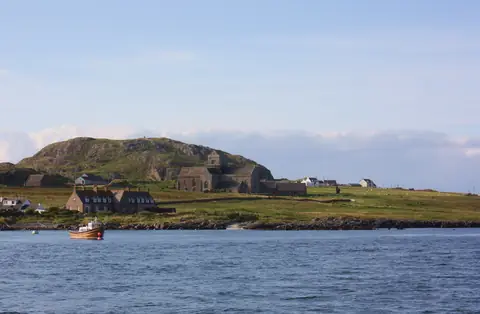
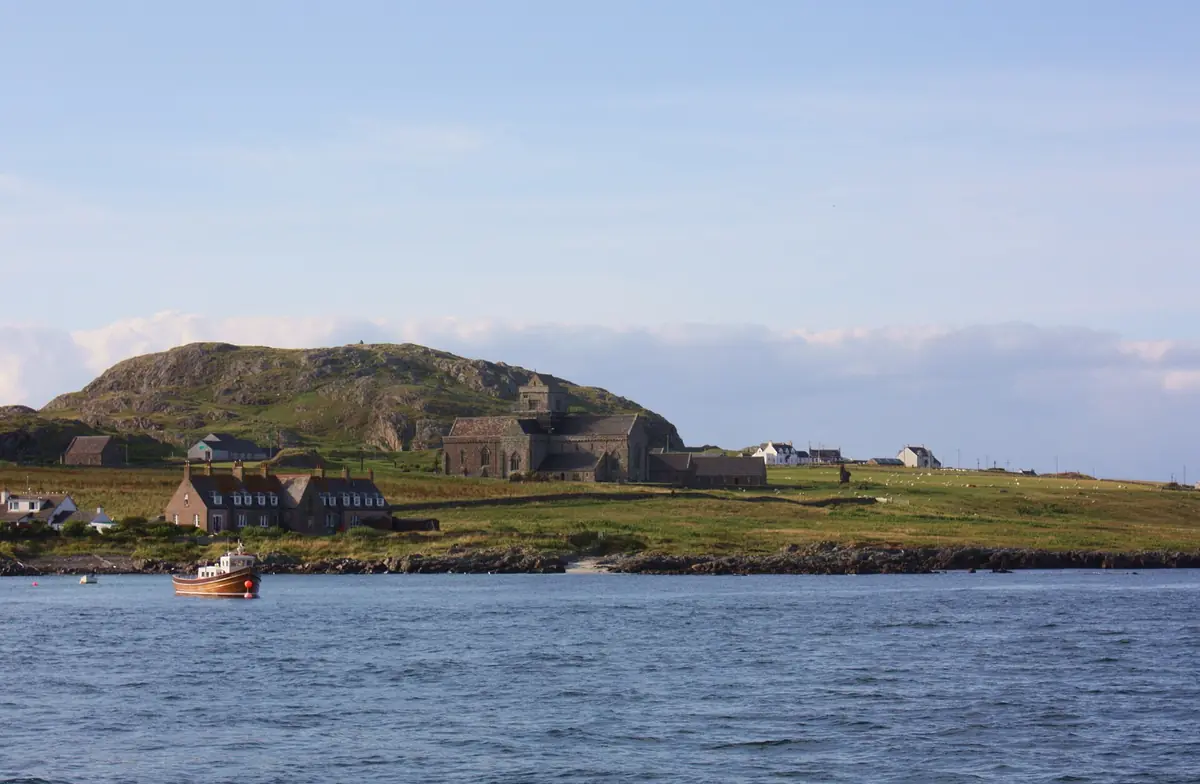
Image: Wikimedia Commons · CC BY 2.0 · Photo: Jan Smith from Brisbane, Australia Iona from the sea
Look closely. The island is low and small, with a hill at one end, as it appears from the ferry. Columba and his companions came here by boat from Ireland.
In the library: Bede, in Great Lives
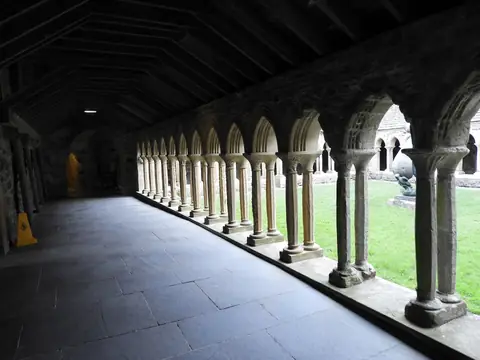
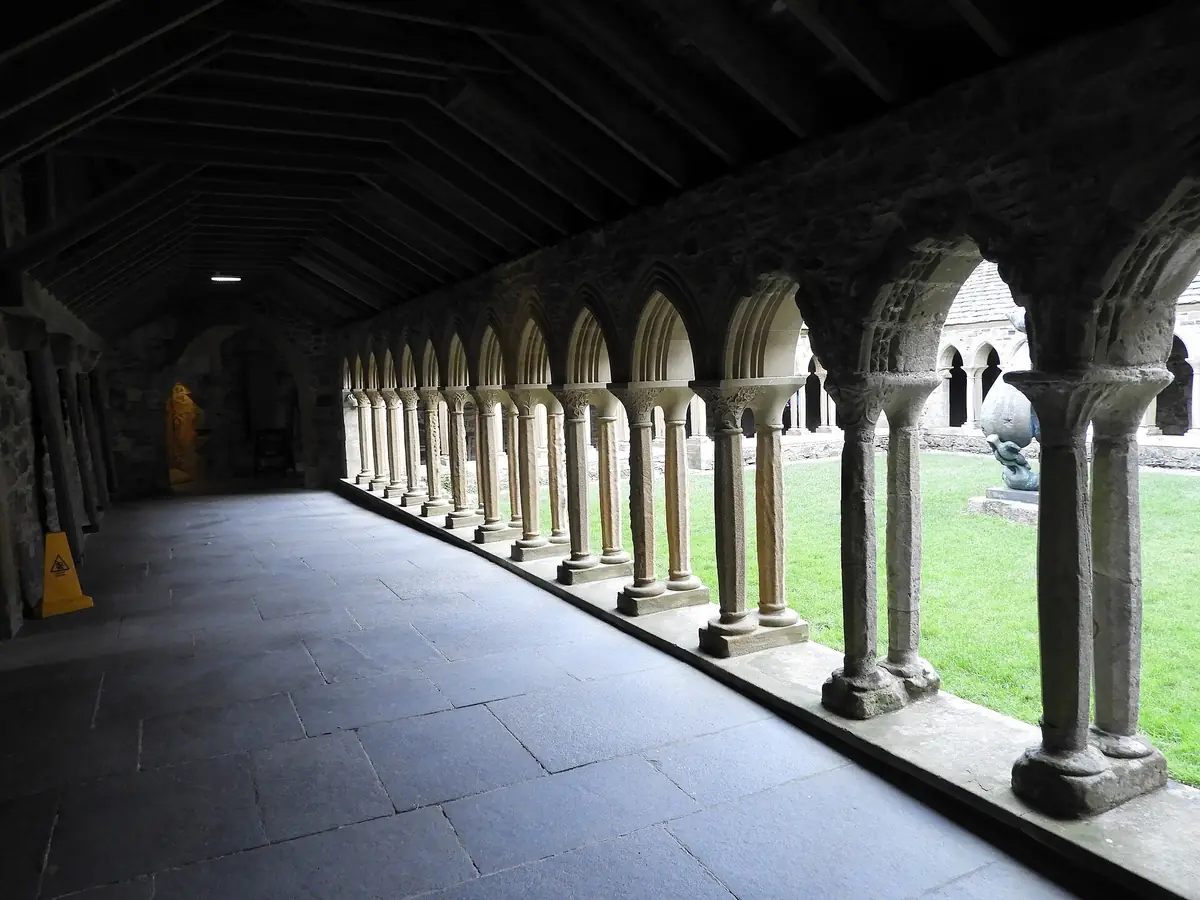
Image: Wikimedia Commons · CC BY 2.0 · Photo: Reading Tom from Reading, UK The cloister
Look closely. A long arcade of slender columns and carved capitals runs around the garth. The cloister was rebuilt in the twentieth century.
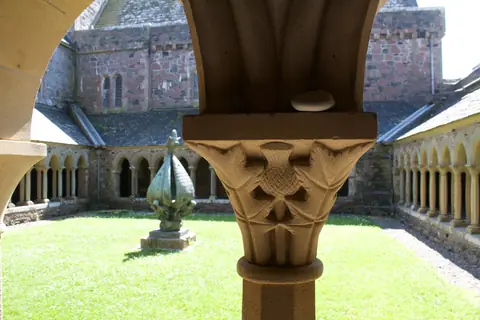
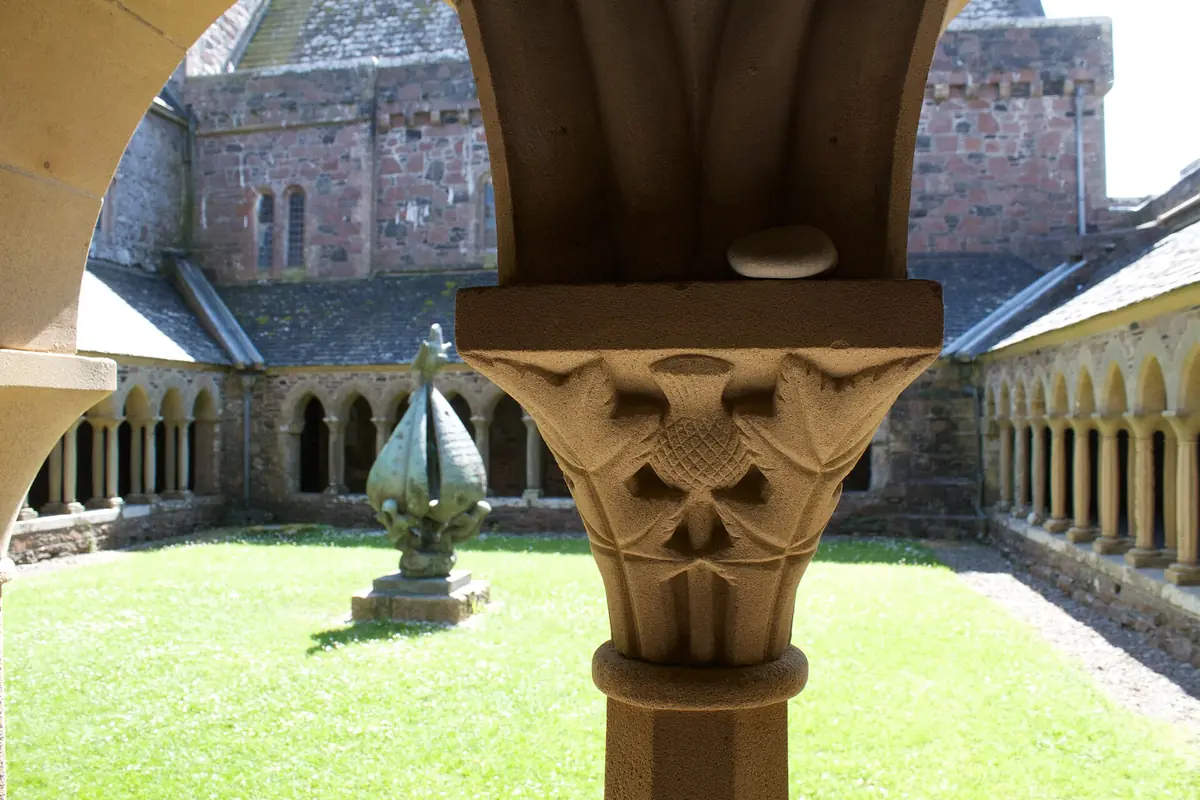
Image: Wikimedia Commons · CC BY 2.0 · Photo: Brian Gratwicke from DC, USA A carved capital and the garth
Look closely. A carved stone capital in the foreground frames the green court of the cloister. The abbey church stands behind it.


What to watch for
Look slowly- St Martin's Cross. An eighth-century carved high cross stands before the abbey.
- The Reilig Odhráin. The old graveyard where kings are said to lie.
- The Abbey cloister. Restored in the twentieth century.
- The island. Notice its smallness, about three miles by one and a half.
Sources
Dates follow standard historical references and, where we quote a book, the wording of the edition hosted in this library. Where a tradition is not certain history, the page says so. Photographs and pictures are used only when the image itself is Public domain, CC0, or CC BY with a named credit. Each picture links to its source page with full licence details. Pictures taken before a site was damaged are labelled with their date.