Great Churches & Monasteries · Western Europe
Durham Cathedral
The Norman cathedral on a river bluff, built to hold the body of St Cuthbert and the tomb of Bede.
Still standing. The cathedral stands and is among the finest Norman buildings in Europe. It is a World Heritage Site, together with Durham Castle.
Lindisfarne · Canterbury Cathedral
What it is
In 875, monks from Lindisfarne fled the Vikings and carried the body of St Cuthbert, who had died in 687, with them as they wandered. In 995 the monks reached the hill at Durham, a rocky peninsula in a loop of the River Wear, and built a church for his body. In 1093 Bishop William of Saint-Calais laid the foundation stone of the present cathedral. Its choir and nave were vaulted with pointed ribbed arches, among the earliest of their kind, and the nave was complete by about 1133. The Galilee Chapel at the west end was built about 1170–75.
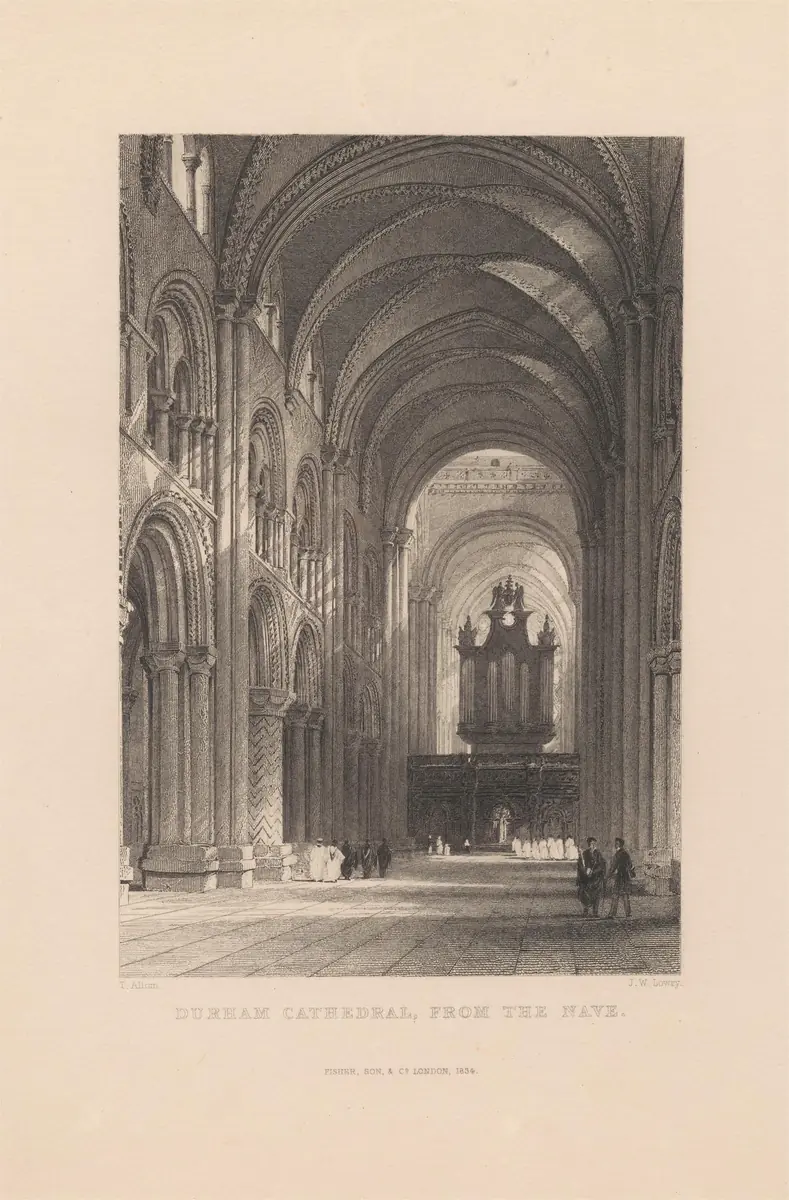
Bede's bones were brought to Durham from Jarrow in the early eleventh century, and he is buried in the Galilee Chapel. William the Conqueror ordered the castle built in 1072, next to the cathedral. The bishops of Durham ruled as prince-bishops, with powers over the border country. The shrine of Cuthbert was destroyed in 1540, and the body was buried beneath its site. After the battle of Dunbar in 1650, thousands of Scottish prisoners were held in the cathedral, and many died. The nave's stout columns carved with zigzag, spiral, and diamond patterns are known to every student of English architecture.
Why it matters for a classical Christian student
Durham unites two themes: the holiness of Cuthbert, who gave up his bishop's seat to return to a hermit's life, and the power of the church in the world of the Normans. Bede, whose history is in the catalogue and who wrote of Cuthbert's life, lies in the same church. The student can also ask what the cathedral shows about the relation between church and state, in the prince-bishops who held both a crozier and a sword.
Read alongside
- Ecclesiastical History of the English People: Bede tells of Cuthbert, whose body the cathedral was built to hold.
Great Lives connected here
- Bede, in Great Lives: Bede's remains were moved to Durham in the early eleventh century, and he lies in the Galilee Chapel.
- William the Conqueror, in Great Lives: William ordered the castle at Durham to be built in 1072.
Look closely
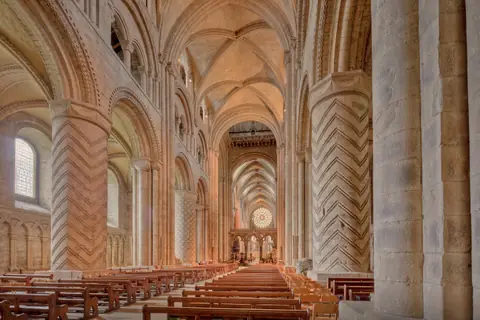
Image: Wikimedia Commons · CC0 (public domain) The nave
Look closely. The nave is Norman, with round arches and heavy piers carved with zigzag and spiral patterns. Notice the strength of the stone and the pointed ribs of the vault overhead.
In the library: Bede, in Great Lives
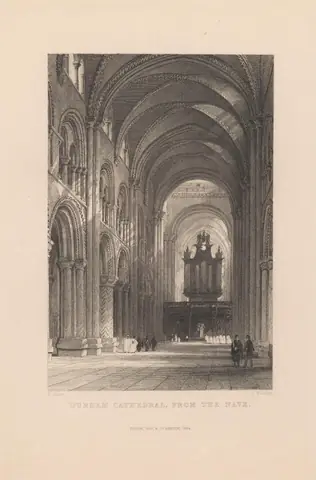
Image: Wikimedia Commons · CC0 (public domain) The nave in 1834
Look closely. An engraving of the nave looks east toward the choir. Compare the engraving with the modern photograph.
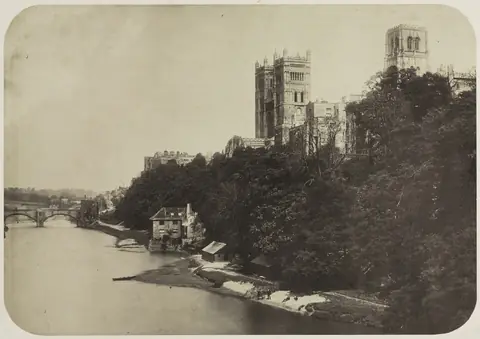
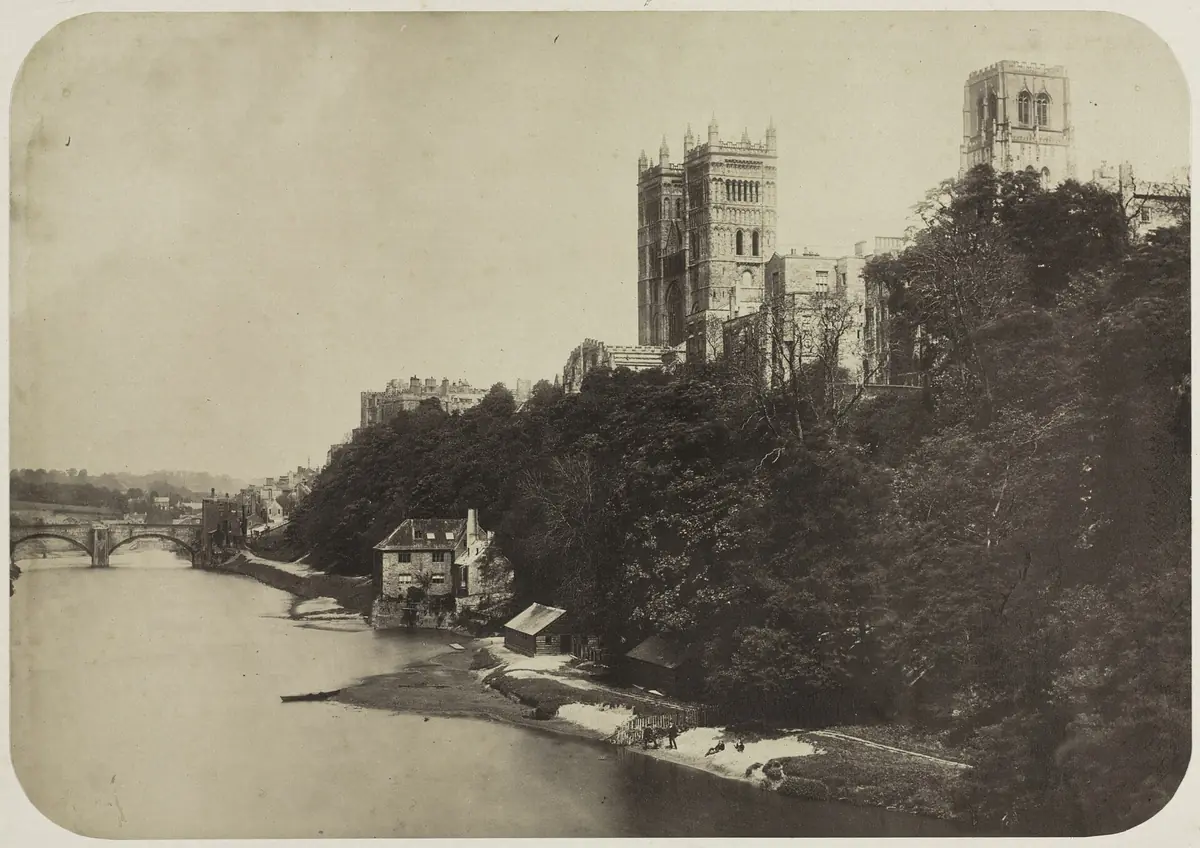
Image: Wikimedia Commons · CC0 (public domain) The cathedral above the River Wear
Look closely. An early photograph shows the cathedral on its hill above the river and the trees. The site is a rock peninsula, which made it a strong place for a church and a castle.
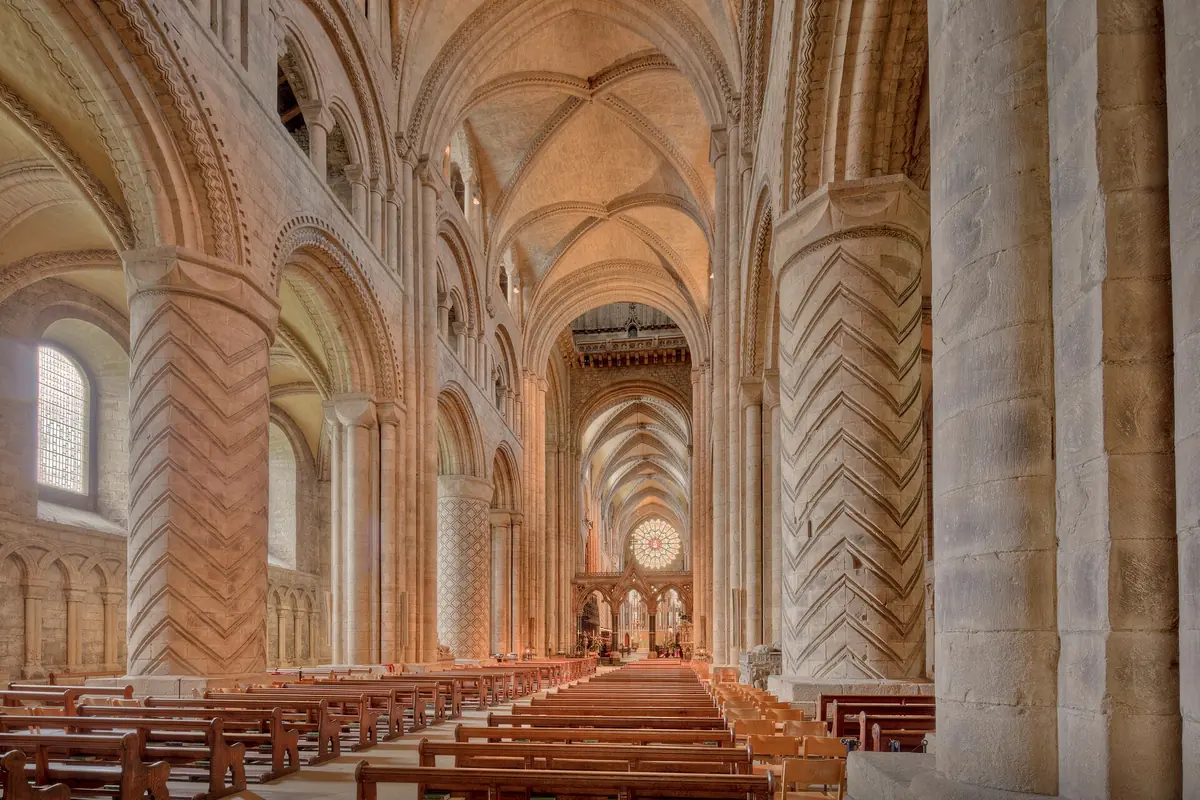


What to watch for
Look slowly- The nave piers. Look at the patterned columns.
- The ribbed vault. One of the earliest in Europe.
- The Galilee Chapel. Bede's tomb is here.
- The site. Notice how the cathedral and castle command the river loop.
Sources
Dates follow standard historical references and, where we quote a book, the wording of the edition hosted in this library. Where a tradition is not certain history, the page says so. Photographs and pictures are used only when the image itself is Public domain, CC0, or CC BY with a named credit. Each picture links to its source page with full licence details. Pictures taken before a site was damaged are labelled with their date.