Great Churches & Monasteries · Western Europe
Lindisfarne Priory
The tidal island where Aidan and Cuthbert served, where the Lindisfarne Gospels were made, and where the Viking age began.
In ruins. The ruins of the Norman priory stand on the tidal Holy Island, and are cared for by English Heritage. The earlier Anglo-Saxon monastery has not been certainly located.
What it is
In 635 Oswald, king of Northumbria, who had spent his exile among the monks of Iona, invited a missionary from there. Aidan was sent and set up his see at Lindisfarne, an island joined to the mainland at low tide. Aidan and his monks walked among the people and preached to them. Cuthbert, who became prior about 664 and bishop in 685, was among its most loved saints. He died on the Inner Farne in 687. Between about 715 and 720 a monk named Eadfrith made the Lindisfarne Gospels, a manuscript of great beauty, now in the British Library.
On 8 June 793 Vikings raided the monastery, an attack that shocked Christian Europe, and Alcuin of York wrote to the community in grief. The community left in 875 with the body of Cuthbert. About 1093 monks from Durham refounded a priory, whose red sandstone ruins can still be seen with a surviving arch of the crossing. It was dissolved in 1537. The island can be reached on foot at low tide on a pilgrim route called St Cuthbert's Way.
“Bishop Aidan, a man of singular gentleness, piety, and moderation”
Why it matters for a classical Christian student
Lindisfarne combines the simplicity of Aidan's walking mission, the holiness of Cuthbert's life, and the beauty of the Gospels made there. A classical Christian student can read Bede's portrait of Aidan and see how much he valued gentleness, piety, and moderation. The attack of 793 is also a lesson in the vulnerability of holy places, and how the survivors carried their saint's body across the land until it rested in Durham.
Read alongside
- Ecclesiastical History of the English People: Bede on Aidan's arrival and his see at Lindisfarne.
Great Lives connected here
- Bede, in Great Lives: Bede wrote the earliest accounts of Aidan and Cuthbert, including the king's gift of Lindisfarne to Aidan.
Look closely

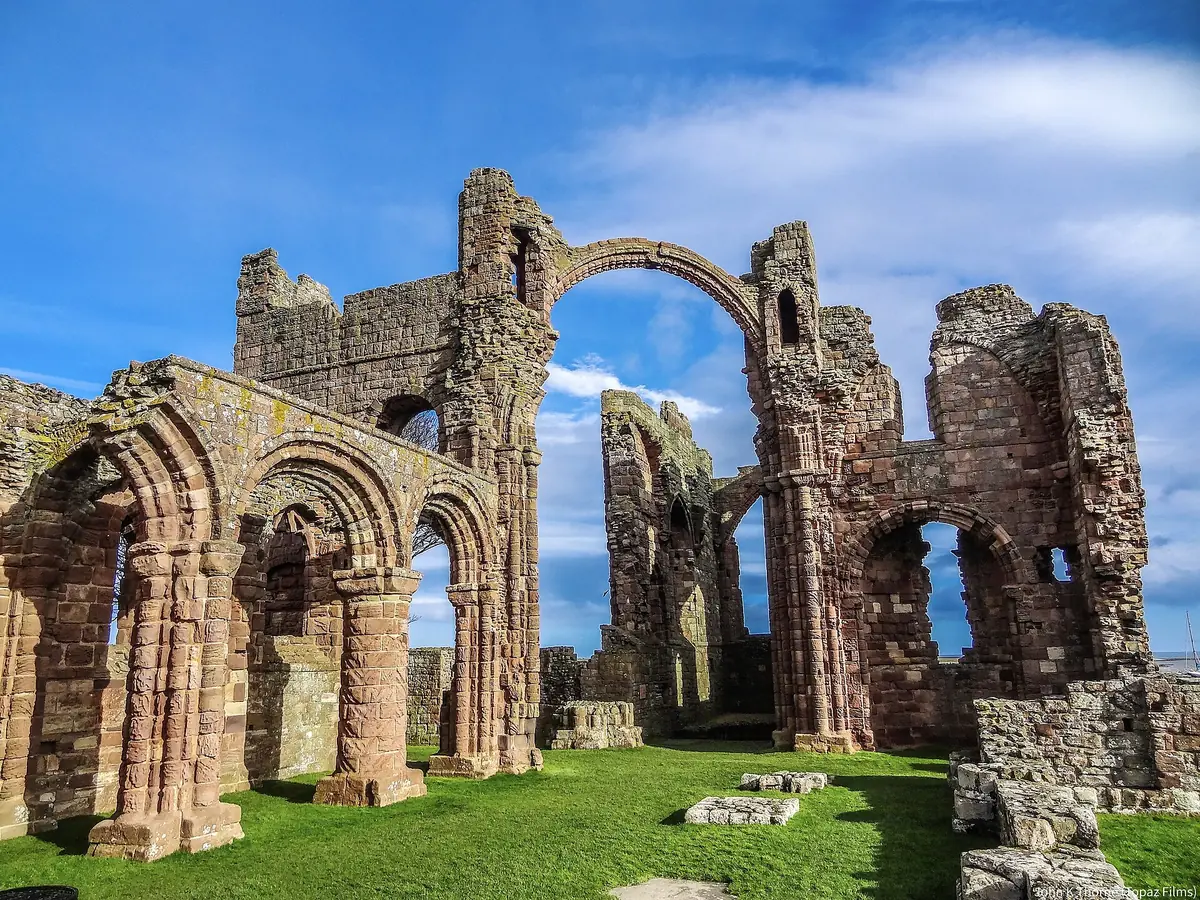
Image: Wikimedia Commons · CC0 (public domain) The ruins of the priory
Look closely. The red sandstone ruins stand on the island. The arch in the middle is a surviving rib of the vault under the central tower. Notice the zigzag moldings on the arches.
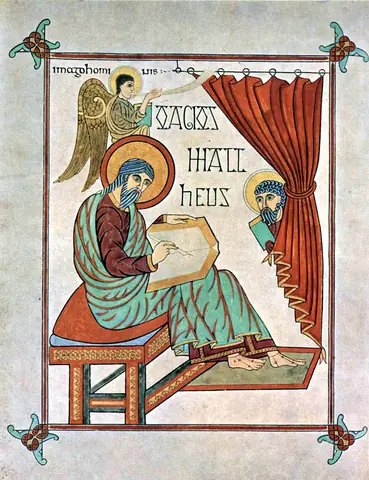
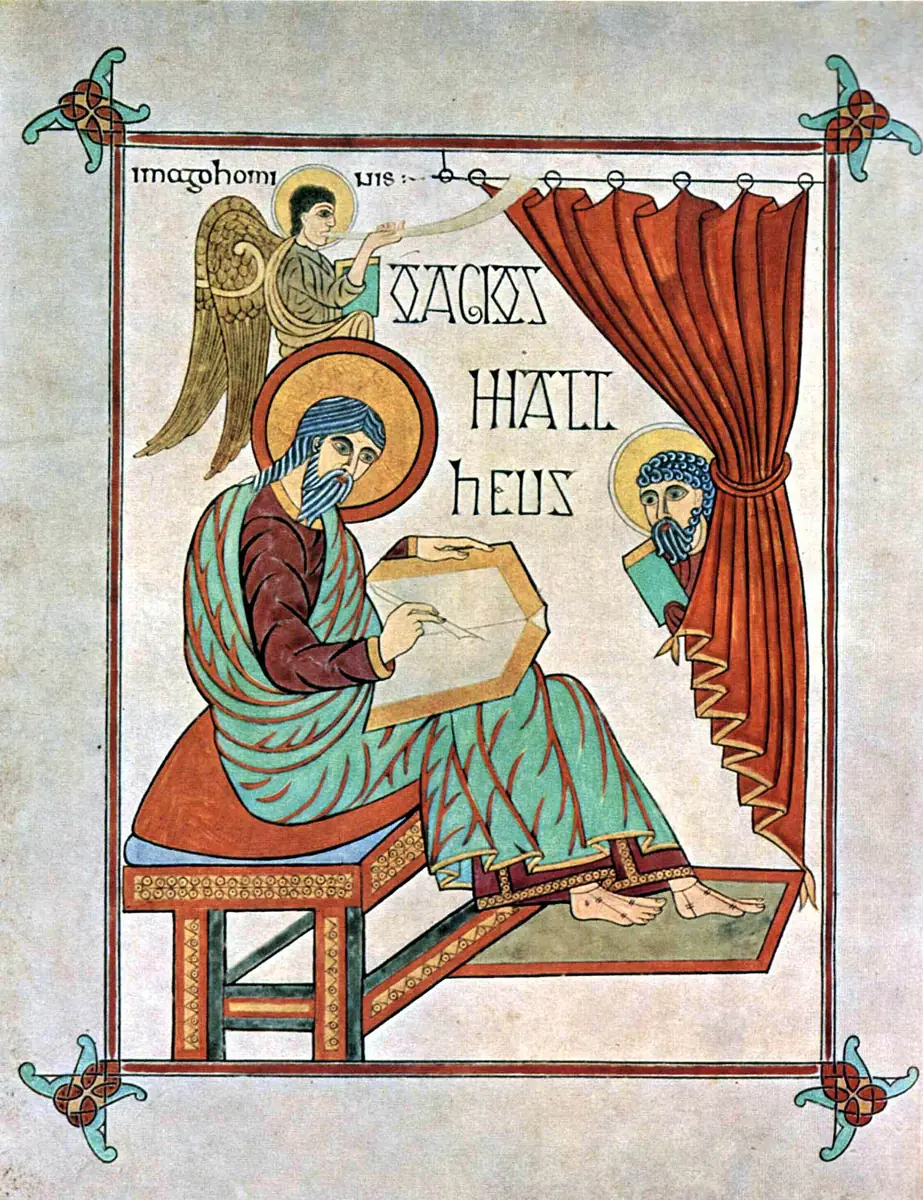
Image: Wikimedia Commons · Public domain Matthew the Evangelist in the Lindisfarne Gospels
Look closely. A page from the Lindisfarne Gospels shows Matthew seated and writing, with a curtain, and a figure behind it. The manuscript is traditionally said to have been made on the island about 715–720.
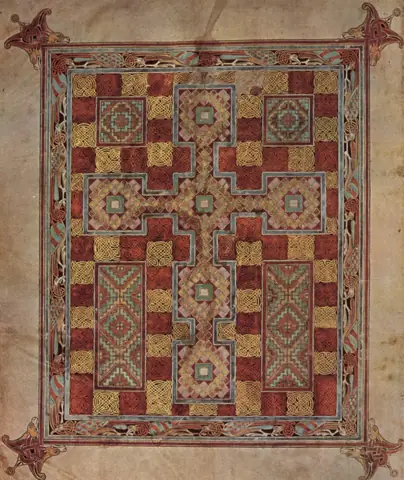
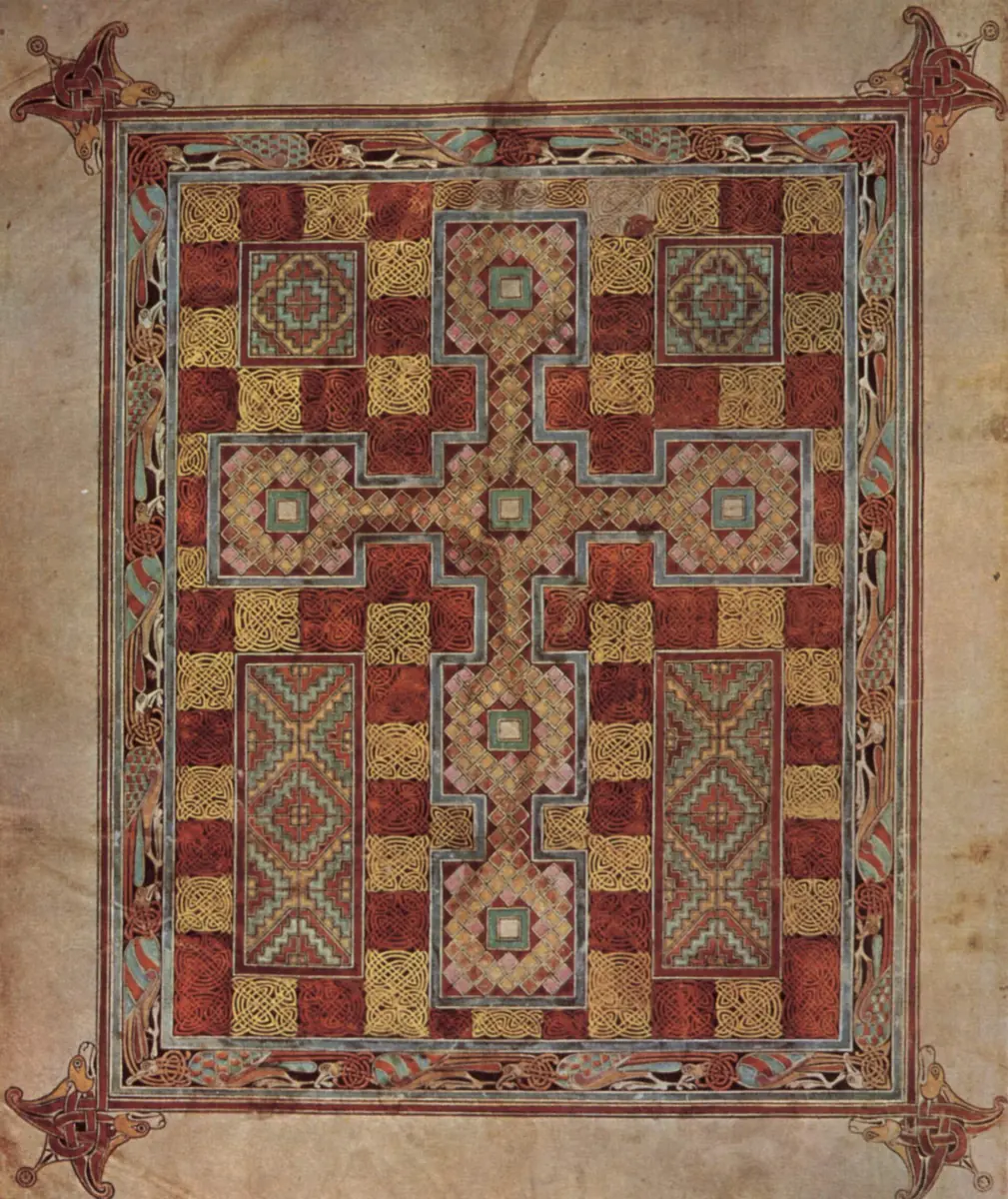
Image: Wikimedia Commons · Public domain (PD-Art) A carpet page
Look closely. A carpet page is a full page of patterns, in the form of a cross, placed before a Gospel. Look at the interlaced knotwork and the careful geometry.


What to watch for
Look slowly- The rainbow arch. A surviving arch of the Norman priory crossing.
- The tide. The causeway floods twice a day.
- The Lindisfarne Gospels. Look at images of the carpet pages.
- The statue of Aidan. It stands in the churchyard of St Mary's.
Sources
Dates follow standard historical references and, where we quote a book, the wording of the edition hosted in this library. Where a tradition is not certain history, the page says so. Photographs and pictures are used only when the image itself is Public domain, CC0, or CC BY with a named credit. Each picture links to its source page with full licence details. Pictures taken before a site was damaged are labelled with their date.