Great Churches & Monasteries · Eastern Europe & Russia
St Sophia's Cathedral, Kyiv
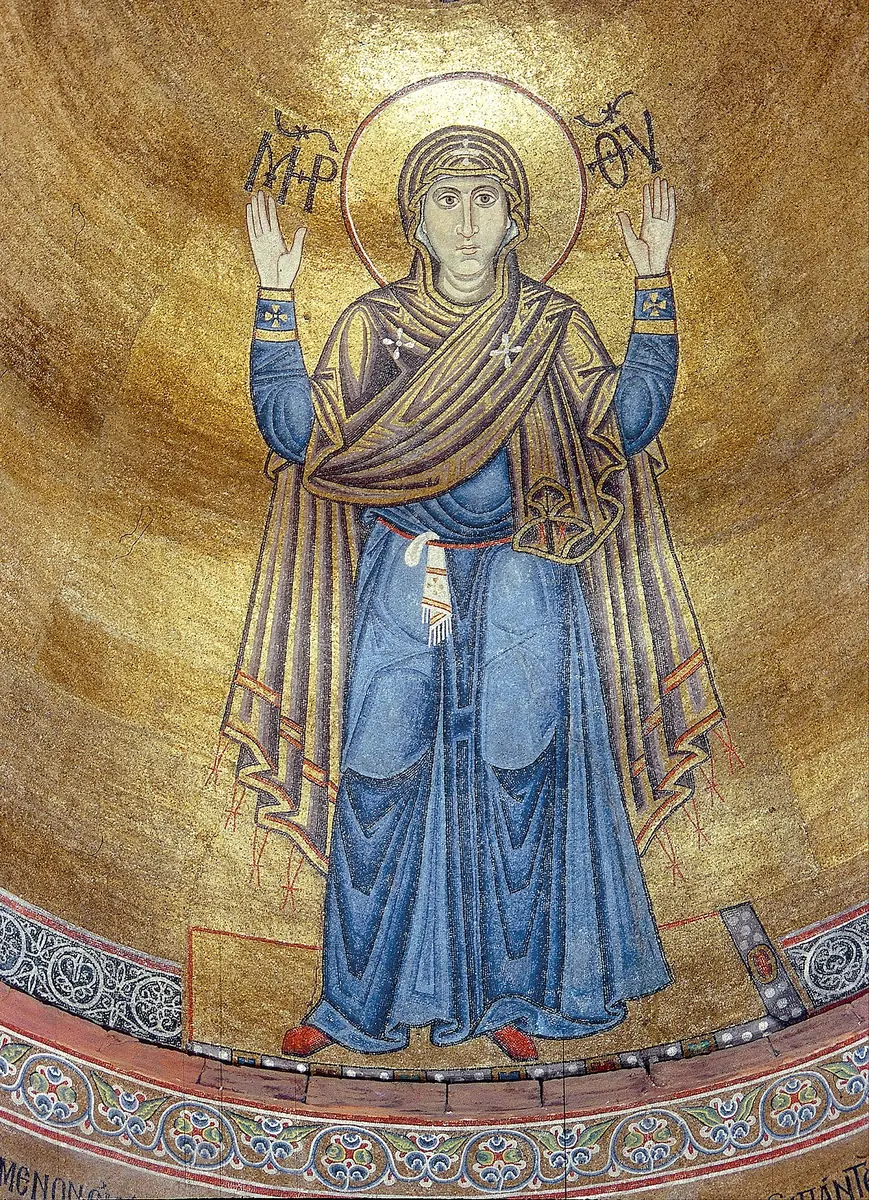
The eleventh-century cathedral of Kyiv, built to rival Constantinople's Holy Wisdom, with a giant mosaic of the Virgin in its apse.
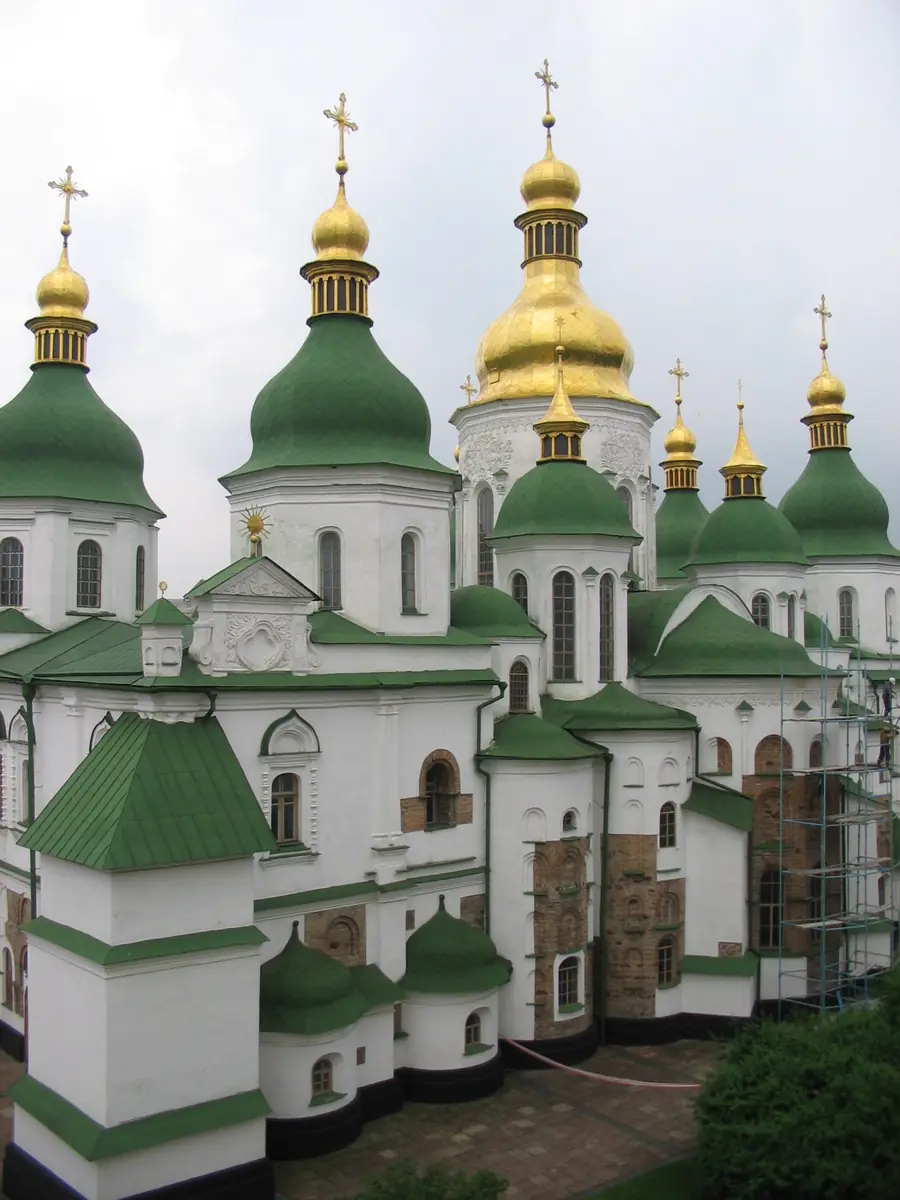
Still standing. The cathedral stands with its eleventh-century mosaics and frescoes. Its exterior was reshaped in the 1600s and 1700s in the Ukrainian Baroque style, and it is a museum and reserve. It is part of a UNESCO World Heritage site.
Hagia Sophia, the model for its name · Kyiv Pechersk Lavra
What it is
Kyiv became a Christian city when Prince Volodymyr (Vladimir) the Great accepted baptism from the Byzantine church about 988, according to the Primary Chronicle. His son Yaroslav the Wise, who ruled Kyiv from 1019 to 1054, built a new cathedral in the middle of the city and named it for the Holy Wisdom, after the great church in Constantinople. The Chronicle places the beginning in 1037, though some scholars have argued for an earlier start. Byzantine masters likely worked with local builders on a church with five aisles and thirteen domes, covered inside with mosaics and frescoes.
The mosaic in the apse of a tall Virgin with raised hands, called the Orans, 'the Indestructible Wall' in popular devotion, is the best known. The cathedral was damaged when the Mongols took Kyiv in 1240. In the seventeenth and eighteenth centuries it was repaired and given a Baroque exterior, while keeping the early interior. Yaroslav's marble sarcophagus still stands inside. In 1990 the cathedral and the Kyiv-Pechersk Lavra were inscribed together on the UNESCO list.
Why it matters for a classical Christian student
The cathedral belongs to the story of how the Christian faith reached the Slavic lands. A classical Christian student can see here how the church of Constantinople passed on liturgy, art, and learning to a new nation, and how the new nation made it its own. The virtue is faithful stewardship. A building that has survived invasions and changes of rule for nearly a thousand years is a monument to patient care.
Look closely
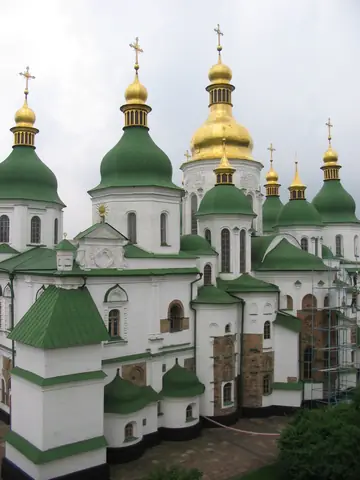
Image: Wikimedia Commons · Public domain The cathedral exterior
Look closely. The cathedral rises in tiers of rounded apses and green and gold domes. The outer shape is the Ukrainian Baroque of the eighteenth century, built over the eleventh-century church.
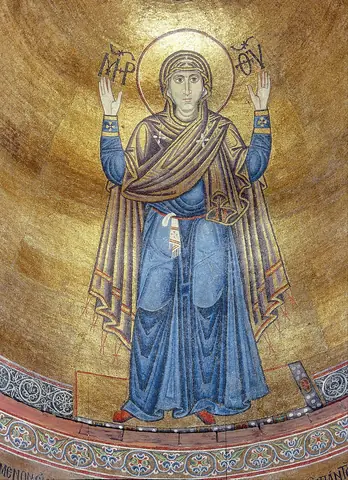
Image: Wikimedia Commons · Public domain (PD-Art) The Orans in the apse
Look closely. The Virgin stands with her arms raised in prayer against a gold ground. The mosaic dates from the time of Yaroslav the Wise and has been admired for almost a thousand years.
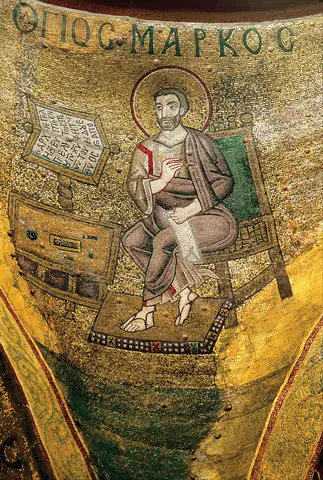
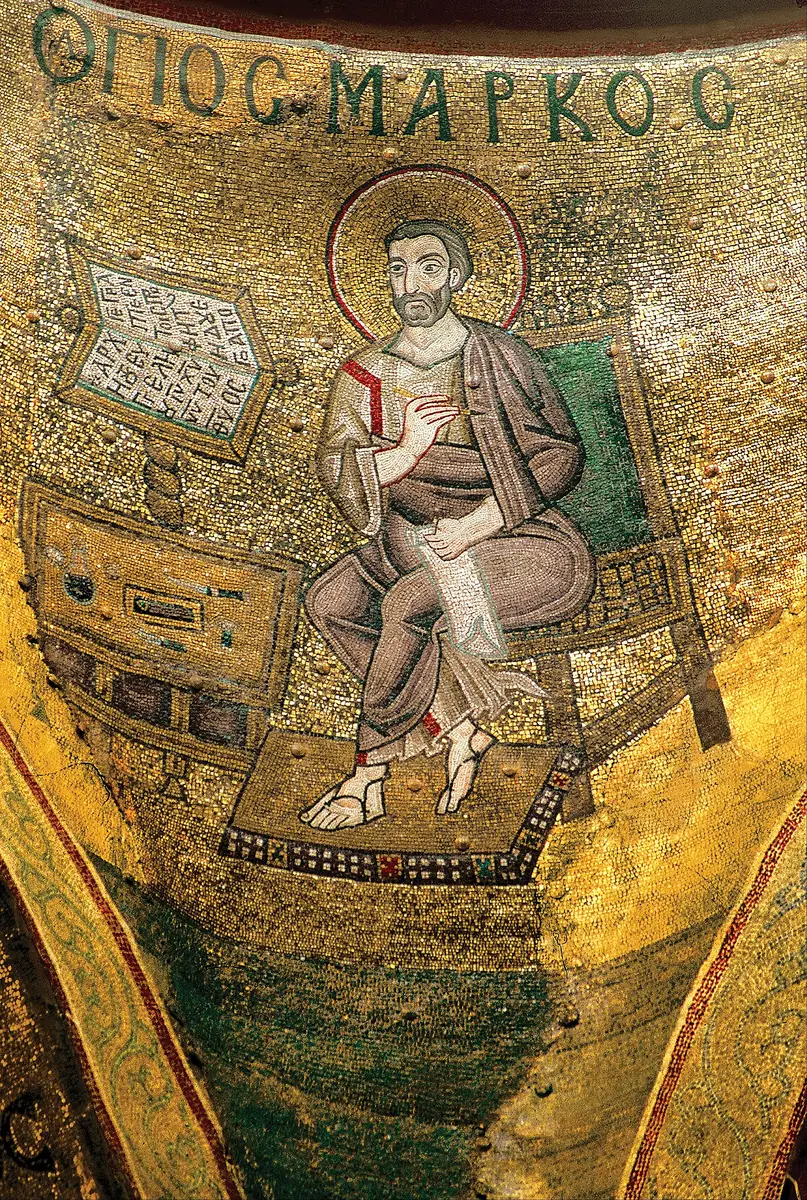
Image: Wikimedia Commons · Public domain (PD-Art) Saint Mark the Evangelist
Look closely. An evangelist writes his Gospel, seated, with the Greek letters of his name. The mosaics were made of small cubes of glass and stone.
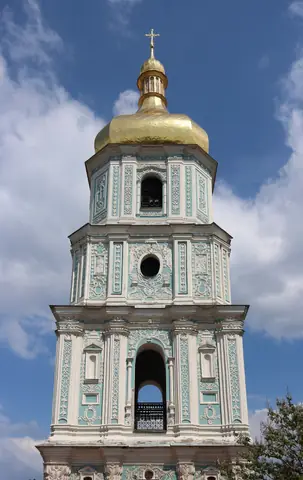
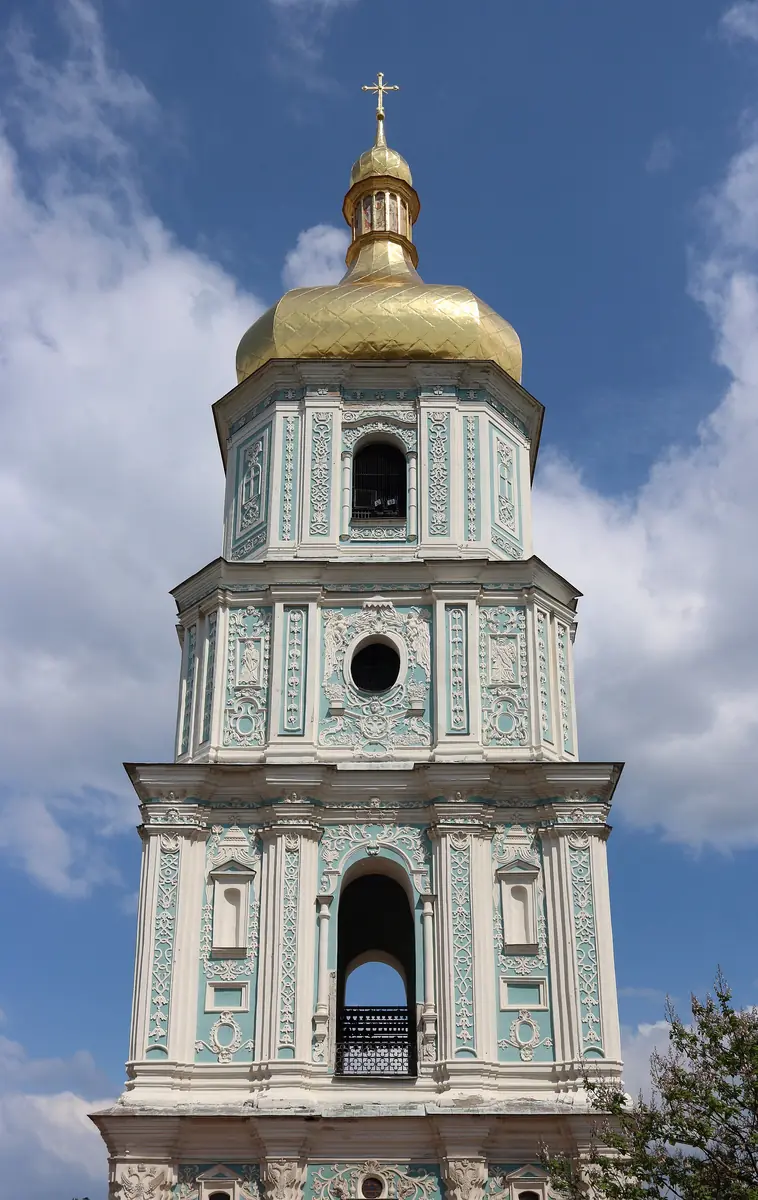
Image: Wikimedia Commons · Public domain The bell tower
Look closely. The Baroque bell tower stands beside the cathedral. It was built in the eighteenth century and is crowned with a gilded dome.


What to watch for
Look slowly- The Orans mosaic. The Virgin with open hands stands in the center of the apse.
- The Eucharist mosaic. Christ gives the bread and the wine to the apostles in two groups.
- Yaroslav's sarcophagus. It is carved with crosses and palms.
- Baroque outside, Byzantine inside. Notice the two periods.
Sources
Dates follow standard historical references and, where we quote a book, the wording of the edition hosted in this library. Where a tradition is not certain history, the page says so. Photographs and pictures are used only when the image itself is Public domain, CC0, or CC BY with a named credit. Each picture links to its source page with full licence details. Pictures taken before a site was damaged are labelled with their date.