Great Churches & Monasteries · Greece & Byzantium
Mount Athos
A peninsula of monasteries where Orthodox monks have prayed for more than a thousand years.
Still standing. Mount Athos is a self-governing monastic region of twenty monasteries within Greece. Monks still live there by their ancient rules and women are not admitted.
What it is
Athos is a rocky peninsula in northern Greece, ending in a peak of about 2,000 meters. Hermits lived there from the early Byzantine centuries. In 963 Athanasios the Athonite, with the support of the emperor Nikephoros II Phokas, founded the Great Lavra, the first of the large monasteries. Other houses followed, among them Iviron, founded by Georgian monks, Hilandar, founded in 1198 by the Serbian prince Stefan Nemanja and his son Sava, and Zografou and Panteleimon, with Bulgarian and Russian communities. Twenty monasteries now govern the peninsula.
The Athonite monks keep the Byzantine liturgy, copy and keep manuscripts, and practice the Jesus Prayer, a form of prayer that was defended in the fourteenth century by Gregory Palamas, who had lived on the mountain. Women are not admitted to the peninsula, a rule that dates back centuries. The monasteries are rich in icons, manuscripts, and relics, and the peninsula is a World Heritage site under both cultural and natural criteria.
Why it matters for a classical Christian student
Mount Athos is a living link with the life of the early church. The student should notice that monasteries from many Orthodox nations stand side by side, which shows that Orthodoxy has often been a family of peoples. The virtue is constancy in prayer, a discipline that includes fasting, work, and long night services. The student should also ask what the rule of no women means for a community of men, and learn it as the monks' own rule, which not everyone shares.
Read alongside
- Childe Harold's Pilgrimage: In Childe Harold (1812) Byron pictures the life of a godly hermit 'on lonely Athos'.
Look closely
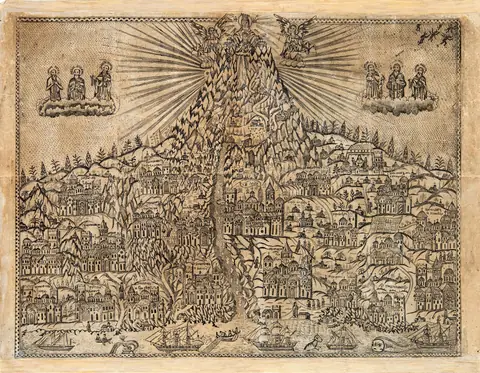
Image: Wikimedia Commons · Public domain (PD-Art) Map of Mount Athos and its monasteries
Look closely. A map of the peninsula drawn in the seventeenth century shows the monasteries as small buildings, with the mountain in the center. Notice how many there are and the pattern of walled houses.
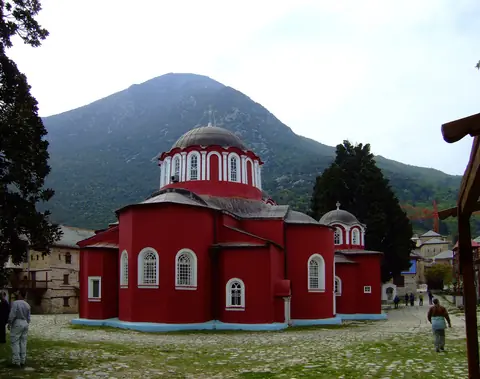
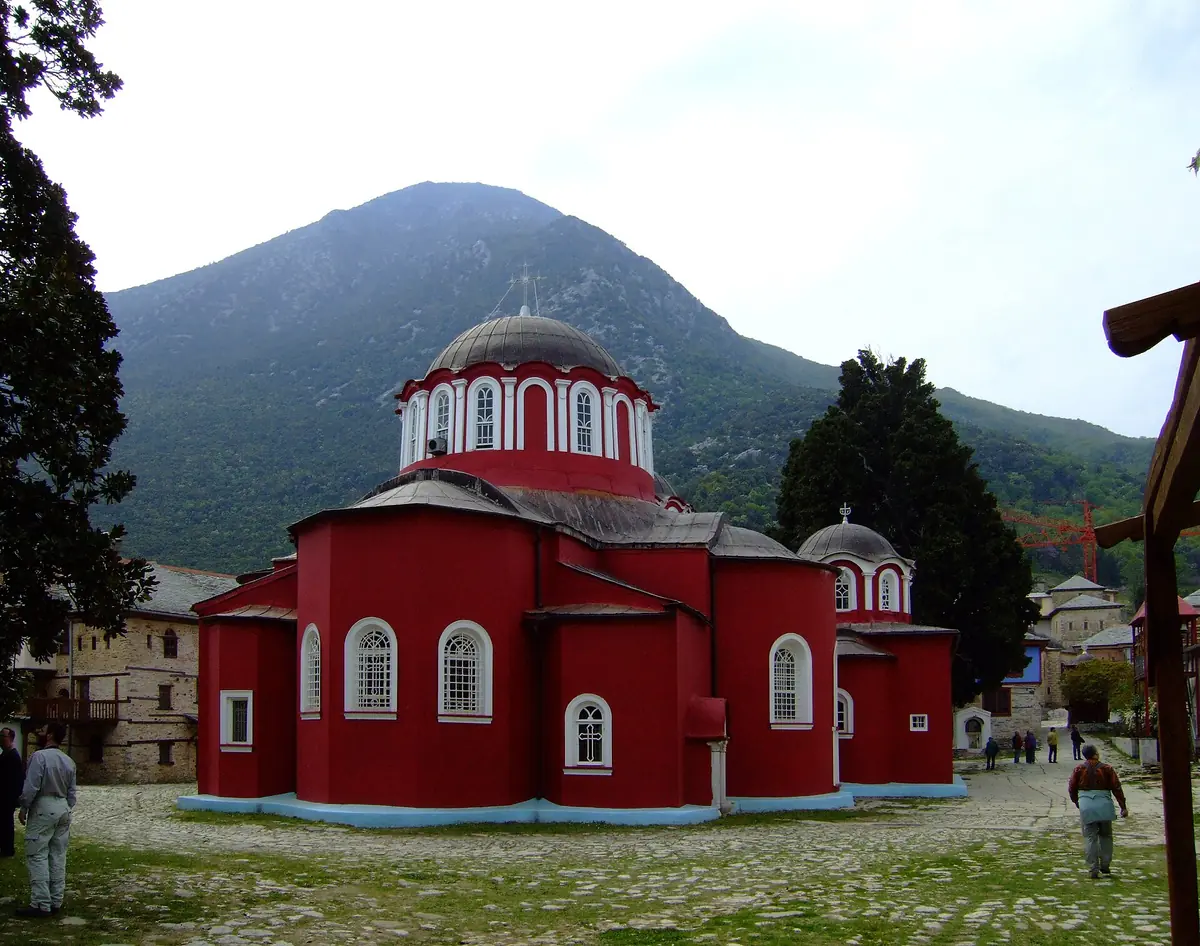
Image: Wikimedia Commons · Public domain The main church of the Great Lavra
Look closely. The katholikon, the main church, of the Great Lavra, the oldest monastery on the mountain, founded in 963 by Athanasios the Athonite. Its red wall paint and domes are typical of Athonite churches.
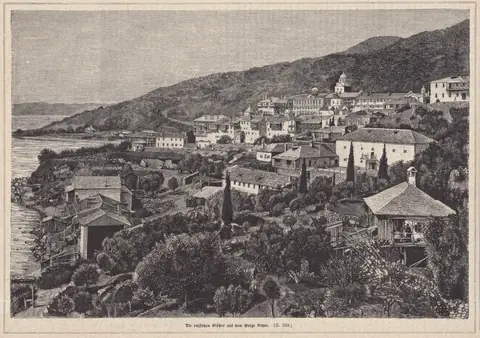
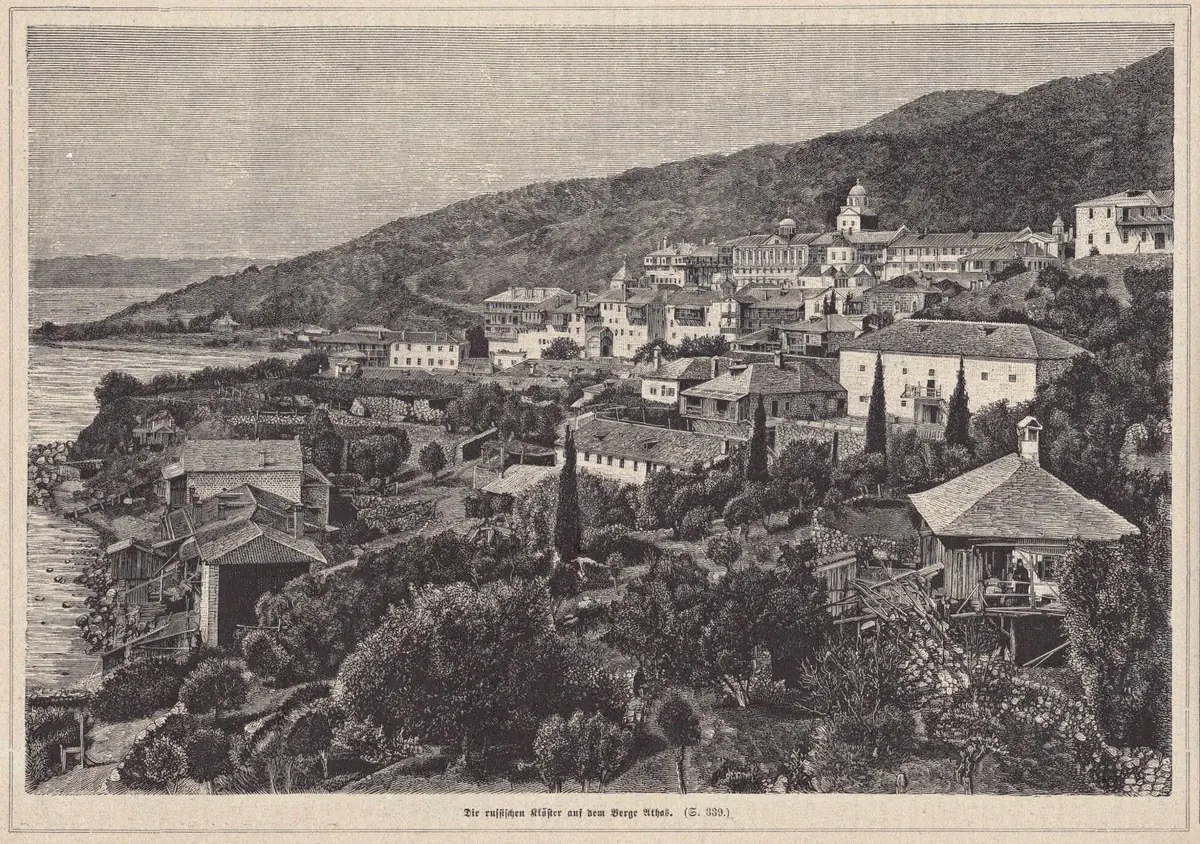
Image: Wikimedia Commons · Public domain (PD-Art) The monastery of St Panteleimon in 1882
Look closely. A nineteenth-century engraving shows a large monastery on the shore, with the sea behind it. The Russian monastery of St Panteleimon was greatly expanded in the nineteenth century.
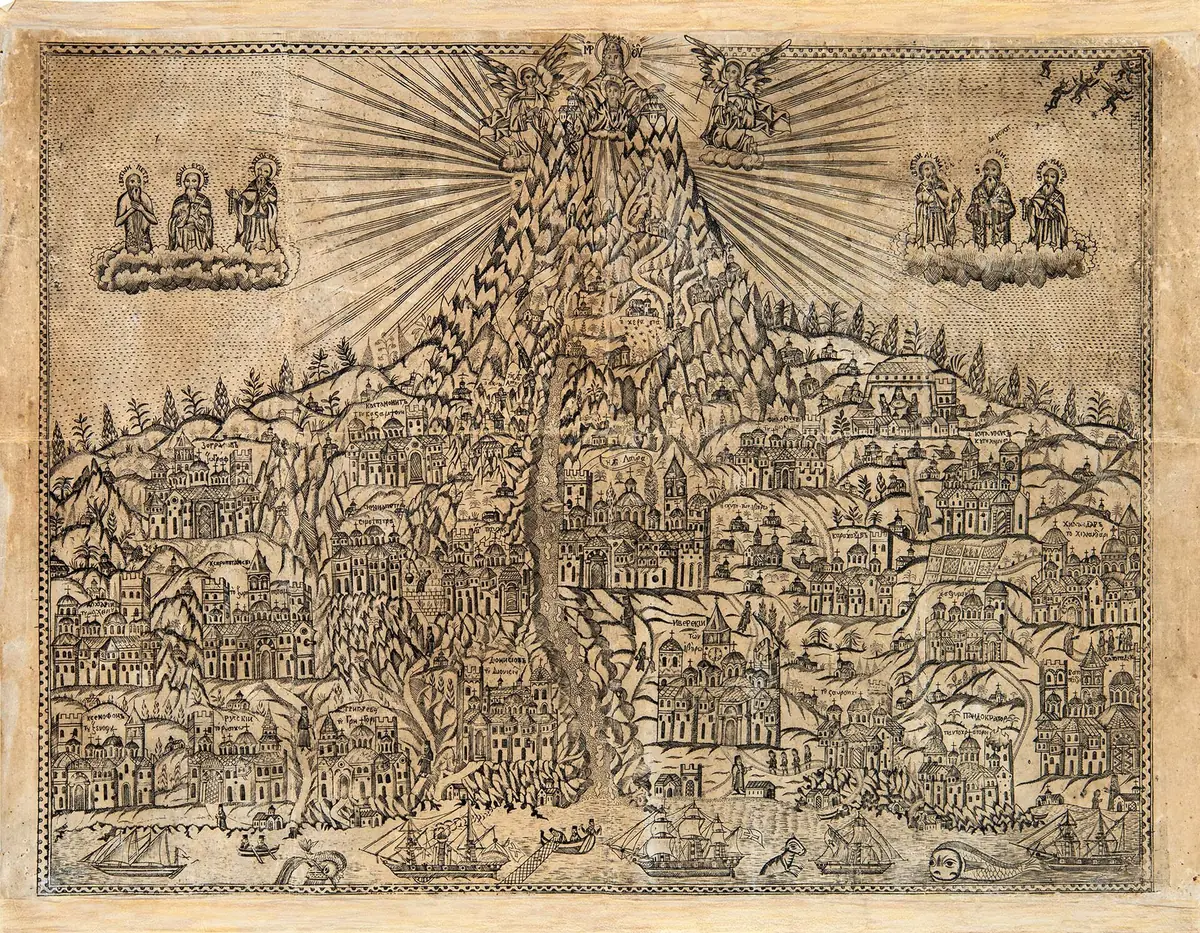


What to watch for
Look slowly- The harbors and the paths. The monasteries stand near the sea or on the slopes, joined by old footpaths.
- Fortress and church. Many monasteries are walled like castles, with a church at the center.
- Manuscripts and icons. The libraries hold some of the oldest Greek manuscripts.
- The Jesus Prayer. Read about the hesychast tradition and how Palamas defended it.
Sources
Dates follow standard historical references and, where we quote a book, the wording of the edition hosted in this library. Where a tradition is not certain history, the page says so. Photographs and pictures are used only when the image itself is Public domain, CC0, or CC BY with a named credit. Each picture links to its source page with full licence details. Pictures taken before a site was damaged are labelled with their date.