Great Churches & Monasteries · Holy Land & Middle East
St Catherine's Monastery
A fortress monastery at the foot of Mount Sinai, with a church, a burning bush, and one of the oldest libraries.
Still standing. The monastery has been in continuous use for about fifteen hundred years and has never been destroyed. It is walled and still home to a Greek Orthodox community.
Mar Saba · Hagia Sophia, also built under Justinian
What it is
Christian hermits settled near Mount Sinai in the early centuries, and by the fourth century pilgrims came to the place where, according to Exodus, Moses saw the burning bush and received the law. The emperor Justinian built a fortified monastery at the foot of the mountain in the sixth century, with a basilica of the Transfiguration whose apse mosaic of Christ on the mountain still survives. Tradition says the church later took the name of Saint Catherine of Alexandria, whose body monks were said to have found on the mountain.
Isolation protected the monastery. Its library is among the oldest in the world, and its icons include some of the earliest known, painted in the sixth and seventh centuries. In 1844 and 1859 the German scholar Constantin von Tischendorf visited and removed parts of the fourth-century Greek Bible now known as Codex Sinaiticus, most of which is today in London. The monastery is a Greek Orthodox community headed by an archbishop and is part of the World Heritage listing for Saint Catherine Area.
“Draw not nigh hither: put off thy shoes from off thy feet, for the place whereon thou standest is holy ground.”
Why it matters for a classical Christian student
Sinai is where, in the Bible, God gave Moses the Ten Commandments, and it is also the place where Elijah heard 'a still small voice'. A classical Christian student can see here a Christian place of pilgrimage that has kept the memory of the law for a millennium and a half. The virtue is constancy: monks lived here through plague, raiders, wars, and changes of rulers and never left. The monastery's manuscripts also remind students that the Bible they read was copied by hand by monks.
Read alongside
- The Bible: The burning bush (Exodus 3), the law at Sinai (Exodus 19–20), and Elijah at Horeb (1 Kings 19).
Great Lives connected here
- Justinian I, in Great Lives: Justinian founded the fortified monastery in the sixth century.
- Moses, in Great Lives: Exodus tells how Moses saw the burning bush and received the law at Mount Sinai (Horeb).
- Elijah, in Great Lives: First Kings tells how Elijah traveled to Horeb, the mount of God.
Look closely
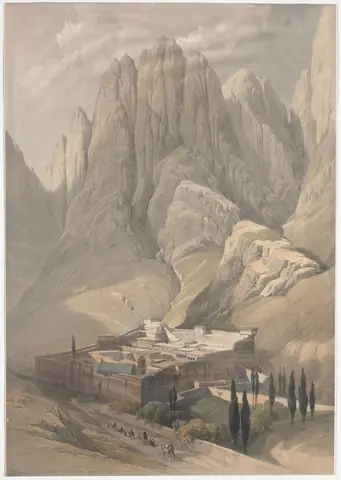
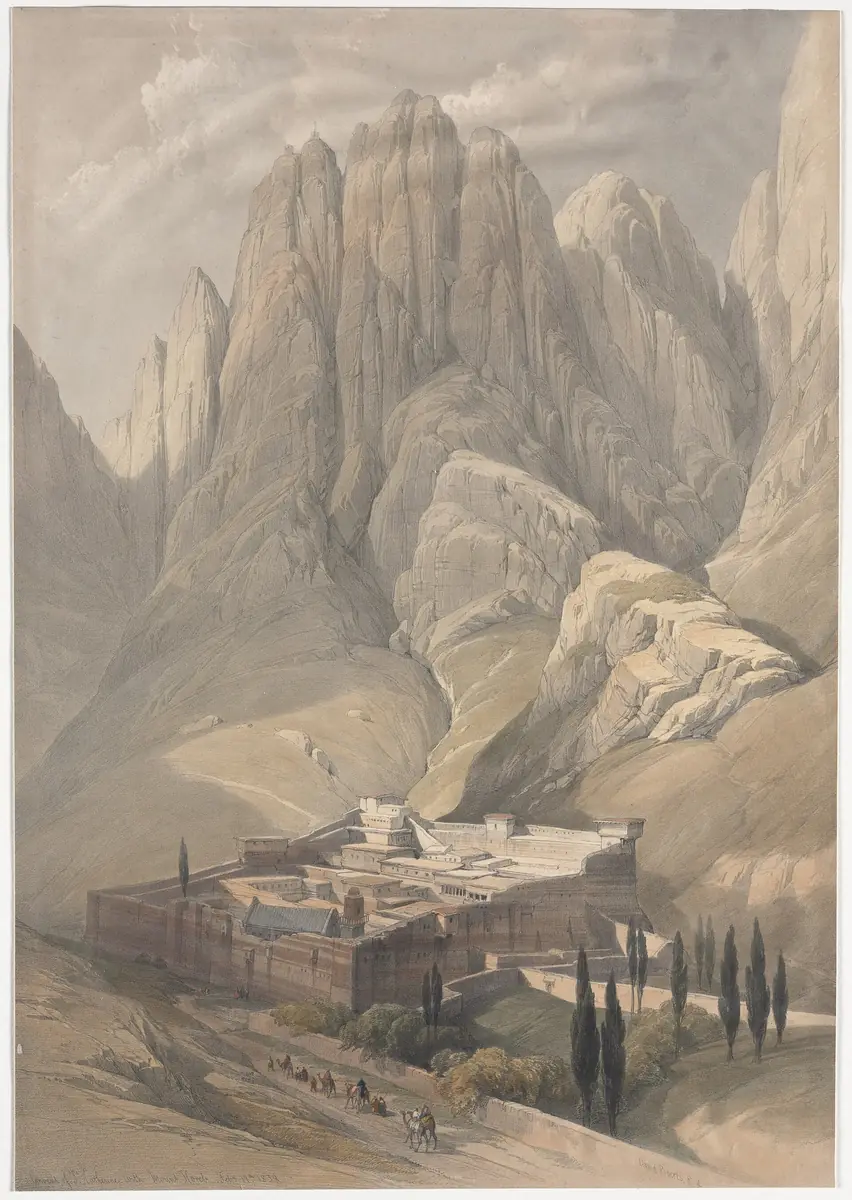
Image: Wikimedia Commons · CC0 (public domain) The Convent of St Catherine with Mount Horeb
Look closely. A lithograph by David Roberts shows the fortress-like monastery in the valley below a rock mountain. Roberts visited in 1839. Notice the high plain walls, which protected the monks, and the smallness of the figures.
In the library: Moses, in Great Lives
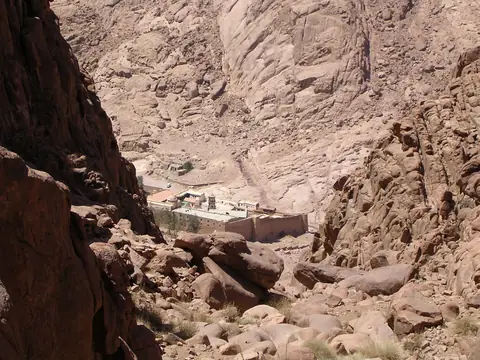
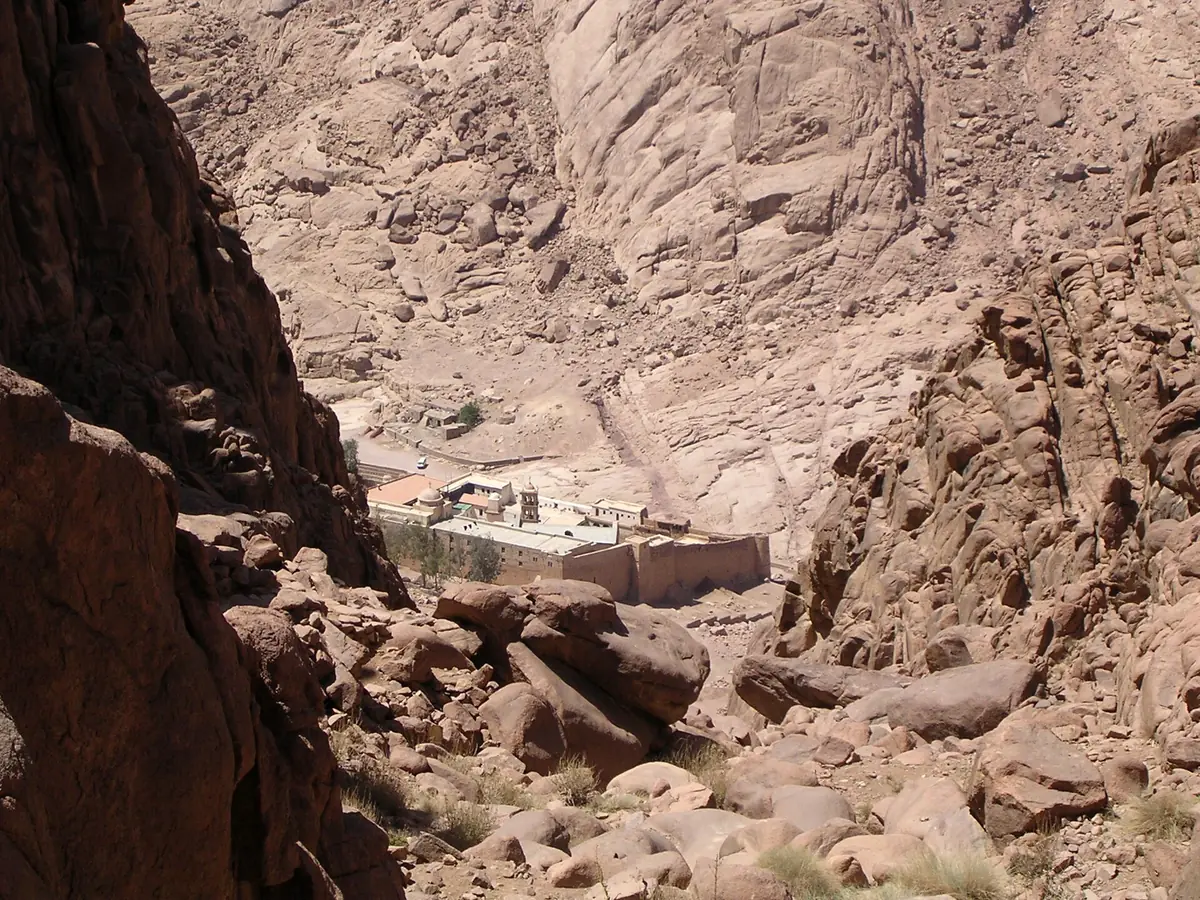
Image: Wikimedia Commons · Public domain The monastery in its valley
Look closely. A photograph from the slope above shows the monastery enclosed by its wall at the foot of the mountain. The walls date from the time of Justinian.
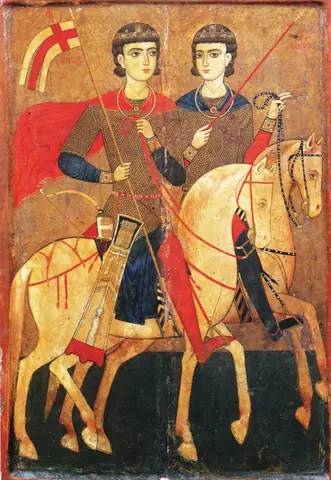
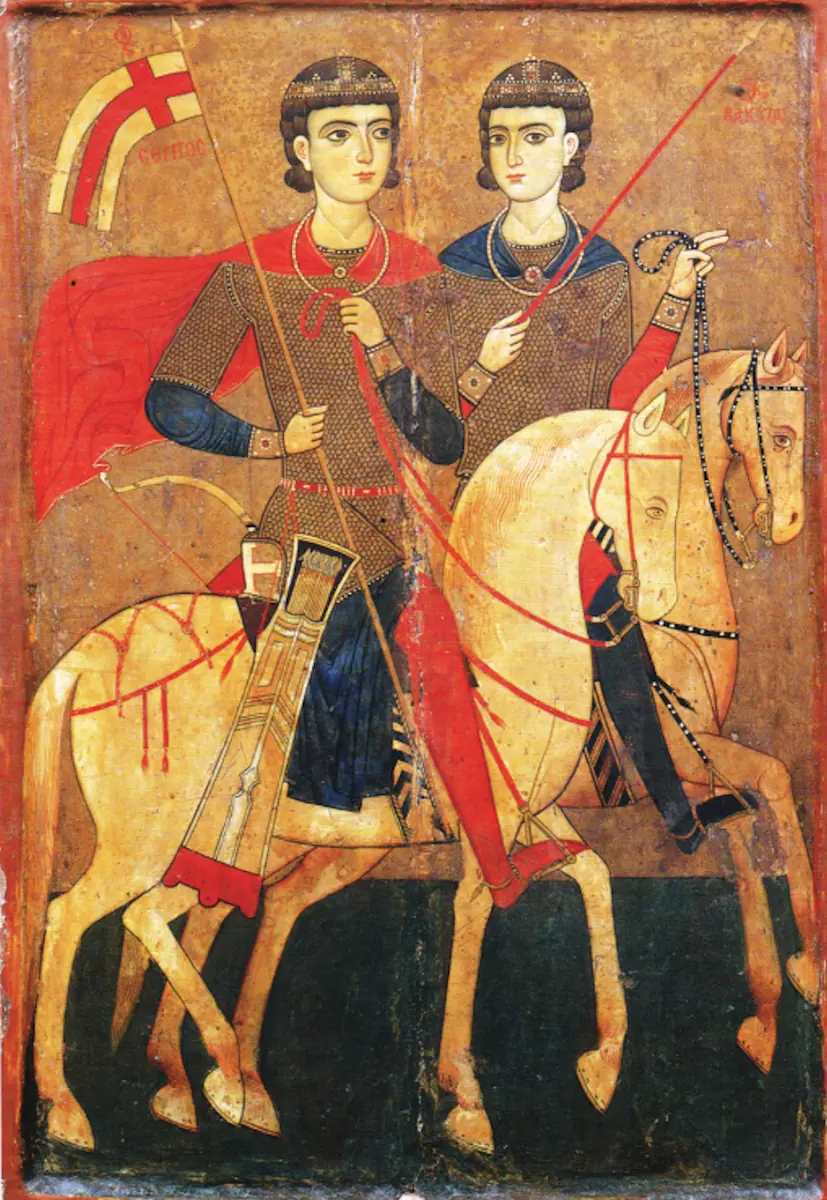
Image: Wikimedia Commons · Public domain Icon of Saints Sergius and Bacchus
Look closely. Two soldier saints on horseback, with halos and flags, from one of the monastery's great collection of icons. The monastery's collection includes some of the oldest icons in the world.
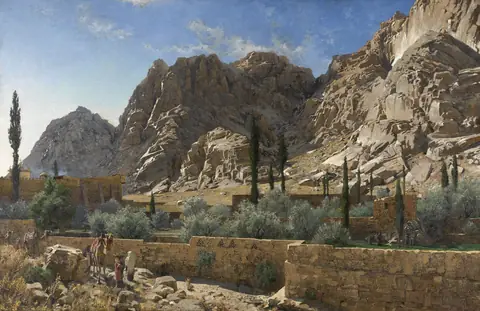
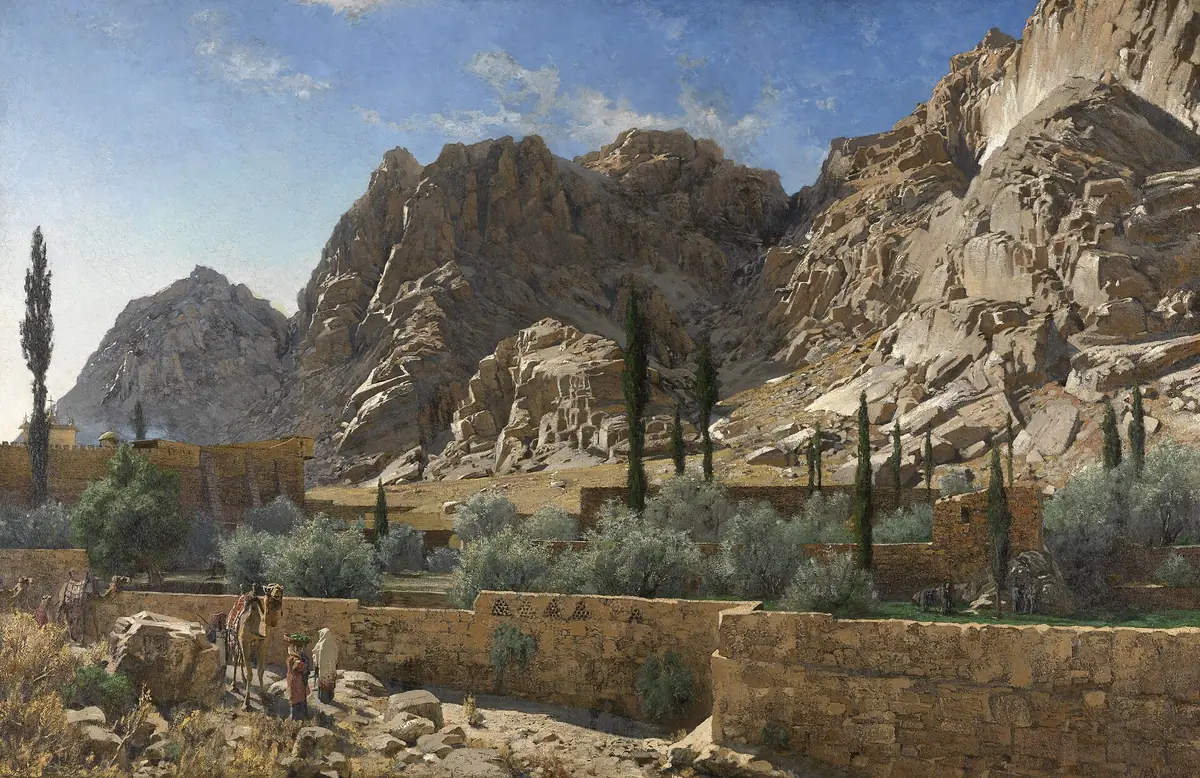
Image: Wikimedia Commons · Public domain (PD-Art) The monastery in 1890
Look closely. A painting by Adolf von Meckel shows the monastery gardens and the rocky mountain behind. Notice the cypress trees and the cultivated terraces in the desert.


What to watch for
Look slowly- The apse mosaic. The Transfiguration mosaic, from Justinian's day, is one of the great works of the sixth century.
- The Chapel of the Burning Bush. A living bush nearby is honored by the monks as the bush of Exodus.
- The walls. Justinian built the monastery as a fort, and the granite walls still stand.
- The library and icons. They are rarely open to the public, but their history is well documented.
Sources
Dates follow standard historical references and, where we quote a book, the wording of the edition hosted in this library. Where a tradition is not certain history, the page says so. Photographs and pictures are used only when the image itself is Public domain, CC0, or CC BY with a named credit. Each picture links to its source page with full licence details. Pictures taken before a site was damaged are labelled with their date.