Great Churches & Monasteries · Holy Land & Middle East
Qal'at Sim'an
Four great basilicas built around the pillar of a monk who lived on top of it for decades.
In ruins. The great complex is a ruin, though much of its east end stands. The site was damaged during the Syrian conflict in 2016.
What it is
Simeon, born about 390, became a monk in northern Syria and began living on a platform on a pillar, which was raised higher over the years. Tradition says he spent about thirty-seven years on pillars until his death in 459. People of all ranks came to ask his advice, and Theodoret of Cyrrhus, a bishop who knew him, wrote about him. The stylites, as such monks were called, were admired for their self-denial and some were criticized for display.
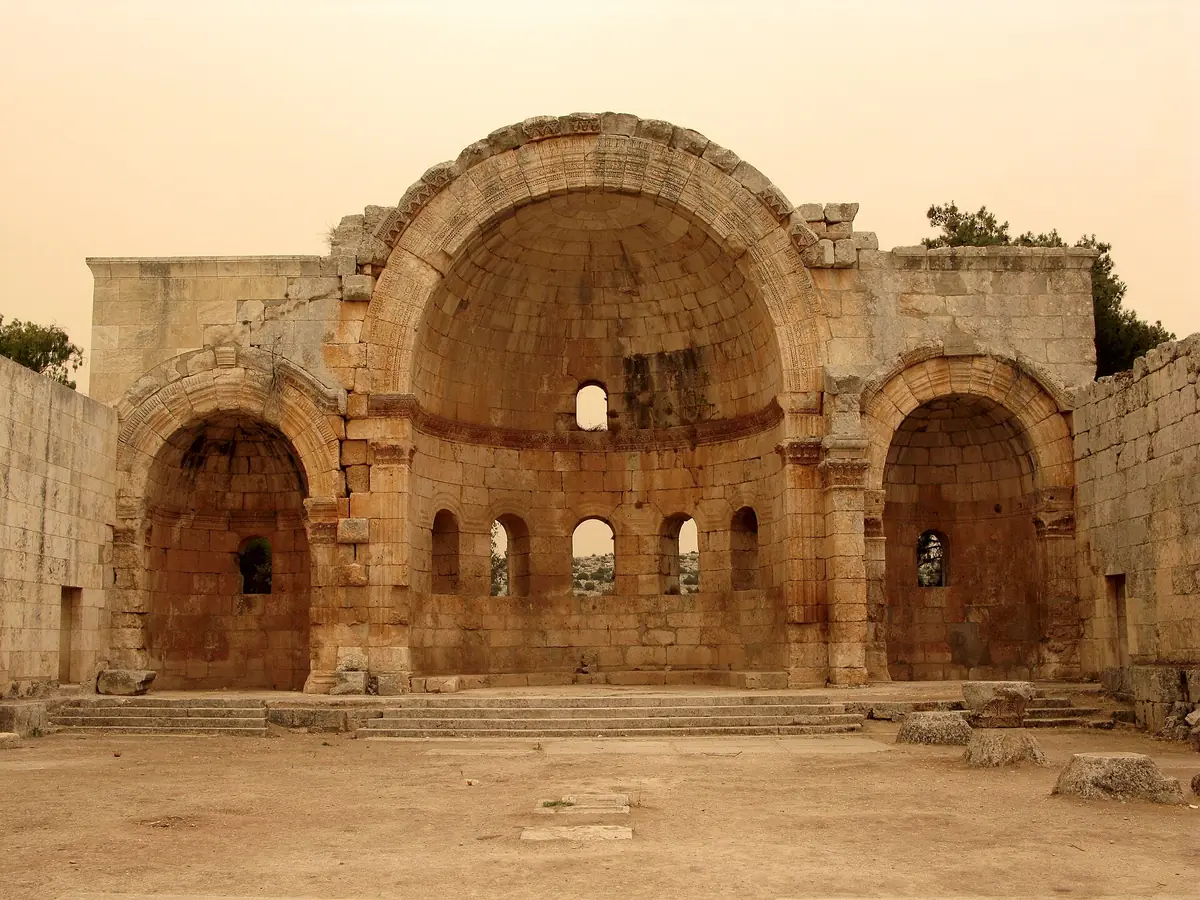
After his death a vast church was raised around the stump of his pillar, finished in the 480s under the emperor Zeno. It had four basilicas arranged in the shape of a cross around an open octagon, with the pillar at the center. It was among the largest churches of its day and a major goal for pilgrims. A monastery and pilgrims' quarters were built beside it. The complex was fortified in the tenth century, which gave the site its Arabic name, Qal'at Sim'an, 'the castle of Simeon'. The east end, with its three apses, is still imposing. The site is part of the UNESCO listing of the ancient villages of northern Syria.
Why it matters for a classical Christian student
Simeon's life raises a hard question for Christians: how far should self-denial go, and what is it for? The church's answer was mixed. Many admired it, and others warned against pride. A student should read Simeon's story with the teaching of Jesus on humility and with Antony's moderation in mind. The ruin also shows that even the largest church can be lost, and that the people it served can be scattered. The virtue to notice is endurance, joined with the need for humility.
Read alongside
- Early Christian Lives: Athanasius's Life of Antony shows the earlier desert asceticism that Simeon's life extended in a more extreme form.
Look closely
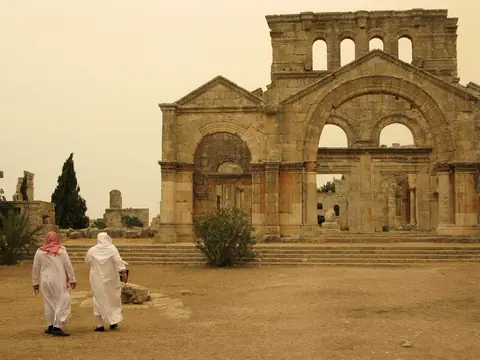
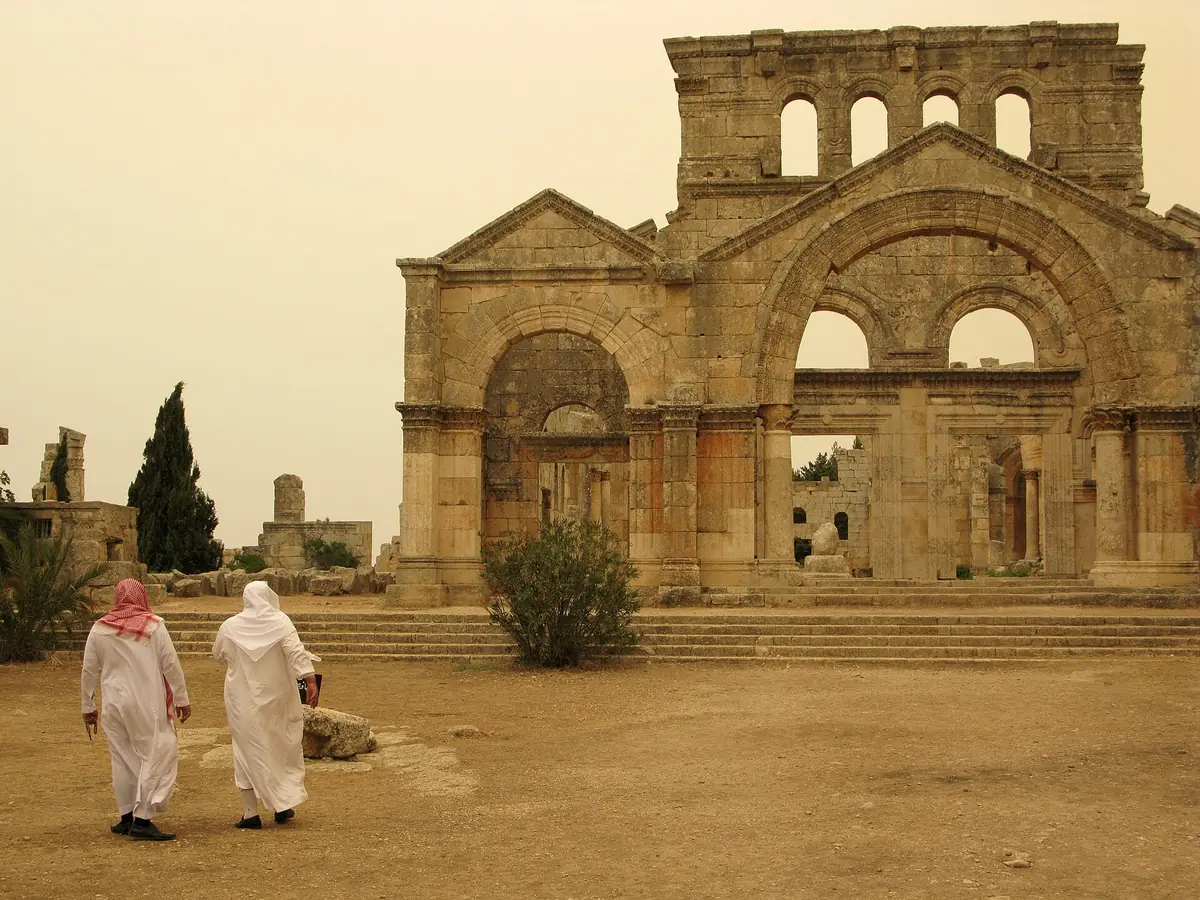
Image: Wikimedia Commons · CC BY 4.0 · Photo: Vyacheslav Argenberg The south front of the church
Look closely. This photograph was taken in 2008, before the damage of the Syrian war. The church has a triple-arched front with a carved gable. The date of the building is the late fifth century.
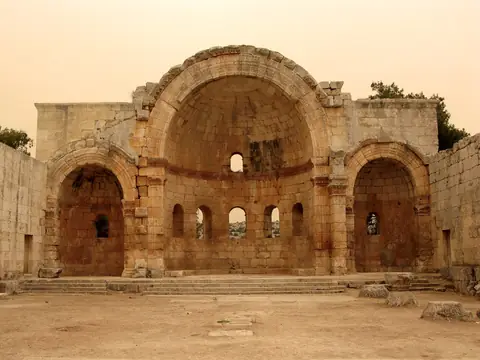
Image: Wikimedia Commons · CC BY 4.0 · Photo: Vyacheslav Argenberg The east end
Look closely. The east end of the church has a great central apse, with smaller apses on each side. Notice the arched windows and the fine carved moldings.
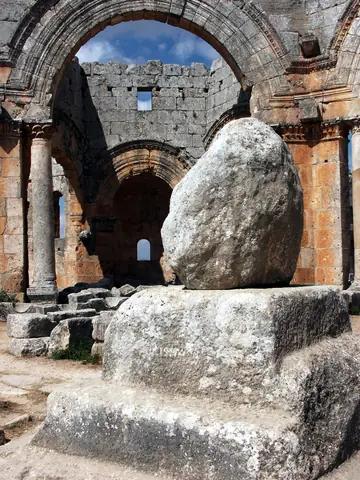
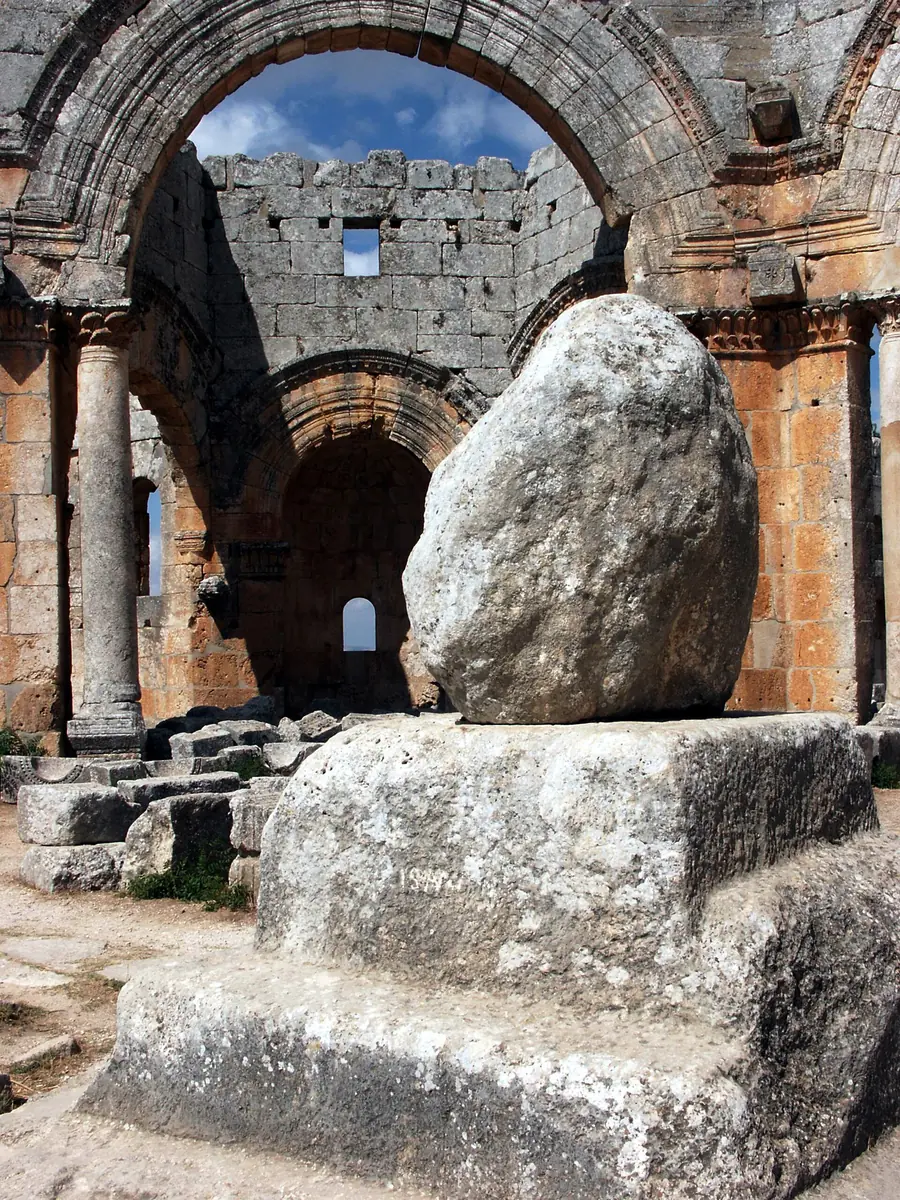
Image: Wikimedia Commons · CC BY 2.0 · Photo: James Gordon The base of the pillar
Look closely. At the center of the octagon where the four basilicas meet stands the rough stone that is the base of the pillar on which Simeon lived. Notice how little is left, and how much was built around it.


What to watch for
Look slowly- The octagon and the pillar base. Look for the stump of the pillar in the center.
- The east end. The three apses and carved moldings are the best-preserved part.
- Four arms of a cross. Notice the plan.
- Careful reading. The best early account is by Theodoret of Cyrrhus, and the historian must tell what is legend and what is record.
Sources
Dates follow standard historical references and, where we quote a book, the wording of the edition hosted in this library. Where a tradition is not certain history, the page says so. Photographs and pictures are used only when the image itself is Public domain, CC0, or CC BY with a named credit. Each picture links to its source page with full licence details. Pictures taken before a site was damaged are labelled with their date.