Great Churches & Monasteries · Holy Land & Middle East
Church of the Nativity
The church over the cave where, from at least the second century, Christians have remembered the birth of Jesus.
Still standing. The church stands and is often called the oldest church in the Holy Land still in regular use. It is shared by Greek Orthodox, Armenian Apostolic, and Roman Catholic communities. A major repair of the roof and windows was carried out in the 2010s.
Church of the Holy Sepulchre · Mar Saba, in the desert nearby
What it is
Christians in the second century already pointed to a cave in Bethlehem as the birthplace of Jesus. After Constantine's reign began, he and his mother Helena sponsored a large basilica over the cave, built in the 330s. The church was badly damaged in a Samaritan revolt in the sixth century, and the present nave, with its forest of red limestone columns and its plan of a long hall and three apses, is generally dated to the rebuilding under Justinian. A tradition holds that Persian invaders in 614 spared the church because they saw the Magi in Persian dress on a mosaic of the Adoration.
The crusaders decorated the church in the twelfth century with mosaics, and a number of fragments survive. To enter, visitors pass through the low 'Door of Humility', made small by later builders to keep out horses and robbers. Below the sanctuary is the Grotto of the Nativity, where a silver star in the floor marks the traditional place of the birth. The site was inscribed by UNESCO in 2012 with the pilgrimage route, and a long program of roof and window repair was completed in the following years.
“And she brought forth her firstborn son, and wrapped him in swaddling clothes, and laid him in a manger; because there was no room for them in the inn.”
Why it matters for a classical Christian student
The Christian claim is that God became man in a stable, in a small town, to a poor family. A visitor must stoop to go in. The classical Christian student should note that the church built here is among the oldest standing churches in the world, and that Christians from every century have come to this small place. The virtue to notice is humility, as taught by the Gospels and shown by the low door.
Read alongside
- The Bible: The stories of the birth are in Luke 2 and Matthew 2.
- The Travels of Ibn Battuta: A fourteenth-century Muslim traveler passes Bethlehem and names it as the birthplace of Jesus.
Great Lives connected here
- Constantine the Great, in Great Lives: Constantine and his mother Helena sponsored the first basilica over the cave.
- Justinian I, in Great Lives: The present church is generally dated to the rebuilding in Justinian's reign.
- Mary, mother of Jesus, in Great Lives: The Gospels of Matthew and Luke place the birth of her son in Bethlehem.
Look closely
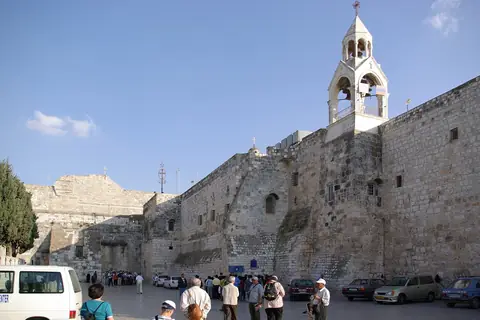
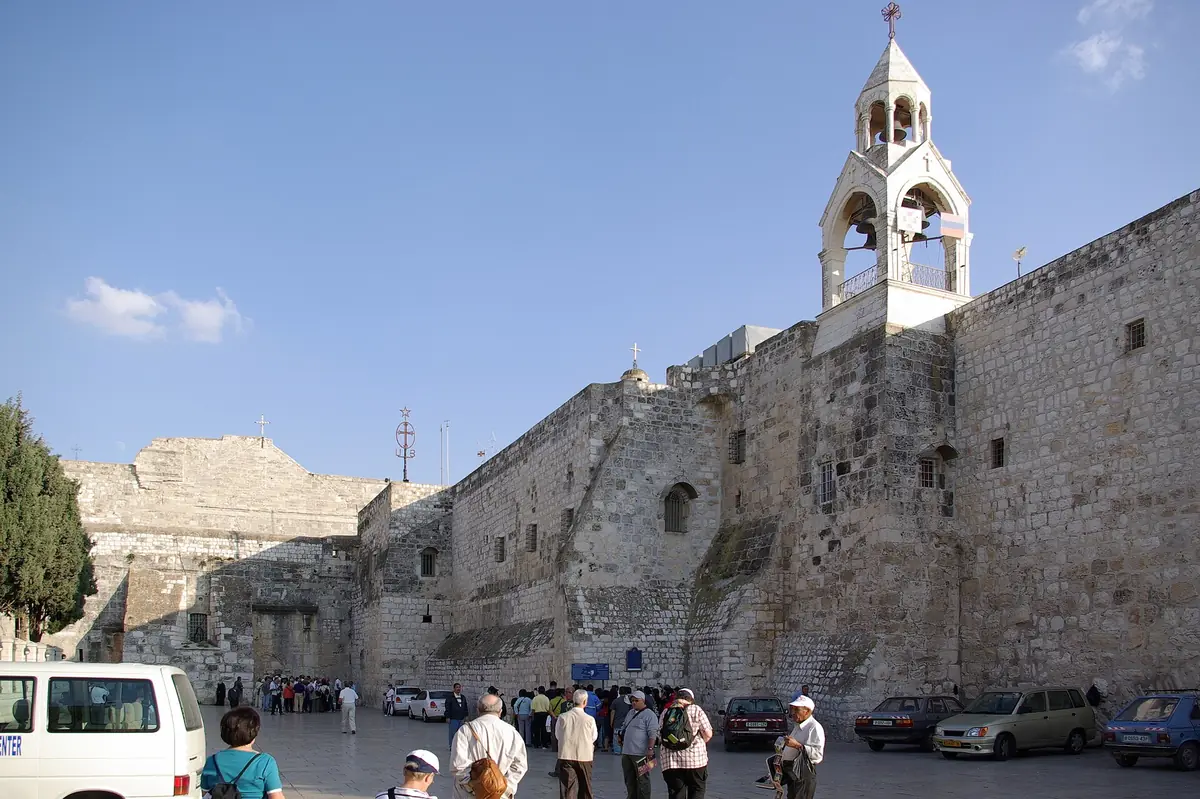
Image: Wikimedia Commons · Public domain The Church of the Nativity from the square
Look closely. From the square the church looks like a fortress, with thick plain walls and a small bell tower. Little of the sixth-century church shows from here. The main door, called the Door of Humility, was made low over the centuries.
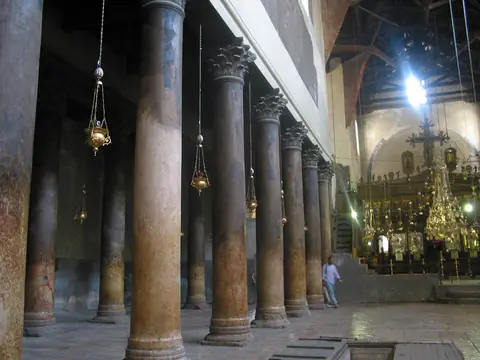
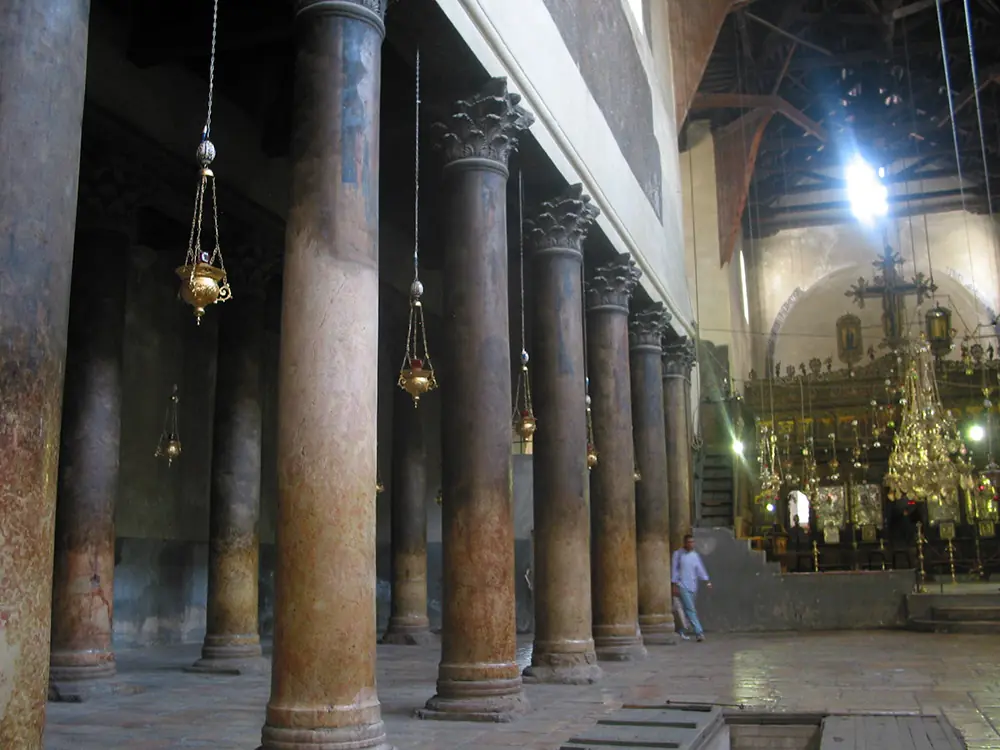
Image: Wikimedia Commons · Public domain The nave columns
Look closely. The nave has four rows of tall stone columns, which support the roof. The present church is largely that of the sixth century under Justinian, which replaced the fourth-century basilica of Constantine.
In the library: Constantine the Great, in Great Lives
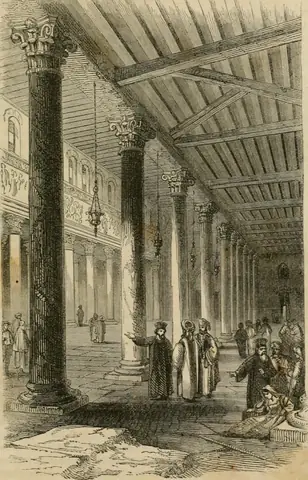
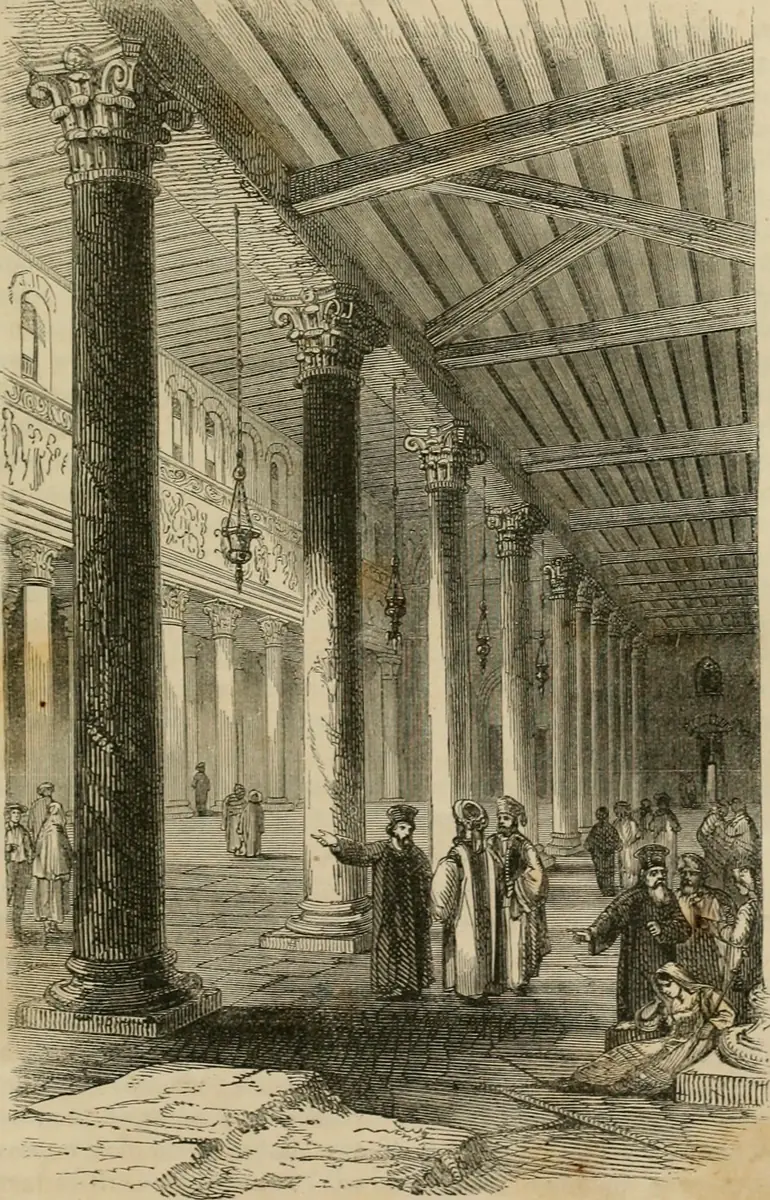
Image: Wikimedia Commons · Public domain (PD-Art) The nave in an engraving
Look closely. A nineteenth-century engraving of the nave, with its columns and its wooden ceiling beams, and figures standing between the columns. Compare the engraving with the later photographs.
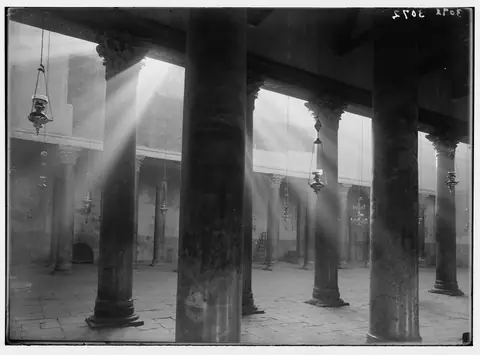
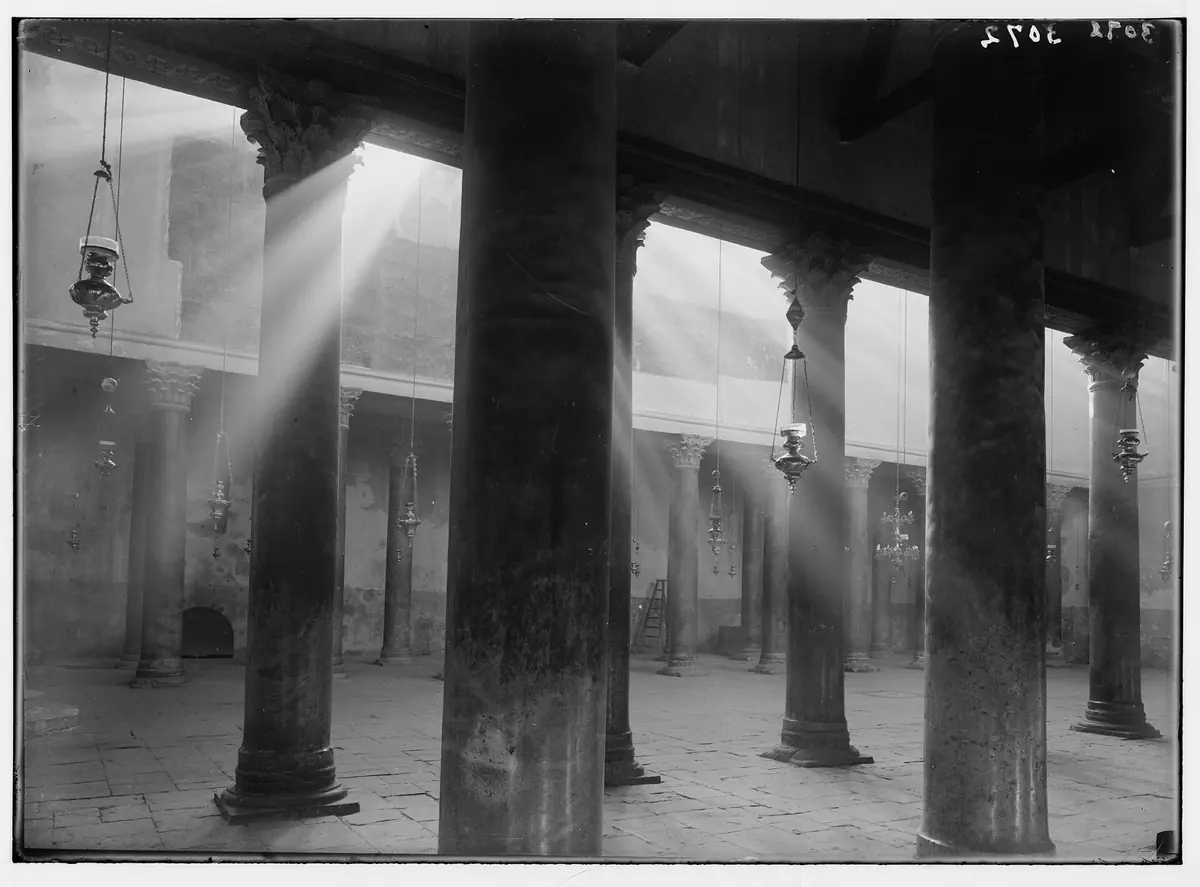
Image: Wikimedia Commons · Public domain (PD-Art) Light falling on the pillars
Look closely. A photograph from 1920 shows shafts of light falling between the ancient pillars of the nave. Notice the hanging lamps and the great height of the columns against the dim roof.


What to watch for
Look slowly- The Door of Humility. The doorway was made lower over the centuries. Notice how you must bow.
- The columns. The red limestone shafts of the nave bear paintings of saints from the crusader age.
- The star in the Grotto. The silver star marks the place that Christians have honored as the birthplace.
- Mosaic fragments. Look for the twelfth-century angels and the mosaics of church councils on the nave walls.
Sources
Dates follow standard historical references and, where we quote a book, the wording of the edition hosted in this library. Where a tradition is not certain history, the page says so. Photographs and pictures are used only when the image itself is Public domain, CC0, or CC BY with a named credit. Each picture links to its source page with full licence details. Pictures taken before a site was damaged are labelled with their date.