Great Art · Classical Greek
Polykleitos, Praxiteles and Lysippos
Three names that set the measure of the Greek body: the canon of Polykleitos, the softness of Praxiteles, and the portraits of Lysippos.
Their work
Polykleitos, working in the mid-fifth century, wrote a Canon and carved the Spear-Bearer as its proof: a standing youth whose weight shifts onto one leg so that the whole body answers itself. Praxiteles, in the next century, made the gods look near enough to touch — an Artemis who might have laid her cloak on a nearby stone, Muses seated on a base at Mantineia. Lysippos, sculptor to Alexander, was said to have made the king's official image, a leaner canon, and heads that still seem to think.
Most of their bronzes are lost. What we can show without turning this page into a gallery of unclothed gods are the draped works, the reliefs, and the portrait heads that later workshops copied in marble. The famous nudes — the Spear-Bearer, the Hermes of Olympia, the Apoxyomenos — are named below for older students. The heads and the draped figures are not a lesser story; they are how a face, a cloak, and a royal likeness were made to last.
Key sculptures
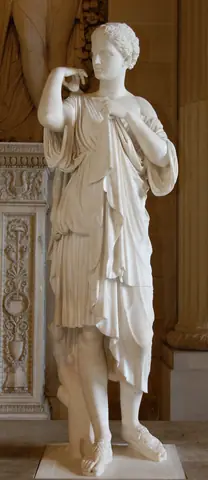
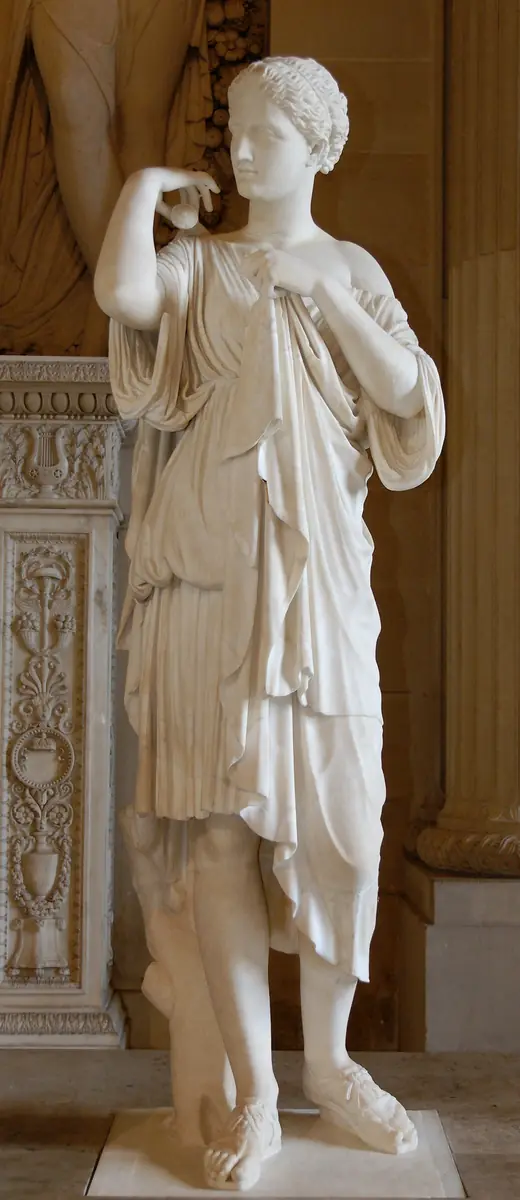
Image: Wikimedia Commons · CC BY 2.5 · Photo: Marie-Lan Nguyen Artemis of Gabii
Look closely. A standing Artemis in a short hunting dress, her weight on one leg, both hands busy at the shoulder as if she were fastening the cloak. The type is often connected with Praxiteles. Look at the raised right arm, the bunch of cloth at the shoulder, and the calm, almost everyday absorption of a goddess caught in a practical act.
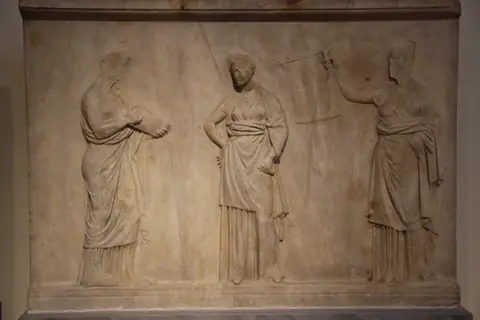
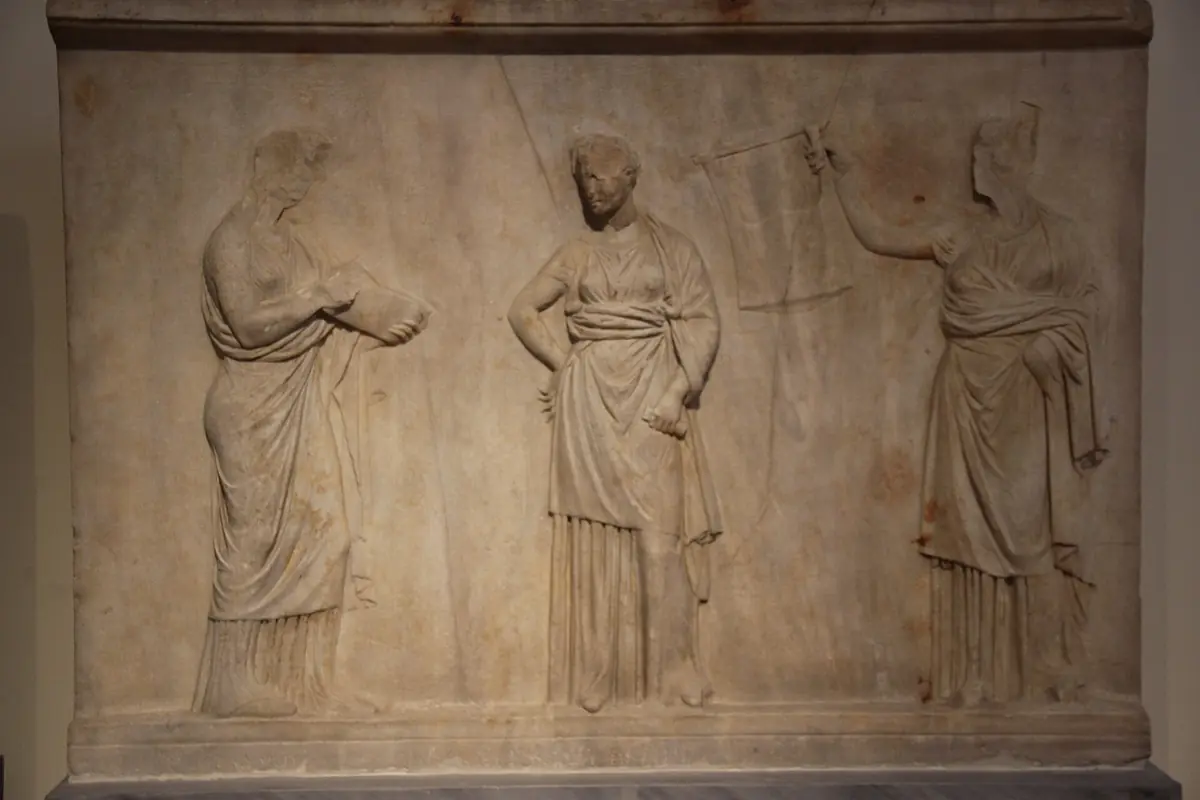
Image: Wikimedia Commons · CC0 (public domain) Slab from the Mantineia base
Look closely. One of the three marble slabs from a pedestal found at Mantineia and associated with Praxiteles's shop. Draped Muses sit and stand with their instruments and scrolls on a shallow stage. Look at the quiet spacing, the deep folds between the knees, and the way a seated figure turns toward her neighbor without breaking the flat of the block.
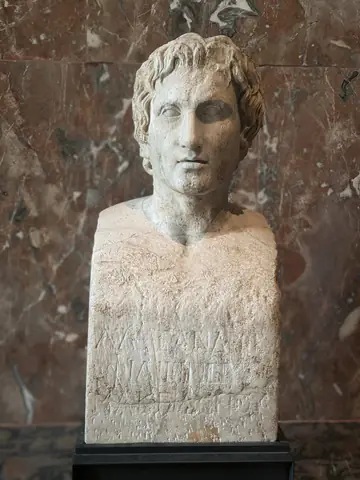
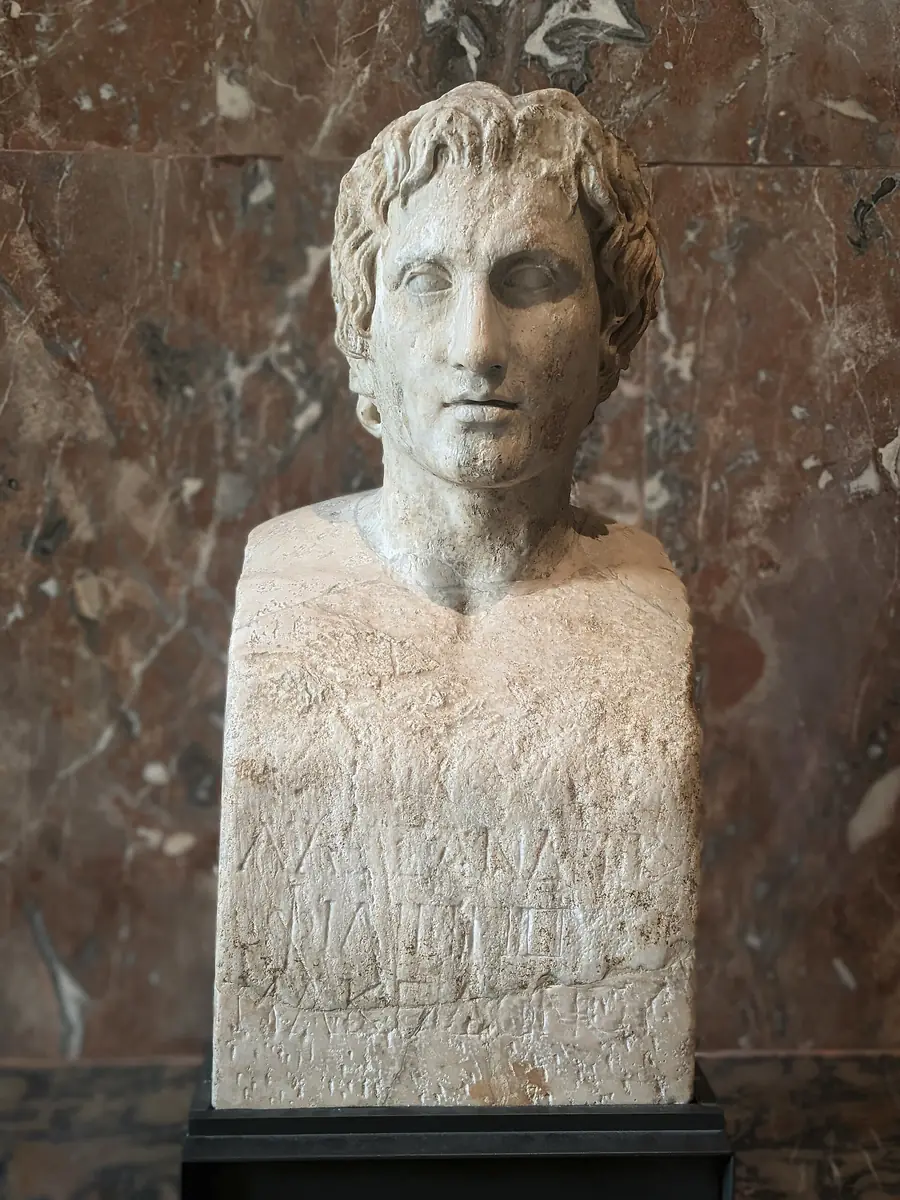
Image: Wikimedia Commons · CC0 (public domain) The Azara herm of Alexander
Look closely. A marble herm inscribed with Alexander's name, long taken as a reflection of Lysippos's official portrait. The neck turns, the hair rises off the brow in the familiar upsweep, and the face is lean. Look at the contrast between the plain shaft and the living turn of the head — a king reduced to the features by which he was known.
In the library: Alexander the Great · Plutarch, Lives
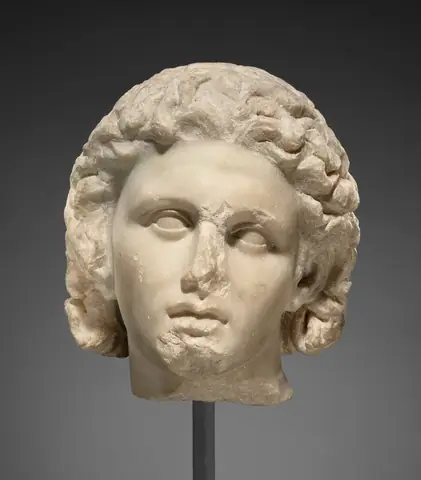
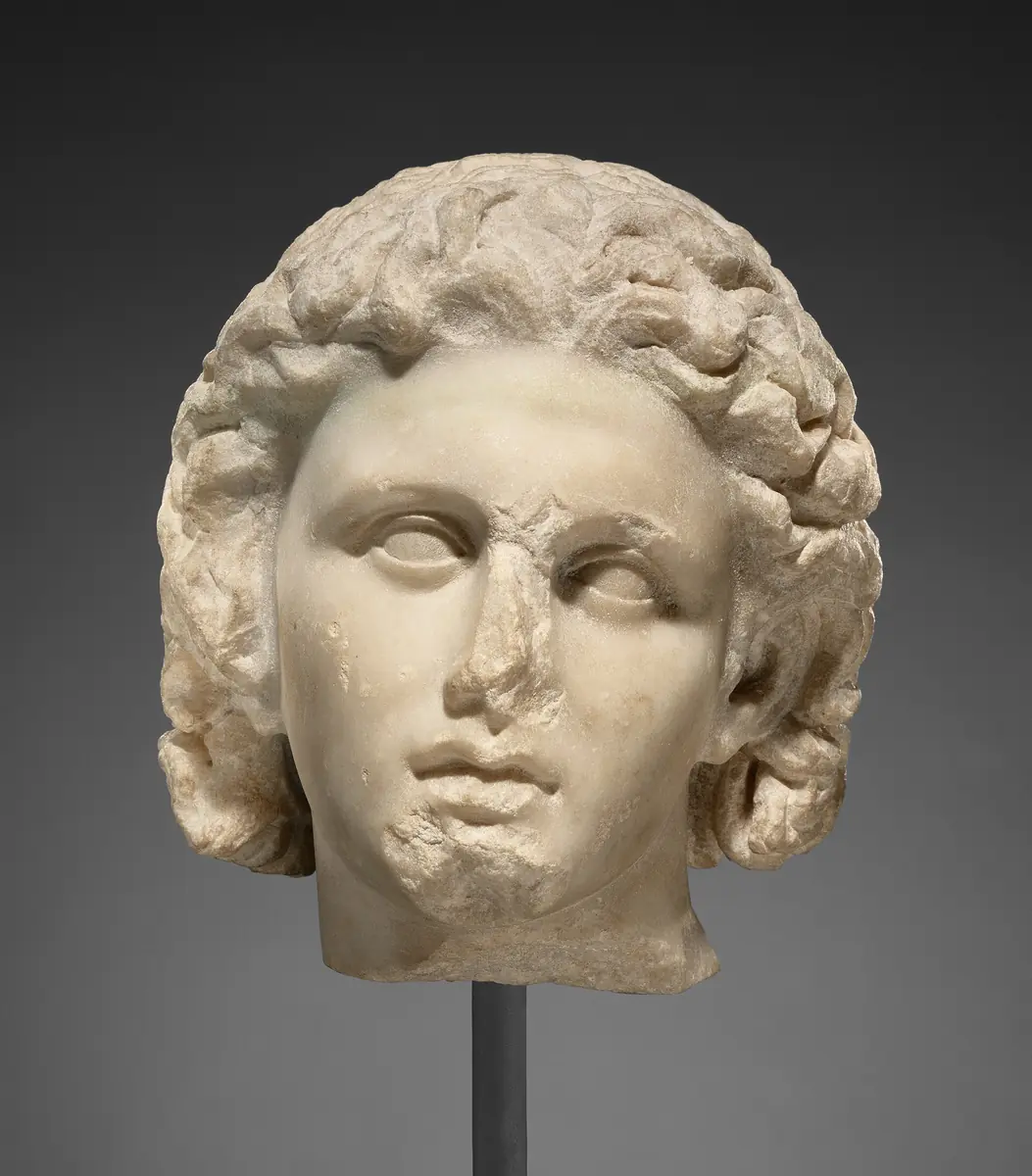
Image: Wikimedia Commons · CC0 (public domain) Portrait of Alexander the Great
Look closely. A marble head of Alexander, the hair thick and restless, the gaze slightly lifted. Works of this type are often related to Lysippos or to his circle. Look at the deep drilling of the hair, the turn of the neck, and the almost boyish fullness of the face against the claim of kingship.
In the library: Alexander the Great · Plutarch, Lives
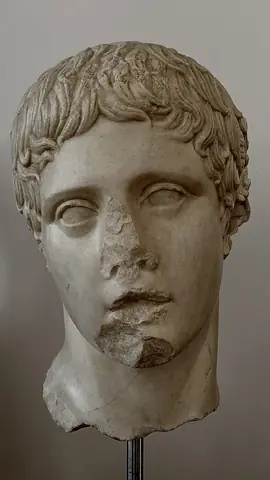
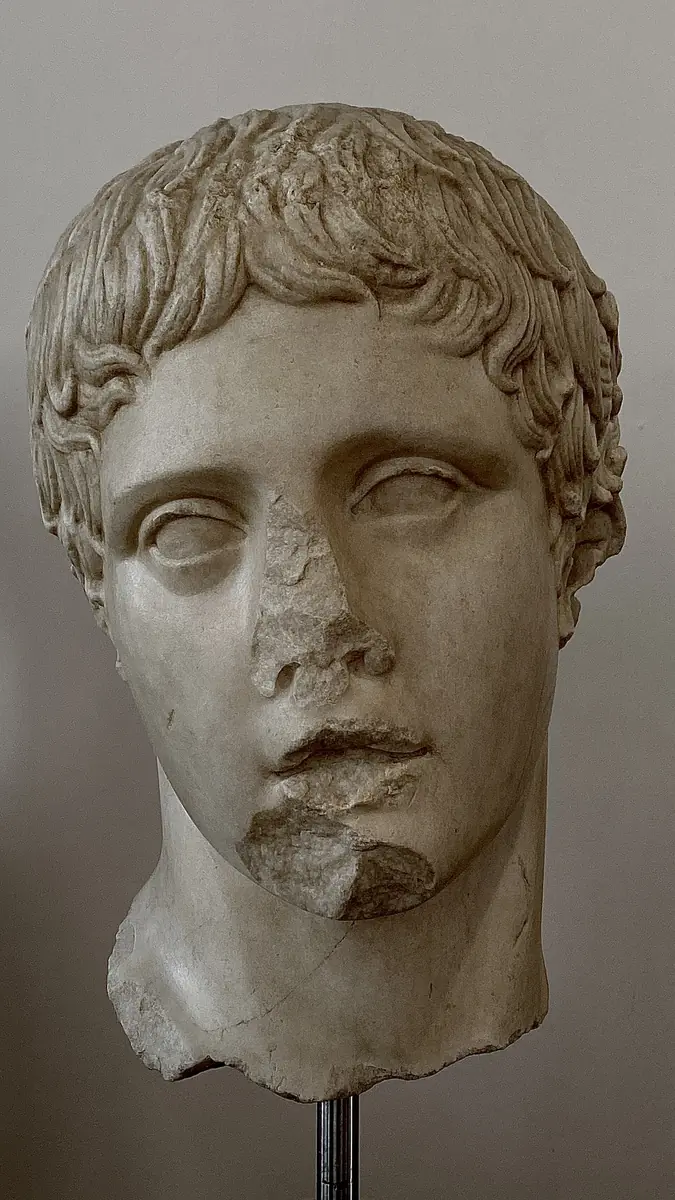
Image: Wikimedia Commons · CC0 (public domain) Head of a Doryphoros
Look closely. A marble head from a copy of Polykleitos's Spear-Bearer. The hair is close and orderly, the face calm, the neck set for a body that — in the full statue — would have stood in the famous shift of weight. Look at the even carving of the locks and at how little the expression needs to do; the thought is in the structure.
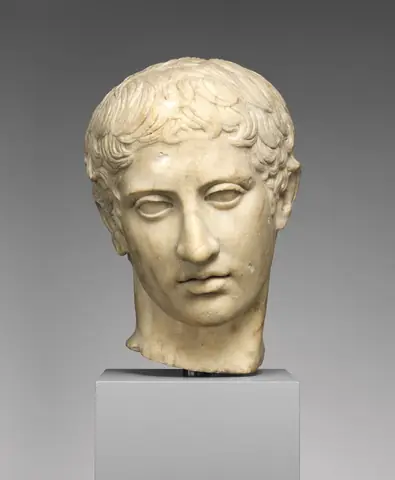
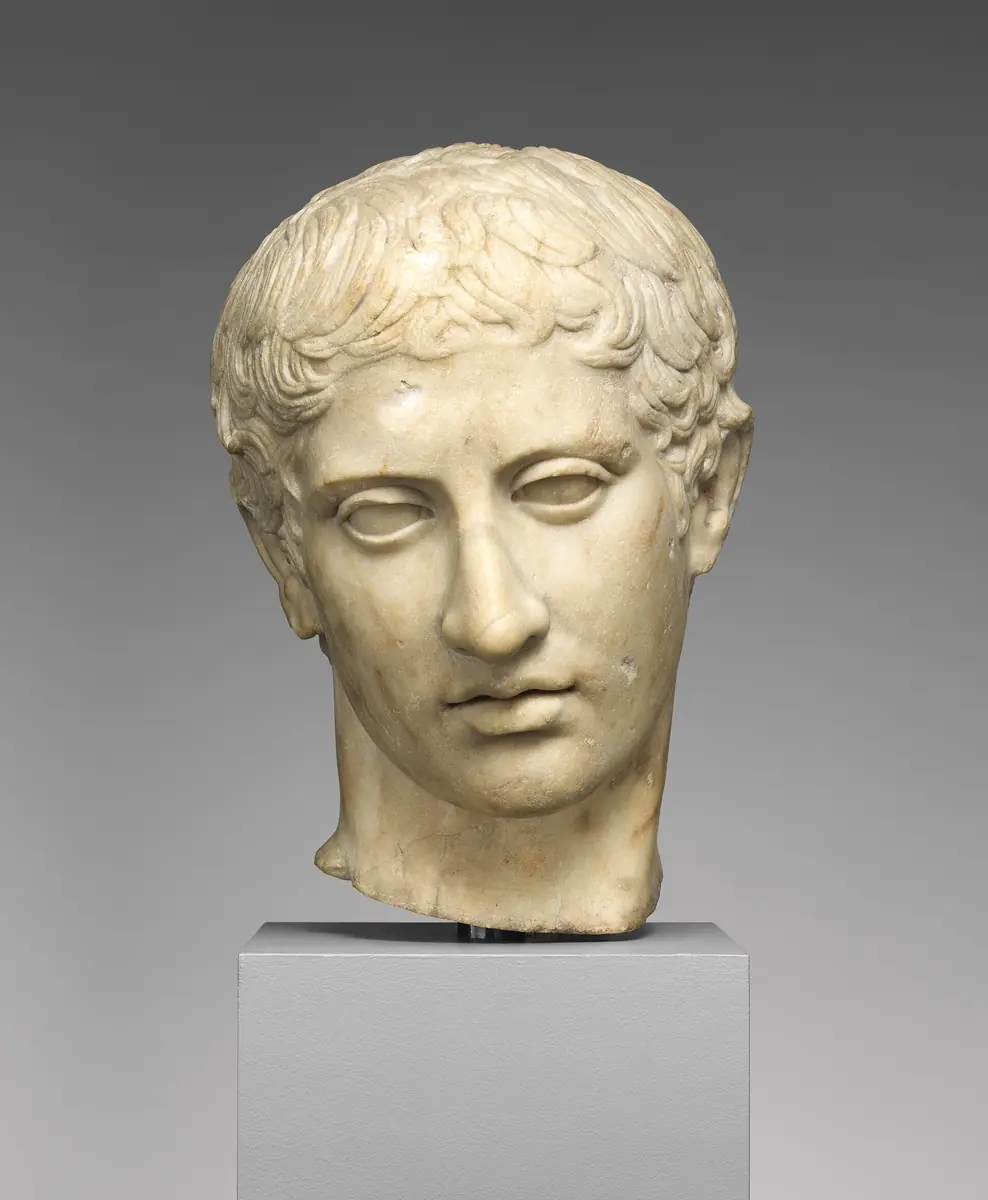
Image: Wikimedia Commons · CC0 (public domain) Head of a youth, after Polykleitos
Look closely. A marble head of a youth after a work attributed to Polykleitos, carved in the early Roman Empire. The planes of the face are broad and simple, the hair a cap of short curls. Look at the clean junction of neck and jaw, and at how a copy made centuries later still tries to keep the original's measured calm.


What to watch for in Polykleitos, Praxiteles and Lysippos
Look slowly- The turn of a head. A slight look left or right is often the whole pose of a herm or a bust.
- A cloak that has been put on, not drawn on. In the Artemis of Gabii, one arm is still busy with a fastening.
- Copies after lost bronzes. Roman marble often stands in for a Greek bronze; read the label, then judge the work in front of you.
- Alexander's look. Later ages knew him by the lift of the hair and the turn of the neck.
- Relief as a quiet stage. The Mantineia base puts the Muses on a shallow ledge, not in a deep box.
For older students
These famous works include nudity, so they are named here but not shown. Teachers and parents can decide when to look at them together.
- The Doryphoros (Spear-Bearer), c. 450–440 BC (original bronze; later marble copies), Copies in Naples and elsewhere. Polykleitos's famous standing male nude, known from Roman copies.
- The Diadumenos, c. 420 BC, Copies in Athens, London and elsewhere. A youth binding his hair, unclothed, after Polykleitos.
- Hermes and the Infant Dionysus, 4th century BC (attributed to Praxiteles), Archaeological Museum, Olympia. A largely unclothed Hermes holding the child Dionysus.
- Aphrodite of Knidos, c. 350 BC, Known from later copies. Praxiteles's famous female nude, the first of its kind at full scale.
- The Apoxyomenos (Scraper), c. 330 BC, Vatican Museums (marble copy) and elsewhere. Lysippos's athlete scraping oil from his body, unclothed.
Dates and collections follow the holding museums and Wikidata. Images of paintings are photographs of public-domain pictures from Wikimedia Commons or museum open-access releases; photographs of sculpture are used only when the photograph itself is Public domain, CC0, or CC BY with a named credit. Each picture links to its source page with full licence details.