Alan Turing
1912–1954 · English mathematician who founded computer science and helped break German codes in WWII.
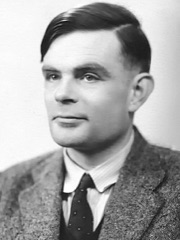
Alan Turing was born in London; his father worked in the Indian Civil Service, and he was raised largely by a foster family in England. At school he loved science and mathematics more than the classics his teachers preferred. At King's College, Cambridge, he proved important results in probability, and in 1936 he published On Computable Numbers, describing an imaginary machine, now called a Turing machine, that could carry out any calculation that can be written as a set of steps. This idea became a foundation of computer science. During the Second World War he worked at Bletchley Park, Britain's secret code-breaking center, where he led work on breaking messages sent with the German Enigma machine, especially naval codes, and designed the electromechanical Bombe used to find the daily settings. This work helped the Allies in the Battle of the Atlantic. After the war he designed an early stored-program computer and in 1950 proposed a test of whether machines can think. In 1952 he was prosecuted for homosexual acts, then a crime in Britain. He died in 1954 of cyanide poisoning.
Alan Turing is also an author in the library: author page and works.
Faith: Became an atheist as a young man; biographers have linked this to the death of his close friend Christopher Morcom. Source: Wikipedia
Key dates
- 1936 On Computable Numbers
- 1939 Joins Bletchley Park
- 1940 First Bombe in operation
- 1950 Computing Machinery and Intelligence
- 1952 Prosecuted
- 1954 Dies at Wilmslow
Fun facts
- At Christmas 1934, as a college graduate, he asked his mother for a teddy bear because he had never had one as a child. He named it Porgy. (Source: Alan Turing (Wikipedia))
- He invented 'round-the-house chess': one player makes a move and then runs around the house, and the other must make a move before the runner gets back. (Source: Alan Turing (Wikipedia))
Watch


Videos load from YouTube in privacy-enhanced mode only when you press play.
Read about them
As an Amazon Associate I earn from qualifying purchases. As a Bookshop.org affiliate I earn from qualifying purchases, which also support independent bookstores.
Grades 9–12
- On Computable Numbers and Computing Machinery · In the library
- Alan Turing: The Enigma by Andrew Hodges (Princeton University Press, 2014; ISBN 9781400865123)
Bookshop.org · Amazon
More lives
Niels Bohr · Vannevar Bush · George Washington Carver · Marie Curie · Arthur Eddington · Albert Einstein