Alexander Pope
1688–1744 · Leading English poet of the early eighteenth century: An Essay on Criticism, The Rape of the Lock, An Essay on Man and his translation of Homer.
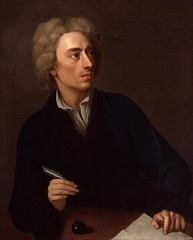
Alexander Pope was born in London on 21 May 1688, the son of a Roman Catholic linen merchant. Because the penal laws barred Catholics from the universities and public office, he was educated mostly at home and by his own wide reading, after his family moved to Binfield near Windsor Forest. From about the age of twelve he suffered from tuberculosis of the spine, which left him very short, bent and often in pain. He won early fame with An Essay on Criticism (1711) and The Rape of the Lock (1712–1717). His translations of Homer's Iliad and Odyssey made him wealthy and allowed him to settle at a villa in Twickenham, where he built a celebrated garden and grotto. He went on to write The Dunciad, a satire on dull writers, An Essay on Man (1733–34) and imitations of Horace. A friend of Swift, Gay and Arbuthnot, he was the master of the heroic couplet. He died at Twickenham on 30 May 1744.
Alexander Pope is also an author in the library: author page and works.
Faith: Born to Roman Catholic parents and remained a Catholic all his life, which under the penal laws barred him from university and public office; he received the last rites before he died. Some critics charged An Essay on Man with deism, a reading he rejected. Source: Wikipedia
See also: Horace · John Milton · Jonathan Swift · Homer

Key dates
- 1688 Born in London, 21 May
- 1700 Family moves to Binfield in Windsor Forest
- 1711 An Essay on Criticism published
- 1714 Five-canto Rape of the Lock published
- 1715–1720 Translation of the Iliad published
- 1719 Settles at Twickenham
- 1733–1734 An Essay on Man published
- 1744 Dies at Twickenham, 30 May
In their words
“To err is human, to forgive, divine.”
“An honest man's the noblest work of God.”
Read about them
Grades 9–12
- The Rape of the Lock · In the library
- An Essay on Criticism · In the library
- An Essay on Man · In the library
More lives
William Blake · James Boswell · Robert Burns · William Cowper · John Dickinson · Denis Diderot