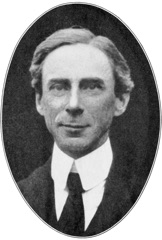
Bertrand Russell
1872–1970 · British philosopher, logician and campaigner, coauthor of Principia Mathematica and winner of the 1950 Nobel Prize in Literature.
Bertrand Russell was born in 1872 in Wales into an aristocratic family; his grandfather, Lord John Russell, had twice been prime minister. Orphaned young, he was raised by his grandmother and educated at home before studying mathematics and philosophy at Trinity College, Cambridge. With Alfred North Whitehead he wrote Principia Mathematica (1910–1913), which tried to base mathematics on logic, and he helped found the tradition of analytic philosophy. The Problems of Philosophy (1912) is a short introduction for general readers. A pacifist during the First World War, he lost his Cambridge lectureship and was imprisoned for six months in 1918 for an article opposing the war. He wrote on education, marriage, religion and politics, ran an experimental school with his wife Dora, and published A History of Western Philosophy (1945). He won the Nobel Prize in Literature in 1950. In later life he campaigned against nuclear weapons. He died in Wales in 1970, aged 97.
Bertrand Russell is also an author in the library: author page and works.
Faith: An agnostic who, in public, was known for his outspoken atheism. Source: Stanford Encyclopedia of Philosophy
Further reading
- Russell: A Very Short Introduction by A. C. Grayling (Oxford University Press, 2002), ISBN 9780192802583

Key dates
- 1872 Born in Wales
- 1910–1913 Principia Mathematica, with Whitehead
- 1912 The Problems of Philosophy published
- 1918 Imprisoned for opposing the war
- 1945 A History of Western Philosophy
- 1950 Nobel Prize in Literature
- 1970 Dies in Wales
Read about them
Grades 9–12
- The Problems of Philosophy · In the library
More lives
Hannah Arendt · Henri Bergson · Niels Bohr · Vannevar Bush · George Washington Carver · Marie Curie