Charles Sanders Peirce
1839–1914 · American philosopher, logician and scientist, founder of pragmatism and of the modern study of signs.
Charles Sanders Peirce was born in 1839 in Cambridge, Massachusetts, the son of Benjamin Peirce, a Harvard professor of mathematics and astronomy. He studied chemistry at Harvard and for about thirty years worked as a scientist for the United States Coast and Geodetic Survey, measuring gravity with pendulums. He also made important contributions to logic, including work on the logic of relations and quantifiers, and to probability and the philosophy of science. In a series of articles in Popular Science Monthly in 1877–1878, called Illustrations of the Logic of Science, including 'The Fixation of Belief' and 'How to Make Our Ideas Clear', he set out the ideas that his friend William James later called pragmatism: that the meaning of an idea lies in its practical consequences. He also developed a theory of signs, or semiotics. He lectured at Johns Hopkins University but never held a permanent academic post. He spent his last decades in poverty in Milford, Pennsylvania, where he died in 1914, leaving many unpublished manuscripts.
Charles Sanders Peirce is also an author in the library: author page and works.
Faith: Faith not well documented. Source: Wikipedia
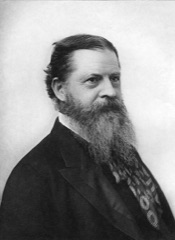

Key dates
- 1839 Born in Cambridge, Massachusetts
- 1859 Begins work for the Coast Survey
- 1877–1878 Illustrations of the Logic of Science
- 1879–1884 Lecturer at Johns Hopkins
- 1914 Dies in Milford, Pennsylvania
Read about them
Grades 9–12
- Illustrations of the Logic of Science · In the library
More lives
Edwin A. Abbott · Charles Babbage · Frédéric Bastiat · Claude Bernard · Eugen von Böhm-Bawerk · George Boole