Ernst Mach
1838–1916 · Austrian physicist and philosopher of science whose name is used for the Mach number, the ratio of a speed to the speed of sound.
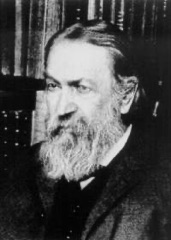
Ernst Mach was born in 1838 in Chrlice, near Brno in Moravia (now the Czech Republic), and was educated largely at home by his father. He studied physics and mathematics at the University of Vienna, then taught at Graz and, from 1867, at Prague, where he was professor of experimental physics for nearly thirty years and served as rector of the university. He studied hearing, vision and the senses, and in the 1880s he took some of the first photographs of shock waves around speeding bullets; the ratio of an object's speed to the speed of sound is now called its Mach number in his honor. Mach argued that science should describe what can be observed and measured, and his criticism of Newton's ideas of absolute space and time in The Science of Mechanics (1883) influenced the young Albert Einstein. His Popular Scientific Lectures explained science for general audiences. From 1895 he held a chair in philosophy at Vienna. After a stroke he retired, and he died near Munich in 1916.
Ernst Mach is also an author in the library: author page and works.
Faith: Baptized as a child; later became a socialist and an atheist. Source: Wikipedia

Key dates
- 1838 Born in Chrlice, Moravia
- 1867 Professor of experimental physics at Prague
- 1883 The Science of Mechanics published
- 1887 Photographs shock waves around a bullet
- 1895 Professor at the University of Vienna
- 1916 Dies in Germany
Fun facts
- The Mach number used for speeds faster than sound is named after him, and so are an asteroid, a crater on the Moon and even Speed Racer's car, the Mach Five. (Source: Ernst Mach (Wikipedia))
Read about them
Grades 9–12
- Popular Scientific Lectures · In the library
More lives
Edwin A. Abbott · Charles Babbage · Frédéric Bastiat · Claude Bernard · Eugen von Böhm-Bawerk · George Boole