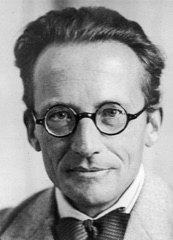
Erwin Schrödinger
1887–1961 · Austrian physicist, a founder of quantum mechanics, whose wave equation won him a Nobel Prize and whose book What Is Life? influenced biology.
Erwin Schrödinger was born in Vienna in 1887, the only child of a botanist who ran a small factory. He studied physics at the University of Vienna and served as an artillery officer in the First World War. After teaching at several universities, he became professor of physics at Zurich, where in 1926 he published the wave equation that describes how the quantum state of a physical system changes over time; it became one of the foundations of quantum mechanics. He shared the Nobel Prize in Physics in 1933 with Paul Dirac. In 1927 he succeeded Max Planck in Berlin, but he left Germany in 1933 after the Nazis came to power. In 1935 he described his famous thought experiment of a cat in a box to show the strangeness of quantum theory. From 1939 he worked at the new Dublin Institute for Advanced Studies in Ireland, where his lectures were published as What Is Life? (1944), which asked how living cells store hereditary information and inspired many biologists. He returned to Vienna and died there in 1961.
Erwin Schrödinger is also an author in the library: author page and works.
Faith: An atheist with a strong interest in Eastern religions; his father was Catholic and his mother Lutheran. Source: Wikipedia
Key dates
- 1887 Born in Vienna
- 1926 Publishes his wave equation
- 1933 Leaves Germany; Nobel Prize in Physics
- 1935 Describes the cat thought experiment
- 1939 Moves to Dublin
- 1944 What Is Life? published
- 1961 Dies in Vienna
Fun facts
- A crater on the far side of the Moon is named after him, and his portrait appeared on Austria's 1,000-schilling banknote. (Source: Erwin Schrödinger (Wikipedia))
Watch
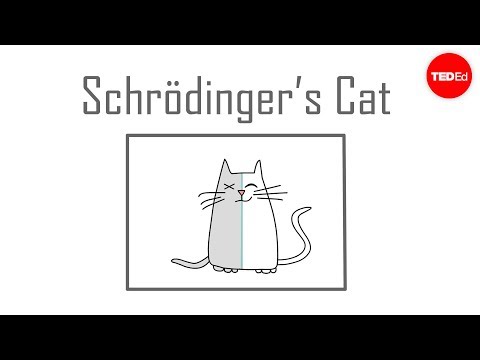

Videos load from YouTube in privacy-enhanced mode only when you press play.
Read about them
Grades 9–12
- What Is Life? · In the library
More lives
Niels Bohr · Vannevar Bush · George Washington Carver · Marie Curie · Arthur Eddington · Albert Einstein