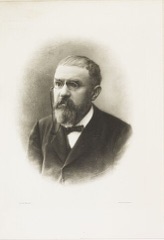
Henri Poincaré
1854–1912 · French mathematician and physicist, a founder of topology and chaos theory and author of Science and Hypothesis.
Henri Poincaré was born in 1854 in Nancy, France, into a distinguished family; his cousin Raymond Poincaré later became president of France. As a child he had diphtheria and was taught at home for a time by his mother. He studied at the École Polytechnique and the School of Mines and briefly worked as a mining engineer before becoming a professor at the University of Paris. He made major contributions to nearly every branch of mathematics of his day. In studying the 'three-body problem' of how three objects move under gravity, entered for a prize offered by the King of Sweden in 1887, he discovered that tiny differences in starting conditions can lead to very different results, an idea basic to modern chaos theory. He helped found topology, the study of shapes under stretching, and the Poincaré conjecture he posed was solved only in the twenty-first century. He also worked on the physics of electricity and on relativity. In Science and Hypothesis (1902) he discussed the role of conventions in science. He died in Paris in 1912.
Henri Poincaré is also an author in the library: author page and works.
Faith: Faith not well documented. Source: Wikipedia

Key dates
- 1854 Born in Nancy
- 1881 Professor at the University of Paris
- 1889 Wins the King of Sweden's prize
- 1902 Science and Hypothesis published
- 1904 Poses the Poincaré conjecture
- 1912 Dies in Paris
Record-breaker
Firsts and records, worded as the sources give them ("first known", "at the time").
- Studying how three bodies move under gravity, he became the first person to discover a 'chaotic' system, laying the foundations of chaos theory. (Source: Henri Poincaré (Wikipedia))
Read about them
Grades 9–12
- Science and Hypothesis · In the library
More lives
Edwin A. Abbott · Charles Babbage · Frédéric Bastiat · Claude Bernard · Eugen von Böhm-Bawerk · George Boole