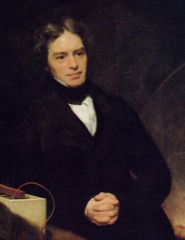
Michael Faraday
1791–1867 · English experimenter who discovered electromagnetic induction.
Michael Faraday was born near London, the son of a poor blacksmith, and had little schooling. At fourteen he was apprenticed to a bookbinder and read the science books he bound. In 1812 he attended lectures by the chemist Humphry Davy, wrote them up carefully and sent them to Davy, who hired him as a laboratory assistant at the Royal Institution. Faraday became one of the greatest experimental scientists in history. In 1821 he built the first device to turn electricity into continuous motion, an early electric motor. In 1831 he discovered electromagnetic induction, showing that moving a magnet near a coil of wire produces an electric current, the principle behind generators and transformers. He discovered benzene, the laws of electrolysis, and the effect of magnetism on light, and he imagined invisible lines of force around magnets that later inspired James Clerk Maxwell. He began the Royal Institution's Christmas Lectures for young people, including The Chemical History of a Candle. A devout member of a small Christian sect, the Sandemanians, he refused a knighthood. He died in 1867.
Michael Faraday is also an author in the library: author page and works.
Faith: A lifelong member of a small Christian sect, the Sandemanians, which he joined by a profession of faith in 1821. Source: Dictionary of National Biography (1885–1900) (via Wikisource)
Further reading
- Michael Faraday: A Very Short Introduction by Frank A.J.L. James (Oxford University Press, 2010), ISBN 9780199574315
Key dates
- 1812 Attends Davy's lectures
- 1813 Becomes Davy's assistant
- 1821 Builds an electric motor
- 1831 Discovers electromagnetic induction
- 1860 The Chemical History of a Candle lectures
- 1867 Dies at Hampton Court
Fun facts
- The farad, a unit used to measure electrical capacitance, is named after him. (Source: Michael Faraday (Wikipedia))
Record-breaker
Firsts and records, worded as the sources give them ("first known", "at the time").
- His first recorded experiment was building an electric battery, a voltaic pile, out of seven halfpenny coins and seven discs of zinc. (Source: Michael Faraday (Wikipedia))
Watch


Videos load from YouTube in privacy-enhanced mode only when you press play.
In their words
“What diamond can shine like flame?”
“Here therefore was demonstrated the production of a permanent current of electricity by ordinary magnets”
Read about them
Grades 6–8
- The Chemical History of a Candle · In the library
Grades 9–12
- Experimental Researches in Electricity, Volume 1 · In the library
More lives
Edwin A. Abbott · Charles Babbage · Alexander Graham Bell · Claude Bernard · George Boole · Louis Braille