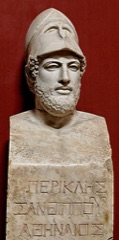
Pericles
c. 495–429 BC · Leading statesman of Athens in its golden age, who built the Parthenon.
Pericles was the leading statesman of Athens for about thirty years in the middle of the fifth century BC, the city's golden age. He came from a noble family but led the democratic side, and was elected general again and again. Under his leadership Athens used funds from its league of allies, the Delian League, to build the Parthenon and other temples on the Acropolis, and the city became a center of drama, philosophy and art. He introduced pay for citizens who served on juries, so that poorer men could take part in government. When war broke out with Sparta in 431 BC, Pericles persuaded the Athenians to shelter behind their city walls and rely on their navy. At the end of the first year he gave a funeral speech for the war dead, recorded by the historian Thucydides, praising the Athenian way of life. Soon afterward a terrible plague struck the crowded city. Pericles lost two sons to it and died of the plague himself in 429 BC.
Pericles is also an author in the library: author page and works.
Faith: Faith not well documented beyond Athenian civic religion; he sponsored temples on the Acropolis. Source: Wikipedia
See also: Plutarch's Life of Pericles
Key dates
- c. 461 BC Becomes leading figure in Athens
- 447 BC Work begins on the Parthenon
- 431 BC Peloponnesian War begins; Funeral Oration
- 429 BC Dies in the plague
Fun facts
- Ancient writers say that, a few nights before he was born, his mother dreamed she gave birth to a lion. (Source: Pericles (Wikipedia))
Watch


Videos load from YouTube in privacy-enhanced mode only when you press play.
In their words
“Its administration favours the many instead of the few; this is why it is called a democracy.”
“In short, I say that as a city we are the school of Hellas”
Read about them
As an Amazon Associate I earn from qualifying purchases. As a Bookshop.org affiliate I earn from qualifying purchases, which also support independent bookstores.
Grades 9–12
- Pericles' Funeral Oration · In the library
- Lives of the Noble Grecians and Romans · In the library
- Pericles of Athens and the Birth of Democracy by Donald Kagan (Free Press, 1998; ISBN 9780684863955)
Bookshop.org · Amazon
More lives
Augustus · Julius Caesar · Cicero · Kautilya (Chanakya) · Moses · Polybius