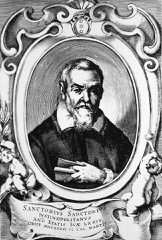
Santorio Santorio
1561–1636 · Paduan physician who measured insensible perspiration in a weighing chair and wrote De Statica Medicina (1614).
Santorio Santorio was born on 29 March 1561 at Capodistria, then a Venetian city and now Koper. He studied medicine at Padua and practiced in the Venetian world, later holding a chair at Padua. His lasting fame rests on a program of measurement. In a specially built weighing chair he recorded the weight of what he ate and drank and of what left the body, and he treated the difference as insensible perspiration, the invisible daily loss that, he argued, a physician must know if he is to restore or preserve health. The Latin aphorisms of De Statica Medicina were published in 1614 and later read in John Quincy’s English translation. Santorio also devised instruments for temperature and the pulse, the thermoscope and the pulsilogium, in the same effort to number the living body. He died at Venice in 1636; reference works disagree on the exact day.
Faith: Catholic physician of the Venetian world; he served as physician to the Servites and was buried at their church in Venice. The 1723 English title page of Medicina Statica bears the motto Pondere, Mensurâ, & Numero Deus omnia fecit (cf. Wisdom 11:20). In 1616 he presided when the Collegio veneto granted degrees without the Tridentine profession of faith and was criticized by the papal nuncio. Source: Treccani, Dizionario Biografico degli Italiani
See also: William Harvey · Andreas Vesalius · Aulus Cornelius Celsus

Key dates
- 29 March 1561 Born at Capodistria (Koper), then under Venice
- 1614 Publishes De Statica Medicina, the Latin aphorisms on insensible perspiration
- 1616 Presides at the Collegio veneto in a degree ceremony later criticized by the papal nuncio for omitting the Tridentine profession of faith
- 1636 Dies at Venice; the exact day is disputed in the sources
Works by Santorio Santorio in the library
In their words
“If there daily be an Addition of what is wanting, and a Substraction of what abounds, in due Quantity and Quality, lost Health may be restor'd, and the present preserved.”
Read about them
Grades 9–12
- Medicina Statica · In the library
- On the Motion of the Heart and Blood in Animals (De Motu Cordis) · In the library
More lives
William Gilbert · William Harvey · John of God · Paracelsus · Ambroise Paré · Thomas Sydenham
Notes: The day of death is given as 6 March 1636 by the Galileo Project and as 25 February 1636 in other scholarly sources. Career details and the 1616 Collegio veneto episode follow the Treccani Dizionario Biografico degli Italiani and should be checked there if the note is quoted at length. The motto Pondere, Mensurâ, & Numero Deus omnia fecit is taken from the 1723 English title page of Medicina Statica, which we have in page image.