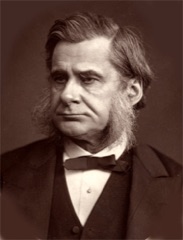
Thomas Henry Huxley
1825–1895 · English biologist and anatomist known as "Darwin's Bulldog" for his defence of the theory of evolution.
Thomas Henry Huxley was born in 1825 in Ealing, near London, the son of a schoolteacher. He had little formal schooling and was largely self-taught; as a teenager he taught himself German. At thirteen he began an apprenticeship in medicine, and he later studied at Charing Cross Hospital. In 1846 he joined the Royal Navy as an assistant surgeon on HMS Rattlesnake,, bound for Australia and New Guinea. His studies of sea creatures during the voyage led to his election to the Royal Society on his return in 1850. In 1854 he became professor of natural history at the Royal School of Mines in London. When Charles Darwin published On the Origin of Species in 1859, Huxley became its most energetic public defender and was nicknamed 'Darwin's Bulldog'. In 1860 he clashed with Bishop Samuel Wilberforce at a famous debate in Oxford. His Man's Place in Nature (1863) argued that humans and apes are closely related. In 1869 he coined the term 'agnosticism'. He served as president of the Royal Society from 1883 to 1885. He died in 1895. His grandsons included Aldous Huxley.
Thomas Henry Huxley is also an author in the library: author page and works.
Faith: Defined 'agnosticism' in 1869 to describe his position, while calling atheism philosophically untenable. Source: Encyclopaedia Britannica (1911) (via Wikisource)

Key dates
- 1825 Born in Ealing
- 1846 Sails on HMS Rattlesnake
- 1850 Elected to the Royal Society
- 1860 Oxford evolution debate
- 1863 Man's Place in Nature published
- 1895 Dies
Fun facts
- As a teenager he taught himself German so well that Charles Darwin later used him as a translator. (Source: Thomas Henry Huxley (Wikipedia))
Read about them
Grades 9–12
- The Huxley-Wilberforce Debate · In the library
More lives
Edwin A. Abbott · Charles Babbage · Claude Bernard · George Boole · Josef Breuer · Lewis Carroll