Work record
The Tyger
1794 · 18th Century · Poetry · English
Abstract
Background. Blake etched and coloured this lyric himself for the Experience half of his 1794 Songs, after reworking it many times in his notebook. It answers The Lamb from the Innocence half, which had settled its own question of origin with the name of Christ.
Content. Addressing a beast that glows like flame in nocturnal woods, the speaker demands to know what deathless power could shape its proportion. He asks where the light of its eyes was kindled and who flew high enough to grasp it; he imagines heart muscle twisted and a brain beaten out on an anvil in a furnace. Then the stars cast down their weapons in tears, and he wonders whether the Creator smiled and whether the Lamb's maker shaped this beast too.
Themes. The mystery of a good God and a fearful world, the terror and glory of making, and the contrary states of innocence and experience.
Form. Insistent trochaic beats and paired rhymes drive a poem made almost wholly of questions; the closing quatrain echoes the opening one with a single verb altered.
Significance. Unnoticed by the public in Blake's lifetime, it became after Gilchrist's 1863 biography one of the most recited English lyrics and a standing text for discussions of creation and evil.
Main characters
- The speaker: Awed questioner of the tiger's origin
- The Tyger: Blazing beast of terrifying design, addressed directly
- The maker: Unnamed creator pictured as a daring smith
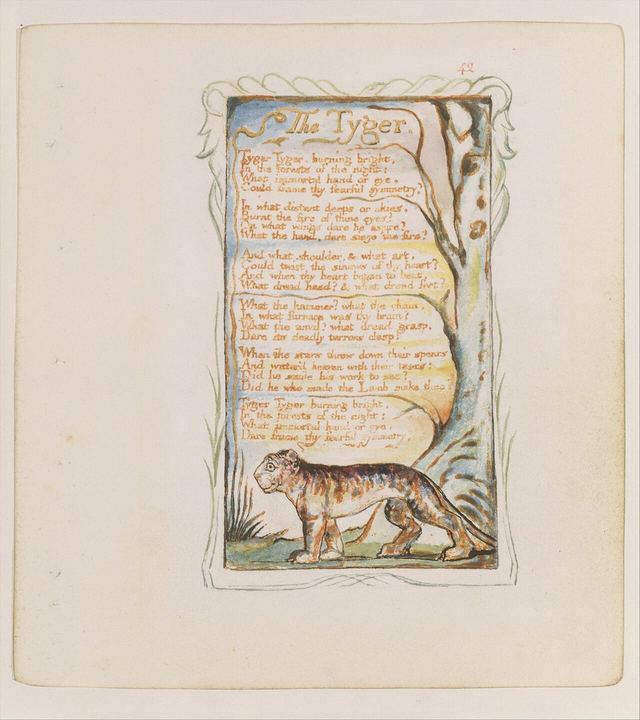

Summary
The Tyger is the most famous lyric in William Blake's Songs of Experience, which he etched, printed and hand-coloured in 1794 and issued together with the earlier Songs of Innocence under the subtitle Shewing the Two Contrary States of the Human Soul. It is the counterpart of The Lamb in Innocence, where a child asks a lamb who made it and answers that its maker is the gentle Lamb of God. The Tyger asks the same question of a terrifying creature and receives no answer at all. The poem is six quatrains of rhymed couplets in short, hammering lines, mostly seven syllables, and almost every sentence is a question. The first stanza addresses the tiger as burning bright in the forests of the night and asks what immortal hand or eye could frame its fearful symmetry. The second asks in what distant deeps or skies the fire of its eyes was kindled and who dared seize that fire, recalling Icarus and Prometheus. In the third and fourth stanzas the maker becomes a blacksmith: shoulder and art twist the sinews of the heart, and hammer, chain, furnace and anvil forge the brain. The questions break into fragments, as if the speaker is overwhelmed. The fifth stanza widens the scene to the cosmos. When the stars threw down their spears and watered heaven with their tears, did the maker smile at his work, and did he who made the Lamb make this? The last stanza repeats the first with one change: could frame becomes dare frame, so the question of ability turns into a question of daring. Readers have heard in the poem the problem of how a good Creator can make a world that includes ferocity and evil, the sublime terror of creation, and an image of revolutionary energy in the years of the French Revolution. Blake never answers. The accompanying plate, with a tiger that many find oddly mild, has added to the debate. The poem has become one of the most anthologized and memorized in English.
Virtues in this work
Plot or Argument
- Stanza 1: The question
The speaker addresses the tiger burning bright in the night forest and asks what immortal hand or eye could frame its fearful symmetry.
- Stanza 2: The source of the fire
He asks where the fire of the tiger's eyes was kindled, in distant deeps or skies, and on what wings the maker dared rise to seize it.
- Stanzas 3-4: The forge
The maker becomes a smith twisting the sinews of the heart and forging the brain with hammer, chain, furnace and anvil; the questions shrink to breathless fragments.
- Stanza 5: The stars and the Lamb
At creation the stars throw down their spears and weep; the speaker asks whether the maker smiled, and whether he who made the Lamb made the tiger.
- Stanza 6: Could becomes dare
The first stanza returns with one word changed, so that the poem ends asking not who could but who would dare frame the tiger's fearful symmetry.
Characters
- The speaker, questioner
An awed voice who cannot stop asking who made the tiger and how.
- The Tyger, addressee
A blazing, symmetrical creature of terror and beauty, addressed directly.
- The maker, unnamed creator
Imagined as hand, eye, wings, shoulder and blacksmith, but never named.
Lessons
The question that is the poem
The Tyger is built almost entirely of questions, and none is answered. Blake teaches by withholding: the reader is left inside the speaker's awe, made to feel how hard it is to see one Creator behind both lamb and tiger.
- Count the questions in the poem. What effect does their number have?
- Why might Blake refuse to answer them?
- Is the speaker afraid, amazed, or both?
Creation as a forge
In stanzas 3 and 4 the Creator is a smith with hammer, chain, furnace and anvil, working by force and heat. The image presents making as dangerous labour, and the tiger as something wrought rather than gently grown.
- What does the forge imagery suggest about the maker?
- Why does the syntax break into fragments in stanza 4?
- How does this picture of creation differ from Genesis 1?
Two contrary states
The Tyger answers The Lamb of Songs of Innocence. Blake sets innocence and experience side by side without letting either cancel the other, and the line about him who made the Lamb asks the reader to hold both creatures together under one maker.
- What does the Lamb stand for in Blake's Songs of Innocence?
- Does the question in stanza 5 expect the answer yes?
- Why does the last stanza change could to dare?
Context
Blake wrote Songs of Experience in London in the early 1790s, a time of war with revolutionary France, political repression and rapid industrial change; the forge images of the poem belong to an age of furnaces and foundries. Eighteenth-century writers such as Edmund Burke had theorized the sublime, the beauty that terrifies, and the natural theology of the period often argued from the design of creatures to a wise designer. Blake's poem presses that argument with a creature whose design inspires fear.
Composition
Drafts in Blake's notebook (the so-called Rossetti manuscript) show him revising the poem heavily, including the order of stanzas and the wording of the forge passage. He published it in 1794 as a relief-etched plate with text and an illustration of a tiger, printing and colouring copies himself, so that surviving copies vary in colour and detail.
Reception
Blake's Songs sold few copies in his lifetime, but Charles Lamb praised the poem in an 1824 letter, and it reached wide readership after Alexander Gilchrist's Life of William Blake (1863). W. B. Yeats co-edited Blake's works in 1893, and the poem is now among the most familiar lyrics in English, much discussed for its unanswered theological question.
Comparisons
- the-bible
God's speeches from the whirlwind in Job 38-41 also answer human questions with fearsome creatures, Behemoth and Leviathan, and with more questions.
- paradise-lost
The stars throwing down their spears has often been read as the fall of the rebel angels, the war in heaven that Milton narrates and that Blake admired and rewrote.
- gods-grandeur
Hopkins also sees creation charged with fire and divine energy, but where Blake only asks, Hopkins affirms the brooding care of the Holy Ghost.
- the-second-coming
Yeats, an editor of Blake, closes with another unanswered question about a terrible beast, though his rough beast heralds historical collapse rather than creation.
Quotes
Frequently cited
“Tyger! Tyger! burning bright In the forests of the night, What immortal hand or eye Could frame thy fearful symmetry?”
Frequently cited
“When the stars threw down their spears, And water’d heaven with their tears, Did he smile his work to see? Did he who made the Lamb make thee?”
“In what distant deeps or skies Burnt the fire of thine eyes? On what wings dare he aspire? What the hand, dare sieze the fire?”
“What the hammer? what the chain? In what furnace was thy brain? What the anvil? what dread grasp Dare its deadly terrors clasp?”
“What immortal hand or eye Dare frame thy fearful symmetry?”
For Students
A reading companion for classical Christian high school students. See the student guide.
Reading Guide
Watch for
- The image of fire in darkness in the opening couplet, burning bright in the forests of the night.
- The parts of the maker the speaker names one by one: hand, eye, wings, shoulder, feet, grasp.
- The blacksmith's tools in stanza 4 and how the questions shorten to single phrases.
- The question about him who made the Lamb in stanza 5, which links the poem to Songs of Innocence.
- The single word changed between stanza 1 and stanza 6.
Key terms and names
- Songs of Experience
- Blake's 1794 book of lyrics showing the soul after innocence is lost, issued with Songs of Innocence as two contrary states.
- The Lamb
- The companion poem in Songs of Innocence, in which a child tells a lamb that its maker is the Lamb of God.
- Symmetry
- Balanced proportion of form; the tiger's fearful symmetry is a design both beautiful and terrifying.
- Frame
- To shape or construct; the verb places the Creator in the role of a craftsman.
- Sublime
- In eighteenth-century aesthetics, the grandeur that overwhelms and frightens, as opposed to the merely beautiful.
- Relief etching
- Blake's method of printing words and pictures together from copper plates, which he then coloured by hand.
Seminar Questions
- Comprehension What single question does the speaker keep asking, and in how many forms does he ask it?
- Comprehension What tools and places of the blacksmith appear in stanzas 3 and 4?
- Interpretation What might the stars throwing down their spears and weeping mean in stanza 5?
- Interpretation Does the poem imply that the maker of the Lamb also made the Tyger, or leave the question open?
- Interpretation How does the change from could to dare in the last stanza alter the poem's meaning?
- Interpretation Is the tiger in this poem evil, or only terrible? What is the difference?
- Big Question Can one good God be the Creator of both the gentle and the terrifying in the world?
Faith Connections
- Job 38-41 (Scripture)
God answers Job out of the whirlwind with questions about the lion, the horse and Leviathan, creatures of terrifying power that he alone made; Blake's speaker asks Job's questions from the human side.
- John 1:29 (Scripture)
John the Baptist calls Jesus the Lamb of God, the figure behind Blake's question about him who made the Lamb.
- Isaiah 11:6 (Scripture)
The prophet foresees the wolf dwelling with the lamb and the leopard with the kid, a peace between Blake's two creatures promised for the age to come.
- Augustine, City of God XI.22 (Church Fathers)
Augustine answers those who object to creatures that hurt us, such as fire, frost and wild beasts, by arguing that each has its own excellence in the order of creation; a reply to the question Blake leaves open.
Logic and Rhetoric
Central argument: The tiger is beautiful, symmetrical and terrifying. Such a creature must have a maker of immense power and daring. The same Creator is said to have made the Lamb. Therefore the reader is forced to ask how gentleness and terror can come from one hand, a question the poem poses with mounting force and deliberately leaves unresolved.
Rhetorical device: rhetorical question and refrain with variation. The whole poem is a series of questions, and stanza 6 repeats stanza 1 with could changed to dare, so the refrain itself carries the argument forward.
Debate: Resolved: that The Tyger expresses wonder at the Creator rather than doubt about him.
Memory Work
Tyger! Tyger! burning bright In the forests of the night, What immortal hand or eye Could frame thy fearful symmetry?
When the stars threw down their spears, And water’d heaven with their tears, Did he smile his work to see? Did he who made the Lamb make thee?
Writing Prompts
Essay: Analyze how Blake uses questions instead of statements in The Tyger, and argue what the poem gains by never giving an answer.
Comparison with God's Grandeur: Both Blake and Hopkins see fire and energy in creation. Compare the stance of each speaker toward the Creator and explain why one ends in a question and the other in an affirmation.
Creative Prompts
- Classroom
Read The Lamb and The Tyger aloud back to back, then chart the differences in metre, sound, questions and answers between the two poems.
- Poetry
Write six quatrains of questions addressed to another creature of awe (a storm, a shark, a star), keeping Blake's seven-syllable lines and refusing to answer.
- Essay
Argue what Blake gains by changing could to dare in the final stanza, using the forge stanzas as evidence.
Further Reading
- Songs of Innocence and of Experience, William Blake
Read in a colour facsimile edition to see the poem with its plate.
- Fearful Symmetry: A Study of William Blake, Northrop Frye
- Blake, Peter Ackroyd
- Life of William Blake, Alexander Gilchrist
Verification notes
The text follows the stored Songs of Experience wording with Blake's spelling (Tyger, sieze) and ampersands. Facts about the 1794 publication, the notebook drafts and the pairing with The Lamb are standard. Interpretations of the stars throwing down their spears and of the poem's politics are readings, not settled facts. All quotes are found verbatim in the stored text.
No verification flags recorded.