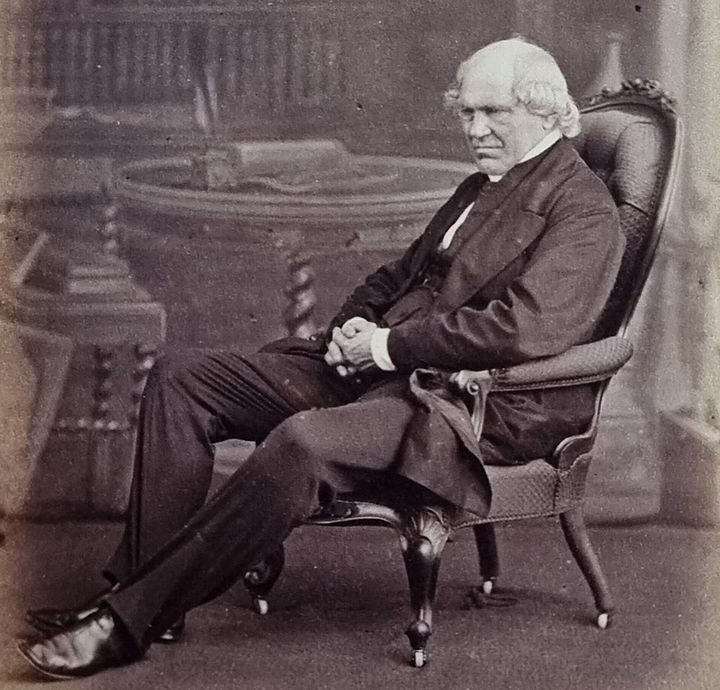
William Whewell
1794–1866 · English polymath and Master of Trinity College, Cambridge, who coined the word "scientist".
William Whewell was born in Lancaster, England, in 1794, the eldest of seven children of a master carpenter. His father wanted him to follow the trade, but William's talent for mathematics at grammar school won him a scholarship to Trinity College, Cambridge, in 1812. There he won the Chancellor's Gold Medal for poetry and was Second Wrangler in mathematics. He became a fellow and tutor of the college, professor of mineralogy, and later Knightbridge Professor of Philosophy. In 1841 he married Cordelia Marshall and in the same year became Master of Trinity. He wrote on mechanics, physics, geology, astronomy, economics, theology, and the history and philosophy of science, and translated Goethe. He organised thousands of volunteers around the world to measure ocean tides, one of the first citizen science projects, and received the Royal Medal for this work in 1837. He was also a gifted maker of words. He coined 'scientist' and 'physicist', and suggested terms such as 'anode', 'cathode' and 'ion' to Michael Faraday. He died in Cambridge in 1866 after a fall from his horse.
William Whewell is also an author in the library: author page and works.
Faith: Faith not well documented. Source: Wikipedia

Key dates
- 1794 Born in Lancaster
- 1812 Enters Trinity College, Cambridge
- 1837 Royal Medal for his work on tides
- 1841 Becomes Master of Trinity College
- 1866 Dies in Cambridge
Fun facts
- He coined the word 'scientist', and suggested to Michael Faraday the words electrode, ion, anode and cathode. (Source: William Whewell (Wikipedia))
Read about them
Grades 9–12
- Novum Organon Renovatum · In the library
More lives
Edwin A. Abbott · Charles Babbage · Frédéric Bastiat · Claude Bernard · Eugen von Böhm-Bawerk · George Boole