Wonders & Monuments · Great monuments
The Church of the Holy Sepulchre
The church in Jerusalem that marks, in Christian tradition, the tomb and the site of the Crucifixion.
Still standing. The church still stands and is in daily use. Almost nothing of Constantine’s fourth-century building survives above ground in its first form. The present courts, rotunda and church are the work of many later rebuildings, especially after the Crusader period.
Jesus Christ, in Great Lives · Constantine the Great, in Great Lives · The Bible, in this library · The Western Wall and the Temple Mount · Church of the Holy Sepulchre, in Great Churches & Monasteries
What it is
The Church of the Holy Sepulchre stands in the Old City of Jerusalem. Christian tradition holds that it marks both Golgotha and the tomb of Christ. The first great church on the site was raised in the fourth century, in the time of the emperor Constantine. That Constantinian building has been destroyed and rebuilt more than once. The entrance, the courtyard and much of the church you see in later pictures belong to medieval and subsequent campaigns, not to the fourth century in a simple way.
Pilgrims have come here for many centuries, and several Christian communities still share the building. This library has the Gospels, and a life of Jesus, and a life of Constantine, but it does not host Eusebius’s Life of Constantine, where the first building of the church is described. That account is therefore not quoted here. The pictures are historic views of the later church: its doors, its courts and the Stone of Unction inside.
Why it matters
This is a place of pilgrimage, rebuilt at great cost because the site was held sacred. The virtue to notice is faith joined to perseverance: the church has been raised again after ruin. Integrity means saying clearly that the present walls are not Constantine’s first church, and that the holiness of the place, for those who come, does not depend on pretending otherwise.
Look closely
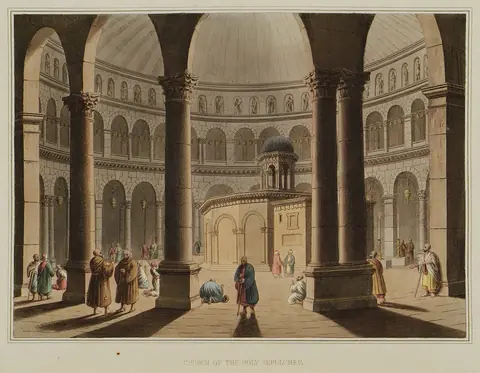
Image: Wikimedia Commons · Public domain (PD-Art) The courtyard of the Holy Sepulchre
Look closely. Mayer’s early nineteenth-century view looks through a portico into the courtyard before the church, with figures in the court and the entrance beyond. It is a traveller’s picture of the place as it then stood, useful for the arrangement of the court and the deep shadow of the arches.
In the library: Jesus Christ, in Great Lives
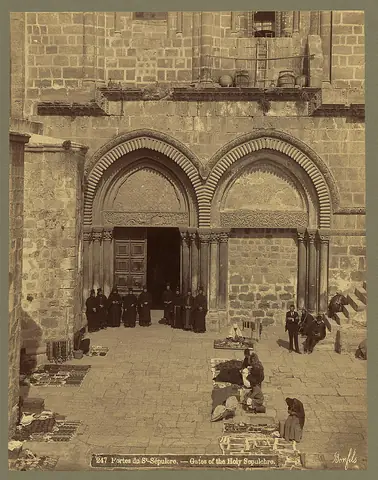
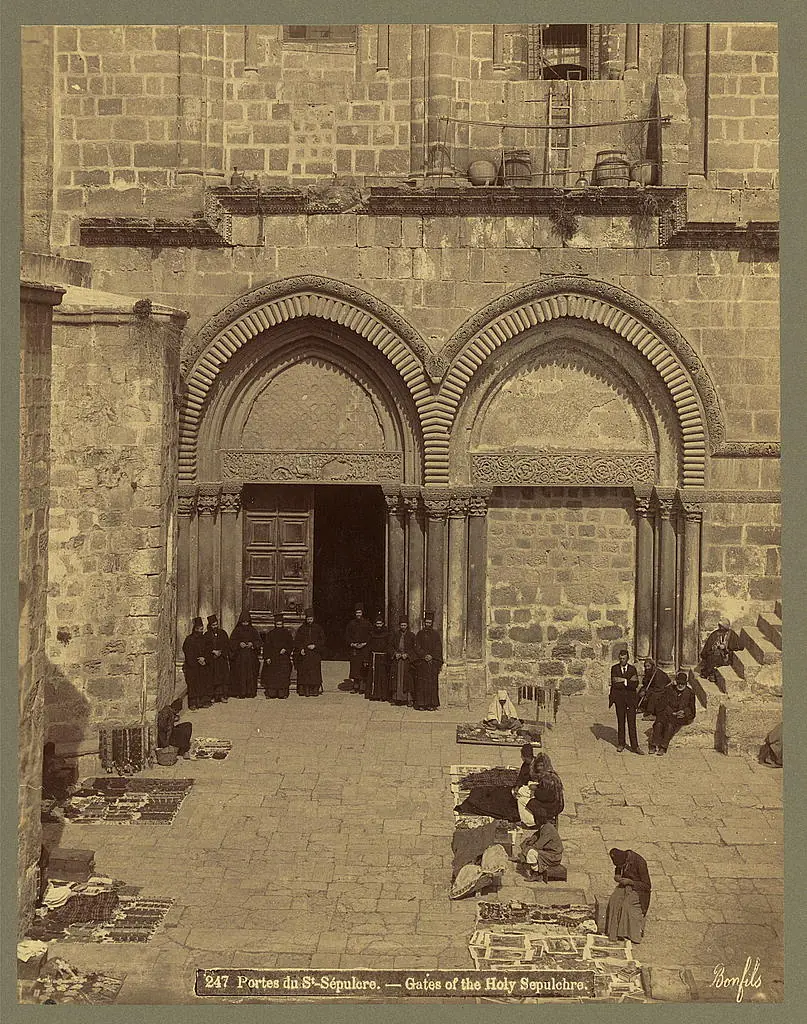
Image: Wikimedia Commons · Public domain The gates of the Holy Sepulchre
Look closely. A photograph by the Bonfils studio of the great entrance doors, with the two arched portals and the stone façade above. People sit and stand at the threshold, giving the doors a human scale. This is the church as a pilgrim would have approached it in the later nineteenth century.
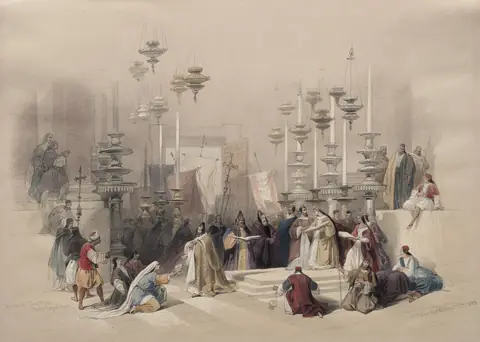
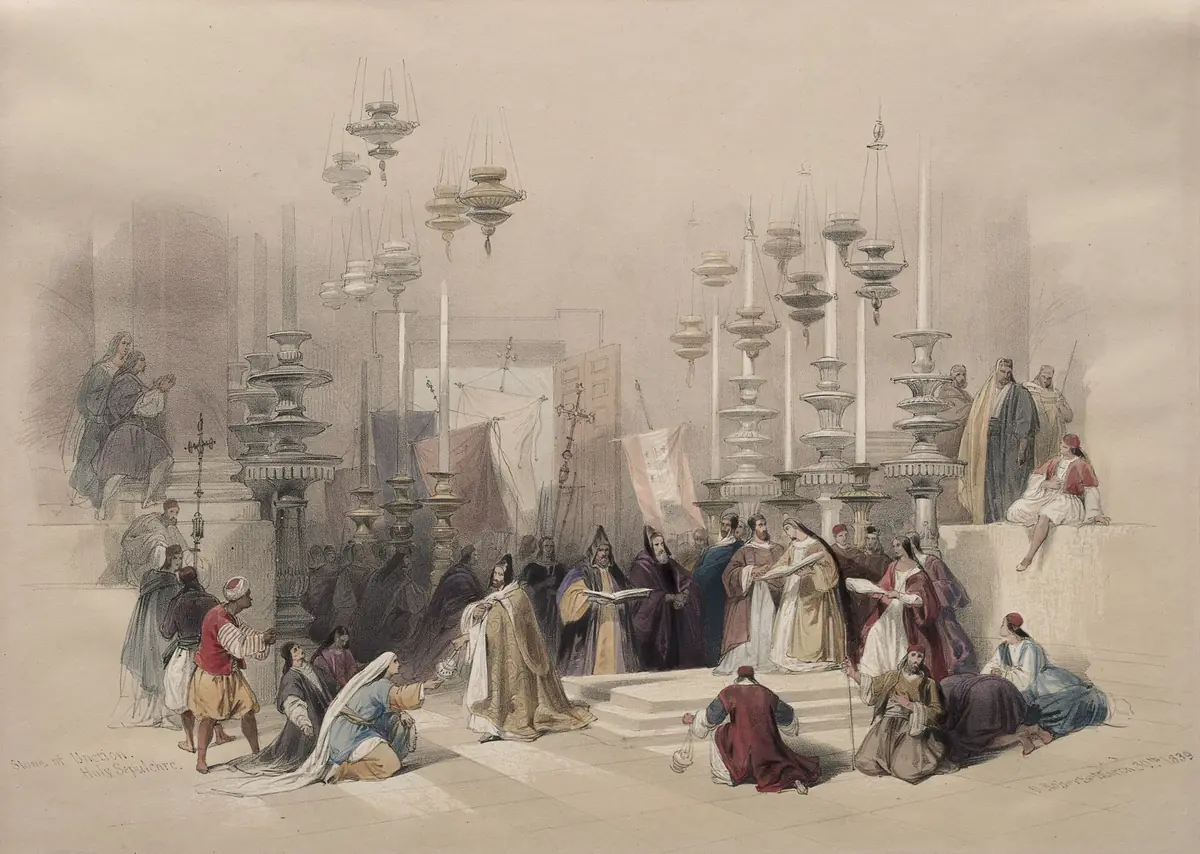
Image: Wikimedia Commons · CC0 (public domain) The Stone of Unction
Look closely. Roberts’s view of the Stone of Unction inside the church, a slab at which, in Christian tradition, the body of Christ was prepared for burial. The picture is of an interior station and of the people gathered there, not of the rotunda over the tomb. It is a record of devotion in the building as Roberts saw it.
In the library: The Bible (King James Version) · Jesus Christ, in Great Lives
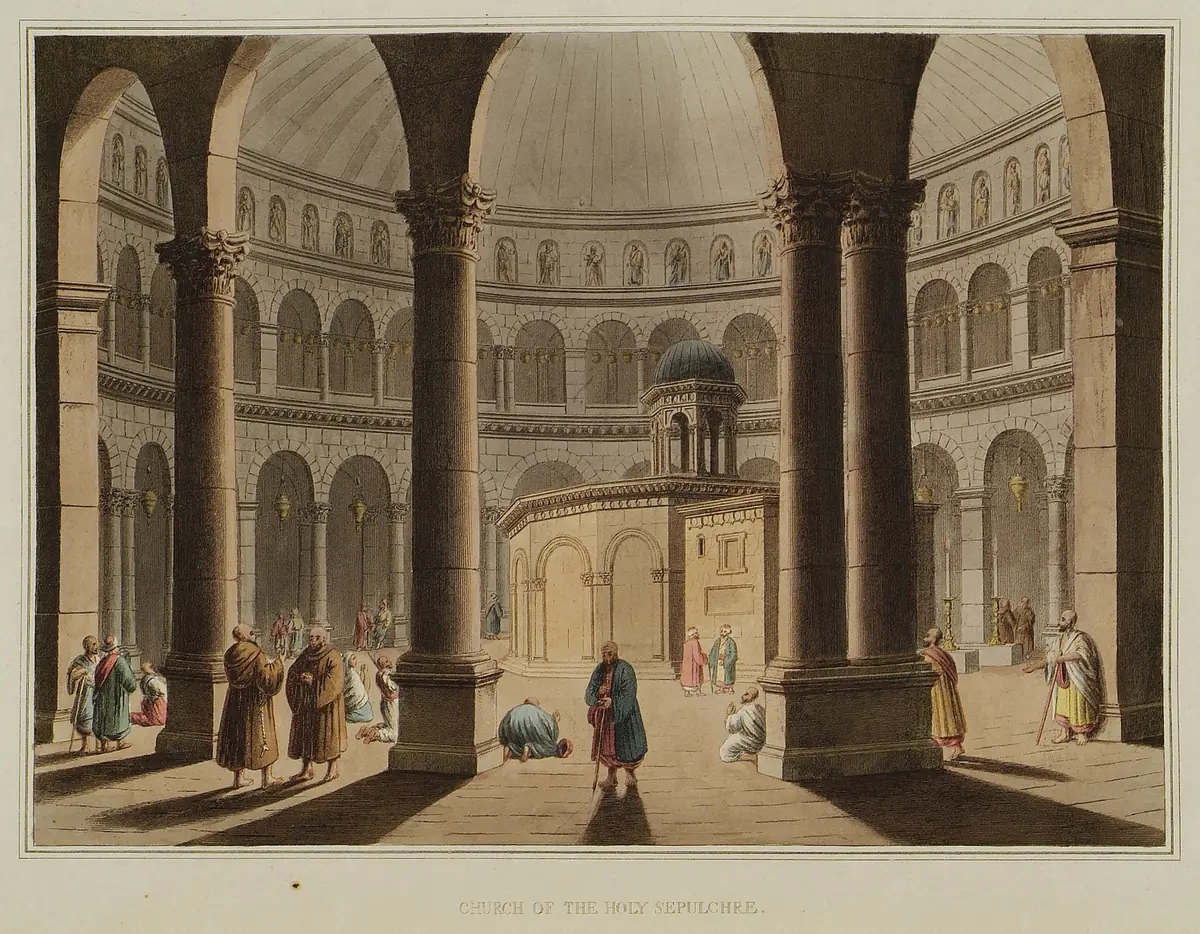


What to watch for
Look slowly- A long afterlife of building. The doors, courts and rotunda have been rebuilt. Do not take a nineteenth-century view for a fourth-century façade.
- The double doors. The historic entrance, with its arched portals, is one of the easiest parts of the church to recognise from the street.
- Courtyard and interior. Mayer shows the court before the church; Roberts shows a station inside. They are not the same room.
- Shared custody. Several churches keep the building. That shared use is part of its later history.
Sources
Dates follow standard historical references and, where we quote a book, the wording of the edition hosted in this library. Photographs are used only when the photograph itself is Public domain, CC0, or CC BY with a named credit. Lost wonders are shown in later engravings and reconstructions, which are imaginings, not photographs of the original work. Each picture links to its source page with full licence details.