Great Churches & Monasteries · Holy Land & Middle East
Church of the Holy Sepulchre
The church built over the place that Christians have honored since the fourth century as the tomb of Christ.
Still standing. The church stands and is shared by several Christian communities under a long-standing agreement. It has been burned, torn down, rebuilt, and repaired more than once, and its present form is chiefly that of the twelfth-century church.
Holy Sepulchre, in Wonders & Monuments · Church of the Nativity, Bethlehem
What it is
After Constantine became sole emperor in 324, he ordered a great church built in Jerusalem at the place where, according to local Christian memory, Jesus had been crucified and buried. His mother Helena traveled to the Holy Land soon afterward. The church, with a rotunda over the tomb and a basilica beside it, was dedicated in 335. It was damaged by the Persians in 614, repaired, and then ordered destroyed in 1009 by the Fatimid caliph al-Hakim. The Byzantine emperor Constantine IX Monomachos paid for a new, smaller church in the 1040s, and the Crusaders rebuilt it as a single building that was consecrated in 1149.
In the Ottoman period the church was shared, as it still is, by Greek Orthodox, Armenian Apostolic, and Roman Catholic communities, with Coptic, Syriac, and Ethiopian Christians also holding places. A written agreement of 1757, called the Status Quo, fixed their rights down to the sweeping of steps, and the famous ladder above the entrance has stood where it is since at least the eighteenth century. A fire in 1808 damaged the rotunda, which was rebuilt in 1810. The small shrine over the tomb, the Edicule, was repaired between 2016 and 2017.
“He is not here: for he is risen, as he said.”
Why it matters for a classical Christian student
The Gospel claim is that Christ was raised on the third day, and the church stands where Christians have said so for seventeen centuries. For a classical Christian student the lesson is perseverance. The building was burned, razed, and rebuilt, and each time pilgrims came back. The mixed community, which can be a trial, also shows how long and how hard the church's unity has been to keep. Read the Gospel accounts first, then look at what each age made of the place.
Read alongside
- The Bible: The accounts of the burial and resurrection are in Matthew 27–28, Mark 15–16, Luke 23–24, and John 19–20.
- The Travels of Marco Polo: Marco Polo tells how Kublai Khan asked for oil from the lamp over the Sepulchre in Jerusalem.
Great Lives connected here
- Constantine the Great, in Great Lives: Constantine ordered the church built over the place of the crucifixion and burial, and it was dedicated in 335.
- Mary Magdalene, in Great Lives: The Gospel of John names Mary Magdalene as the first at the empty tomb.
- Peter the Apostle, in Great Lives: Peter ran to the tomb on the morning of the resurrection, according to the Gospel of John.
Look closely
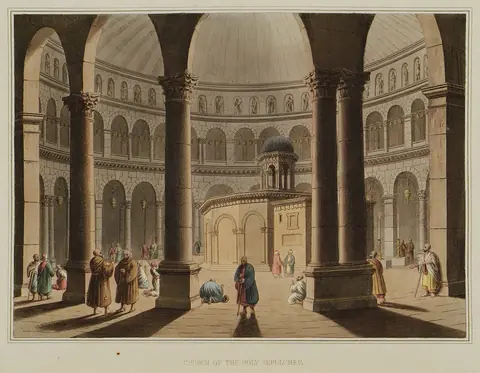
Image: Wikimedia Commons · Public domain (PD-Art) The courtyard of the Holy Sepulchre
Look closely. Mayer’s early nineteenth-century view looks through a portico into the courtyard before the church, with figures in the court and the entrance beyond. It is a traveller’s picture of the place as it then stood, useful for the arrangement of the court and the deep shadow of the arches.
In the library: Jesus Christ, in Great Lives
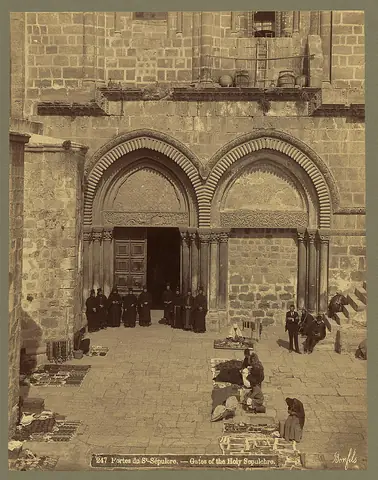
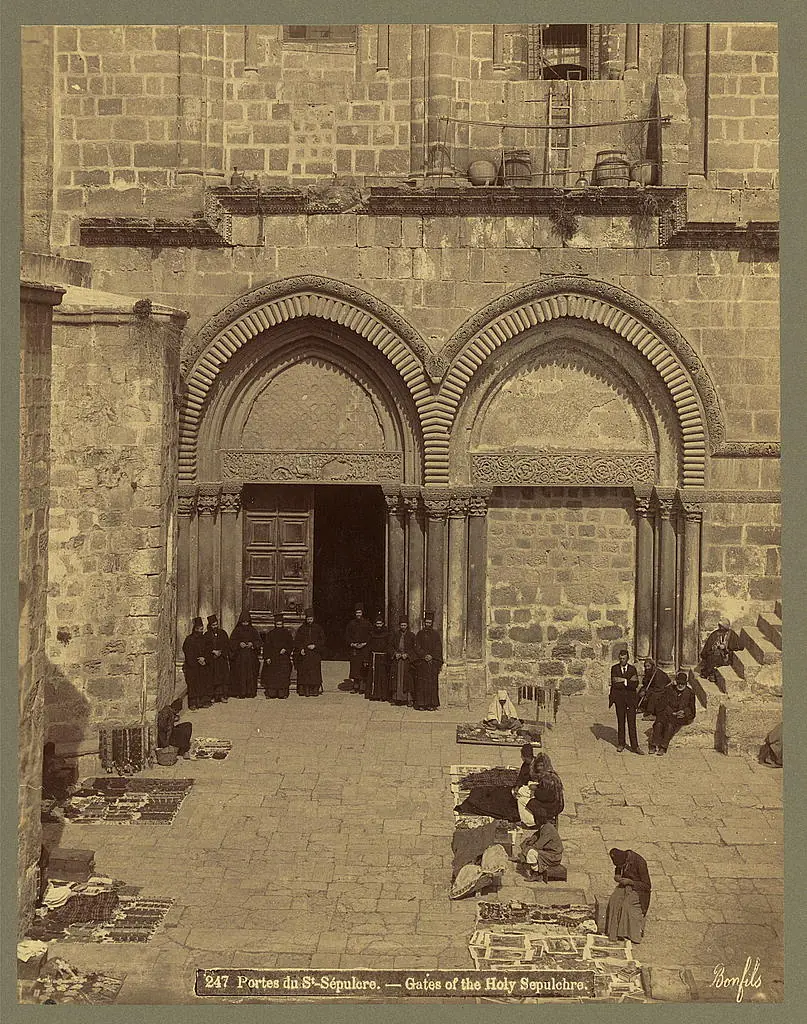
Image: Wikimedia Commons · Public domain The gates of the Holy Sepulchre
Look closely. A photograph by the Bonfils studio of the great entrance doors, with the two arched portals and the stone façade above. People sit and stand at the threshold, giving the doors a human scale. This is the church as a pilgrim would have approached it in the later nineteenth century.
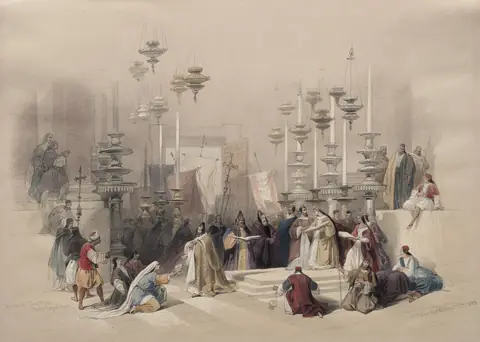
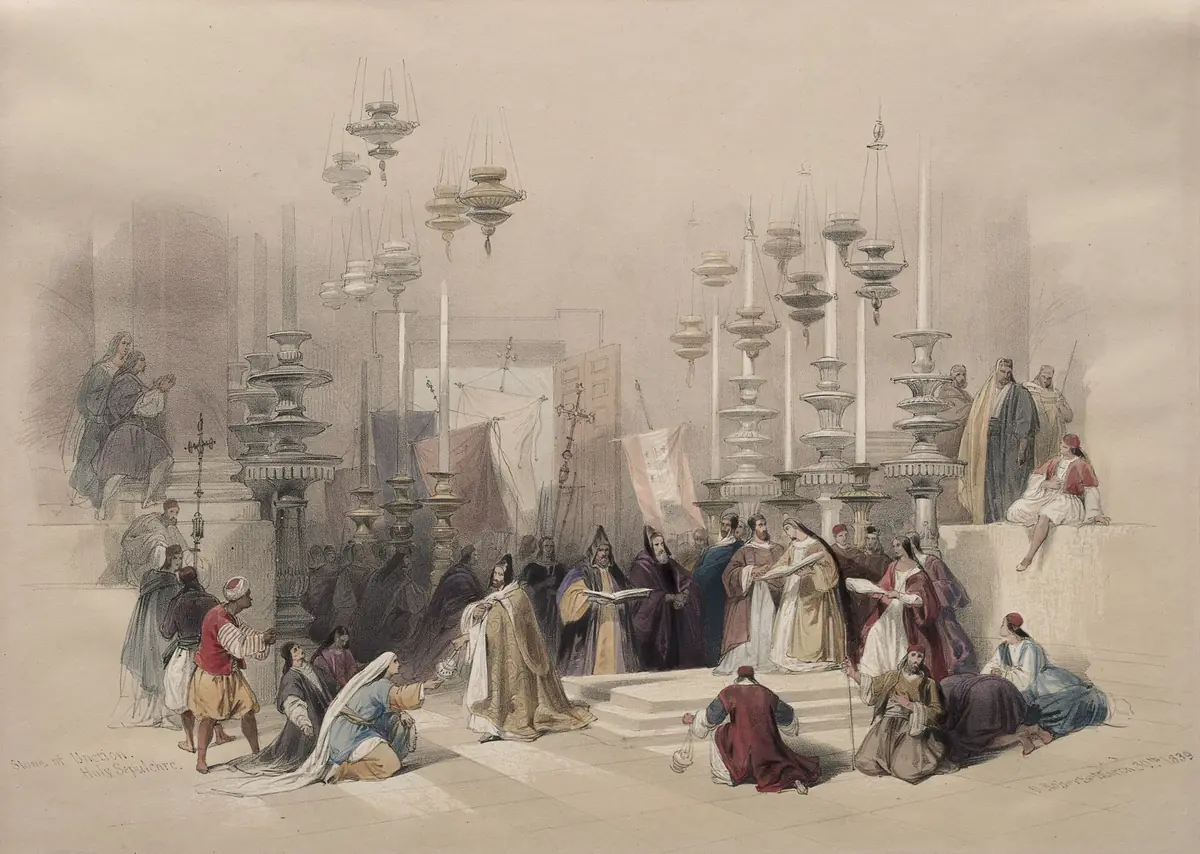
Image: Wikimedia Commons · CC0 (public domain) The Stone of Unction
Look closely. Roberts’s view of the Stone of Unction inside the church, a slab at which, in Christian tradition, the body of Christ was prepared for burial. The picture is of an interior station and of the people gathered there, not of the rotunda over the tomb. It is a record of devotion in the building as Roberts saw it.
In the library: The Bible (King James Version) · Jesus Christ, in Great Lives
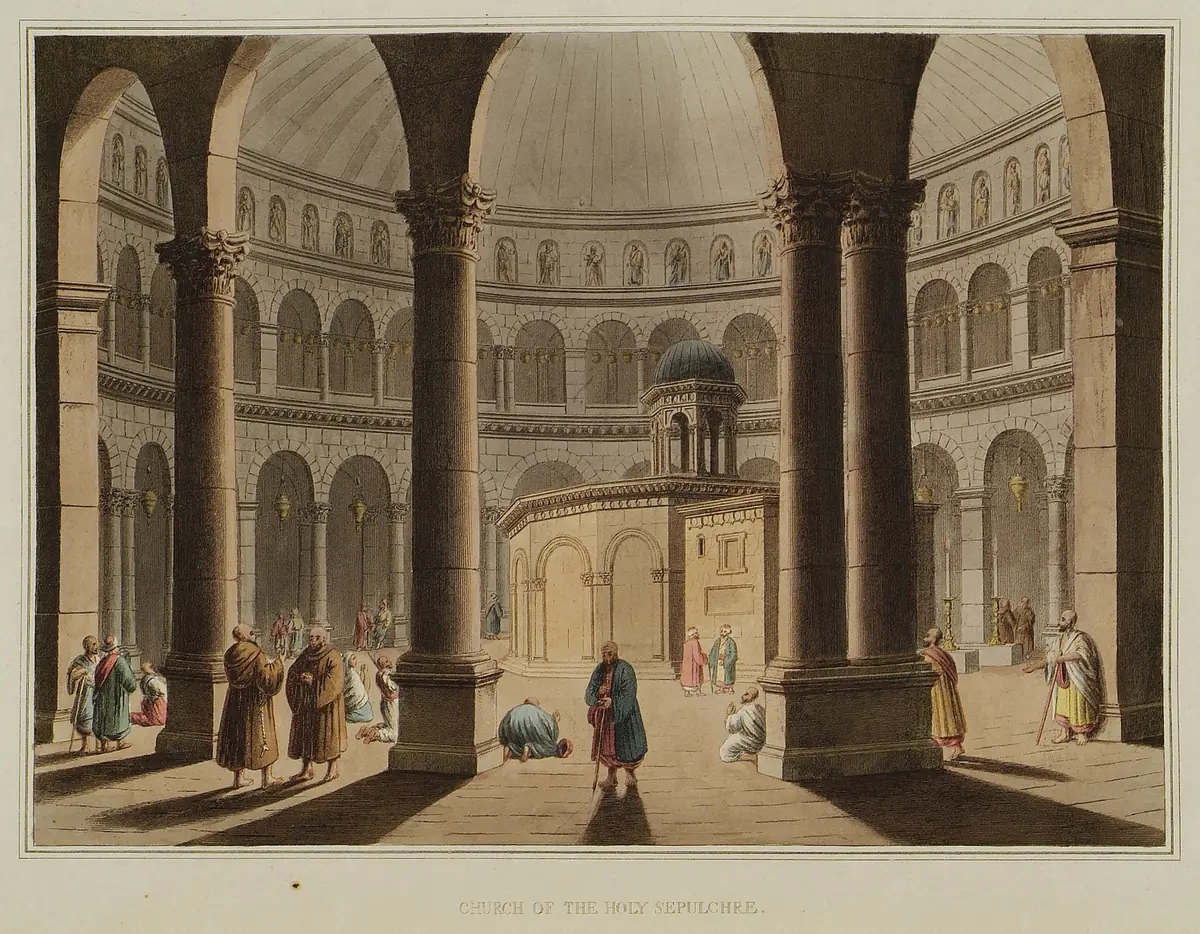


What to watch for
Look slowly- The Rotunda and the Edicule. The tomb shrine stands in the middle of a round hall with a great dome.
- The crusader façade. The two doorways and carved lintels belong to the twelfth century.
- The immovable ladder. A wooden ladder rests on a ledge above the door, left in place under the Status Quo.
- Many hands. Notice which community keeps which chapel, and how they share one roof.
Sources
Dates follow standard historical references and, where we quote a book, the wording of the edition hosted in this library. Where a tradition is not certain history, the page says so. Photographs and pictures are used only when the image itself is Public domain, CC0, or CC BY with a named credit. Each picture links to its source page with full licence details. Pictures taken before a site was damaged are labelled with their date.