Wonders & Monuments · Great monuments
Notre-Dame de Paris
The cathedral of Paris, a Gothic church on the Île de la Cité, shown here as it stood before the fire of 2019.
Still standing. The cathedral still stands. A fire in April 2019 destroyed the nineteenth-century spire and the timber roof, and damaged the vaults. The photographs on this page are historic views made before that fire. Restoration has since been under way.
Victor Hugo, The Hunchback of Notre-Dame · Chartres Cathedral · Notre-Dame de Paris, in Great Churches & Monasteries
What it is
Notre-Dame de Paris was begun in 1163 on the Île de la Cité, and the church as we think of it — the two square towers, the west rose, the long nave and the flying buttresses of the choir — is the work of the twelfth to the fourteenth century, much restored later. In the nineteenth century Eugène Viollet-le-Duc led a famous restoration and added a timber-and-lead spire over the crossing. That spire, and the medieval roof, were lost in the fire of 15 April 2019. The stone structure stood.
Victor Hugo’s novel Notre-Dame de Paris, in the Hapgood translation in this library, was written in defence of the building as well as of a story. In it the archdeacon, looking from a printed book to the church, says that the book will kill the edifice. Hugo meant that the printed word was taking the place of the cathedral as the great teacher of a people. The line is about that change, not about a fire. The historic photographs here — Baldus from the river, Soulier from a tower — show the church in the nineteenth-century city, with Viollet-le-Duc’s spire still on the roof.
“This will kill that. The book will kill the edifice.”
Why it matters
This is costly work offered to the glory of God, at the centre of a city, and loved enough to be rebuilt after ruin. The virtue to notice is perseverance, and a care for what time and fire have taken. Beauty here is the west front and the flying buttresses, and the honesty to show the church as it was, and to say what later happened to it.
Look closely
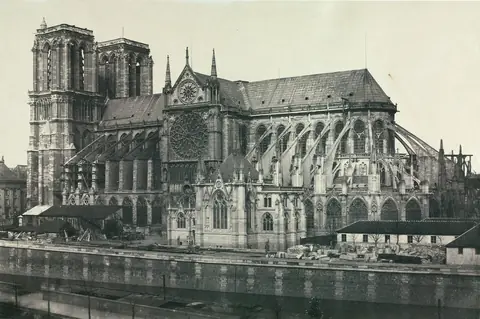
Image: Wikimedia Commons · Public domain Notre-Dame from the river
Look closely. Baldus photographed the cathedral from the south-east, so that the apse, the flying buttresses, the west towers and Viollet-le-Duc’s crossing spire are all in one view. The roof is intact. This is the building as it stood in the mid-nineteenth century, long before the fire of 2019.
In the library: Victor Hugo, The Hunchback of Notre-Dame
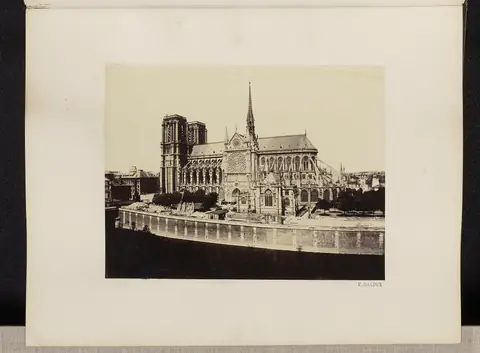
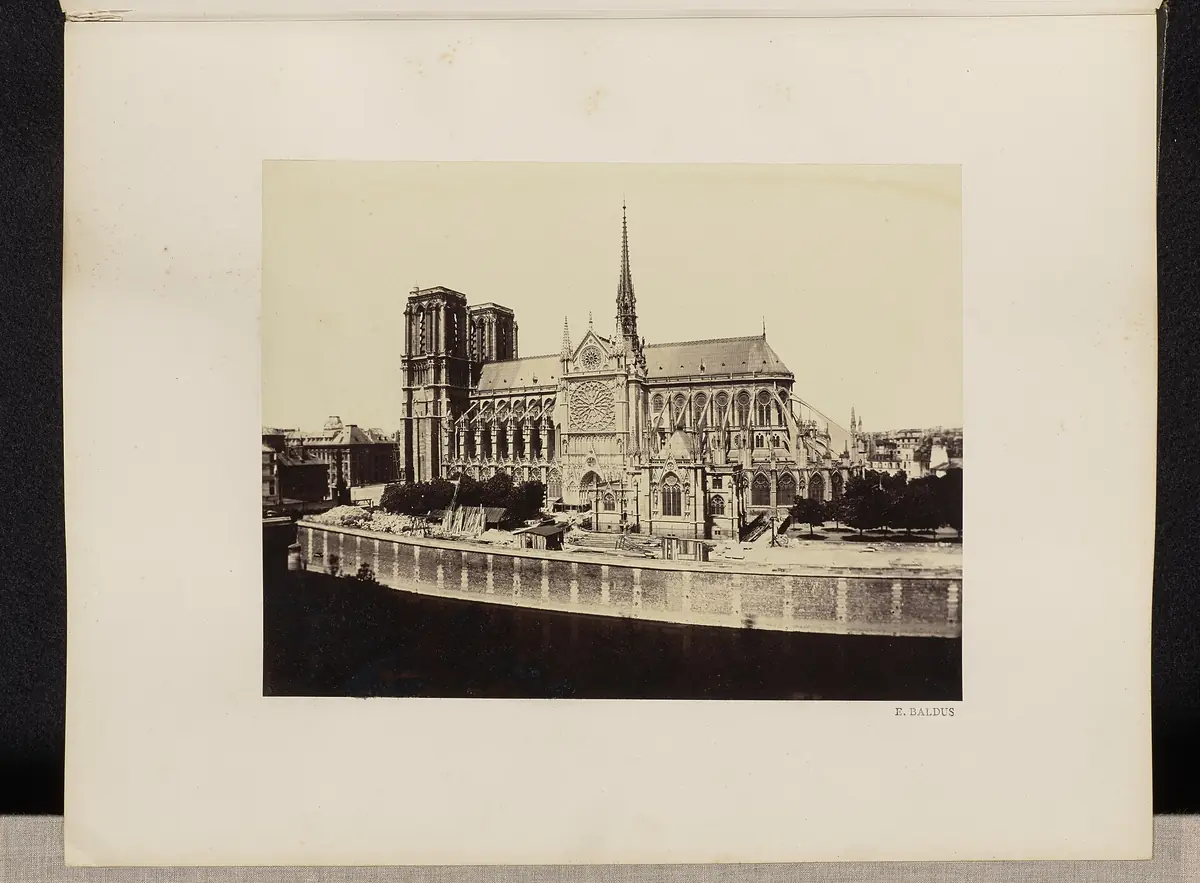
Image: Wikimedia Commons · Public domain (PD-Art) Notre-Dame, a mounted print by Baldus
Look closely. Another Baldus view of the same church from the river side, preserved as a mounted album print with wide margins and the photographer’s name below. The photograph itself is the small, sharp image at the centre: towers, rose, nave, apse and spire. The mount is part of how the picture was first presented, not part of the cathedral.
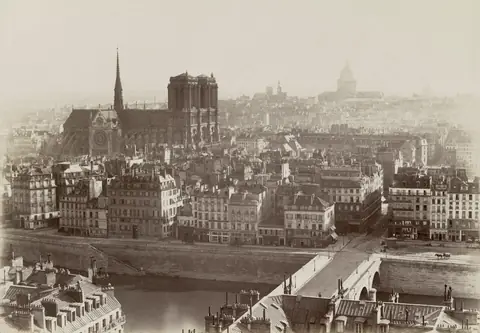
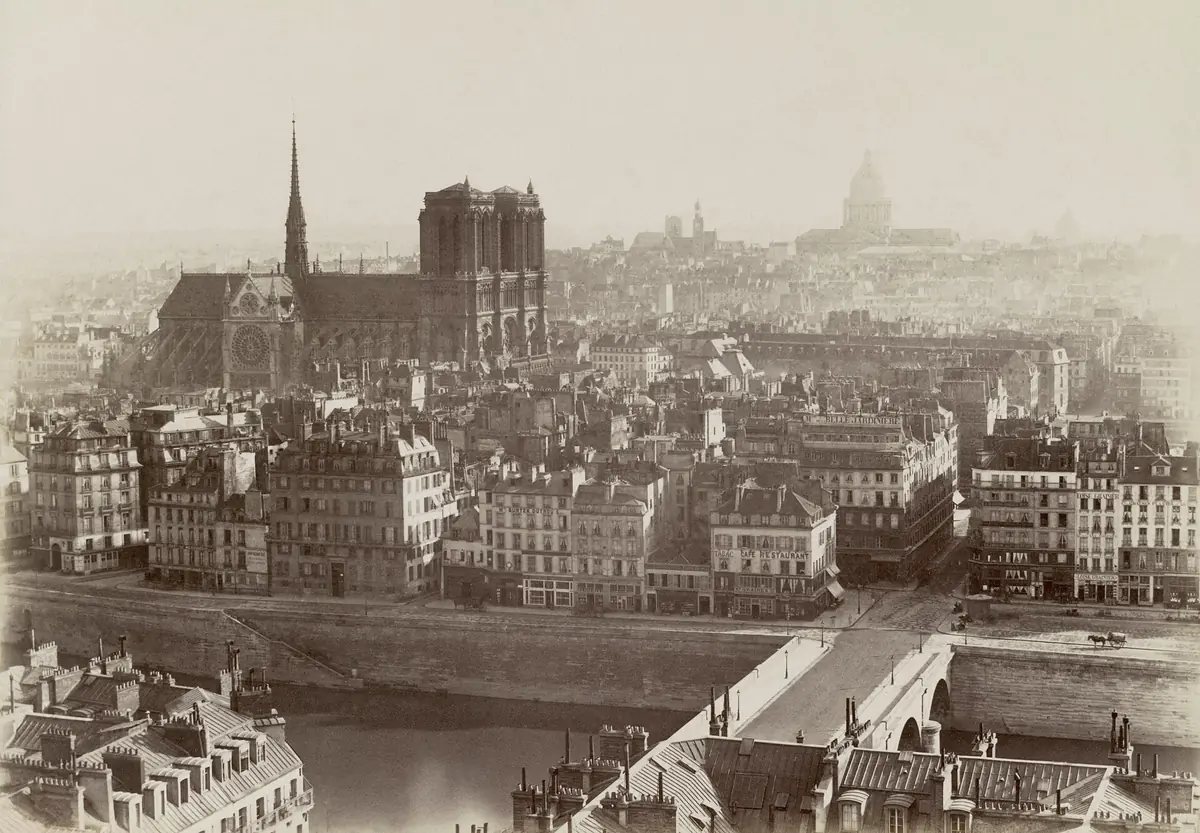
Image: Wikimedia Commons · Public domain Notre-Dame in the city, from the Tour Saint-Jacques
Look closely. Soulier’s panorama, taken from the Tour Saint-Jacques, places the cathedral in the mid-nineteenth-century city, with the river in the foreground and the west towers and spire rising above the streets of the Île de la Cité. The church is the principal subject, but the point of the picture is also its place in Paris.
In the library: Victor Hugo, The Hunchback of Notre-Dame


What to watch for
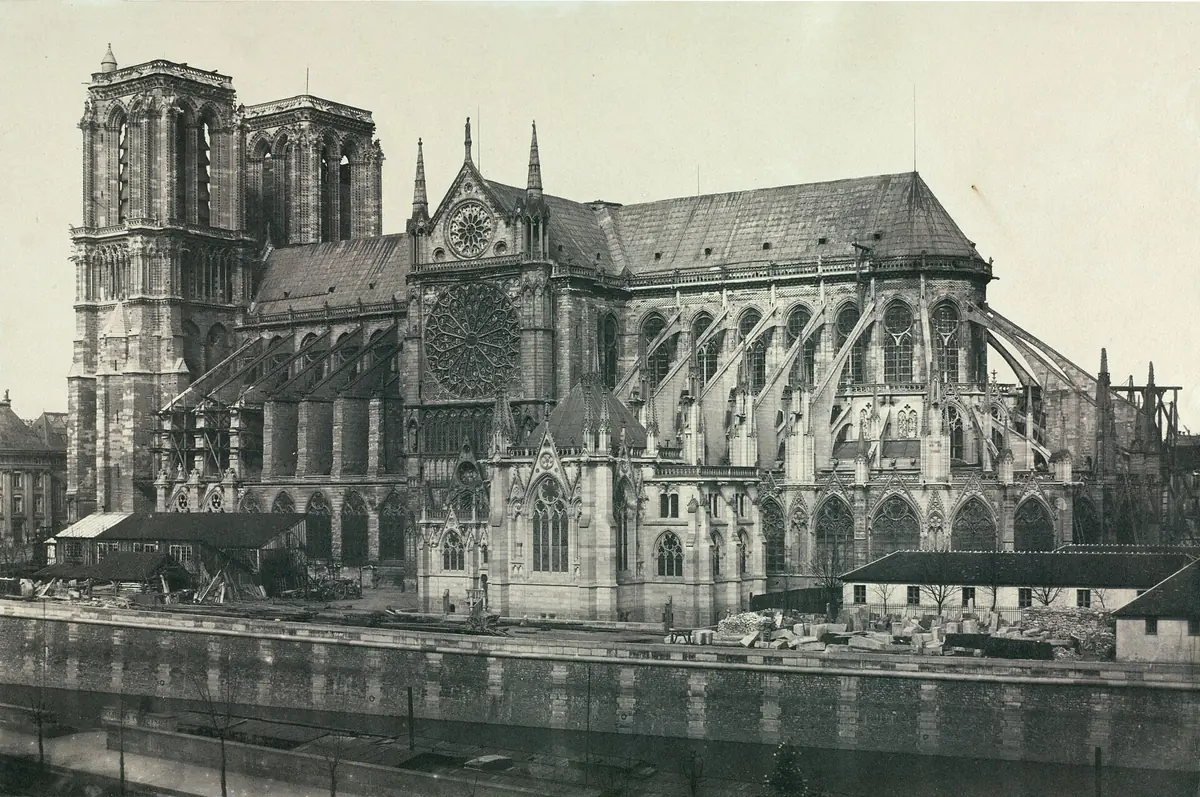
Look slowly- Before the fire. These photographs show the roof and Viollet-le-Duc’s spire. They are records of how the church stood in the nineteenth century.
- The west towers. The two square towers of the façade are medieval. The slender crossing spire in the old views is nineteenth-century.
- Flying buttresses. From the river or the apse, notice the ring of buttresses around the choir.
- A church in a city. Soulier’s panorama places Notre-Dame among streets and the river, not in an empty precinct.
- Hugo’s sentence. In the hosted novel, the line is about printing and the cathedral as a book of stone, not about the 2019 fire.
Sources
Dates follow standard historical references and, where we quote a book, the wording of the edition hosted in this library. Photographs are used only when the photograph itself is Public domain, CC0, or CC BY with a named credit. Lost wonders are shown in later engravings and reconstructions, which are imaginings, not photographs of the original work. Each picture links to its source page with full licence details.