Great Churches & Monasteries · Western Europe
Notre-Dame de Paris
The cathedral of Paris, begun in 1163, damaged by fire in 2019 and reopened in 2024.
Still standing. The cathedral stands. A fire on 15 April 2019 destroyed the spire and much of the roof, and after a long restoration the cathedral was reopened in December 2024.
Notre-Dame, in Wonders & Monuments · Chartres Cathedral
What it is
Maurice de Sully, bishop of Paris, began a new cathedral in 1163 on the Île de la Cité, on the site of older churches. The choir was ready for use in 1182, the nave followed, and the west front and the two towers were built in the first half of the thirteenth century. The cathedral was among the first to use flying buttresses on a large scale. The rose windows of the transepts, from the 1250s, are among the best known.
In the French Revolution the cathedral was damaged and used as a temple of Reason. Napoleon was crowned emperor of the French in it in 1804, with Pope Pius VII present. By 1831 the building was in poor repair when Victor Hugo's novel Notre-Dame de Paris turned public attention to it. Eugène Viollet-le-Duc led a restoration from 1844, and he designed a new spire. On 15 April 2019 a fire destroyed the roof and spire. After a restoration costing years of work by hundreds of craftsmen, the cathedral reopened on 7 and 8 December 2024.
Why it matters for a classical Christian student
Notre-Dame is a lesson in perseverance and in the care of a common inheritance. It took roughly a century to build and nearly six years to repair after the fire. A classical Christian student can ask what a cathedral does for a city: it keeps time with bells, it teaches with stone and glass, and it receives the sorrows and thanksgivings of a people. The virtue is stewardship.
Read alongside
- The Hunchback of Notre-Dame (Notre-Dame de Paris): Hugo's novel gives a long portrait of the cathedral and of the city around it.
Great Lives connected here
- Napoleon Bonaparte, in Great Lives: Napoleon crowned himself emperor in the cathedral on 2 December 1804.
- Victor Hugo, in Great Lives: Hugo's novel of 1831 helped to save the cathedral from neglect.
- Joan of Arc, in Great Lives: In 1455 Joan's mother presented the petition at Notre-Dame that opened the retrial which cleared her name.
Look closely
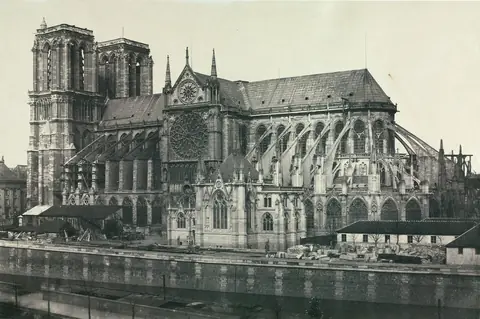
Image: Wikimedia Commons · Public domain Notre-Dame from the river
Look closely. Baldus photographed the cathedral from the south-east, so that the apse, the flying buttresses, the west towers and Viollet-le-Duc’s crossing spire are all in one view. The roof is intact. This is the building as it stood in the mid-nineteenth century, long before the fire of 2019.
In the library: Victor Hugo, The Hunchback of Notre-Dame
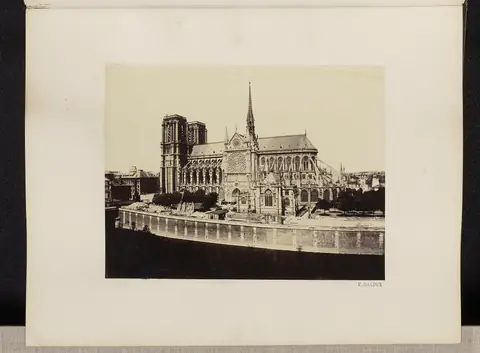
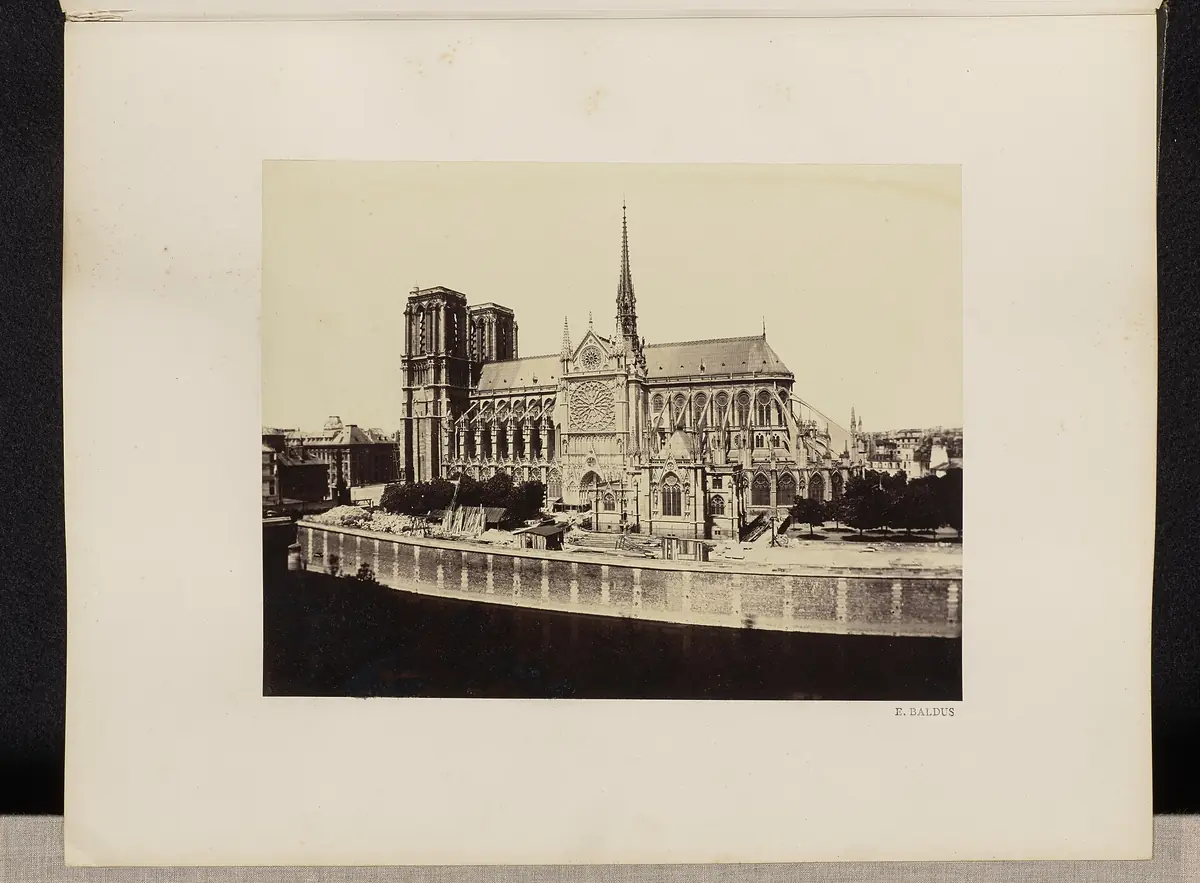
Image: Wikimedia Commons · Public domain (PD-Art) Notre-Dame, a mounted print by Baldus
Look closely. Another Baldus view of the same church from the river side, preserved as a mounted album print with wide margins and the photographer’s name below. The photograph itself is the small, sharp image at the centre: towers, rose, nave, apse and spire. The mount is part of how the picture was first presented, not part of the cathedral.
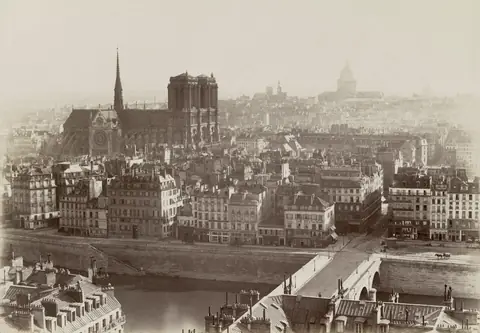
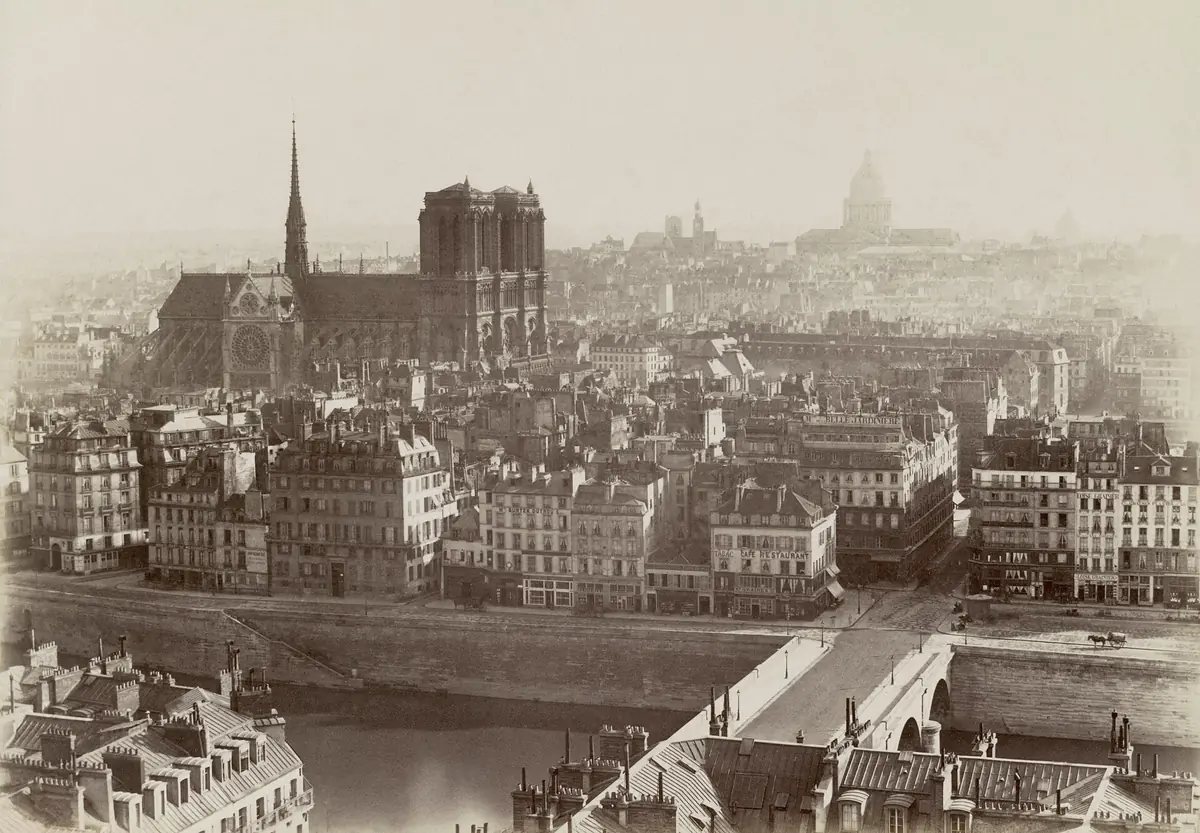
Image: Wikimedia Commons · Public domain Notre-Dame in the city, from the Tour Saint-Jacques
Look closely. Soulier’s panorama, taken from the Tour Saint-Jacques, places the cathedral in the mid-nineteenth-century city, with the river in the foreground and the west towers and spire rising above the streets of the Île de la Cité. The church is the principal subject, but the point of the picture is also its place in Paris.
In the library: Victor Hugo, The Hunchback of Notre-Dame
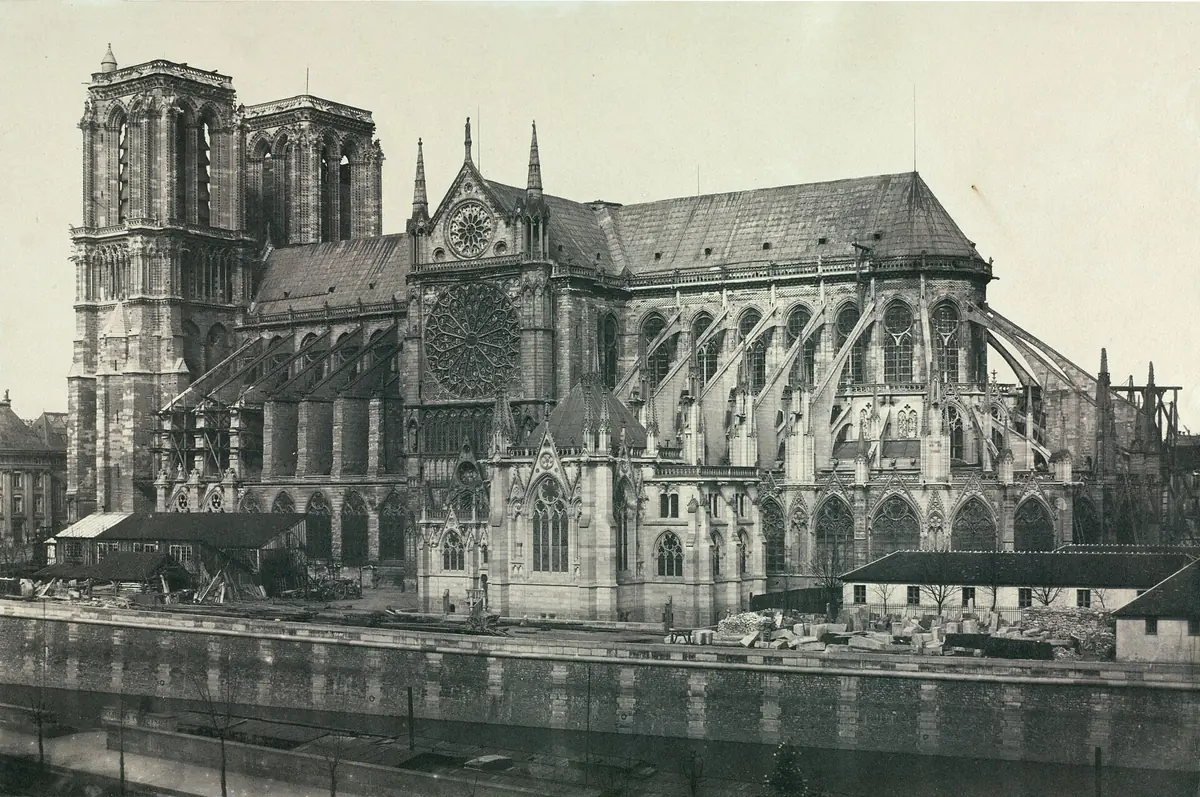


What to watch for
Look slowly- The west front. The three portals and the gallery of kings.
- Flying buttresses. Look at the arches that carry the weight of the walls.
- The rose windows. The north rose is the best preserved from the thirteenth century.
- The restoration. Read about the work of timber, stone, and glass after 2019.
Sources
Dates follow standard historical references and, where we quote a book, the wording of the edition hosted in this library. Where a tradition is not certain history, the page says so. Photographs and pictures are used only when the image itself is Public domain, CC0, or CC BY with a named credit. Each picture links to its source page with full licence details. Pictures taken before a site was damaged are labelled with their date.